
Furnace Not Turning On? Safe Checks and Gas-Furnace Troubleshooting
When a furnace will not turn on, start with the thermostat, the furnace power switch, the circuit breaker, and the air filter, then confirm fuel is available…
By Mara Keene · · 16 min read
Overview
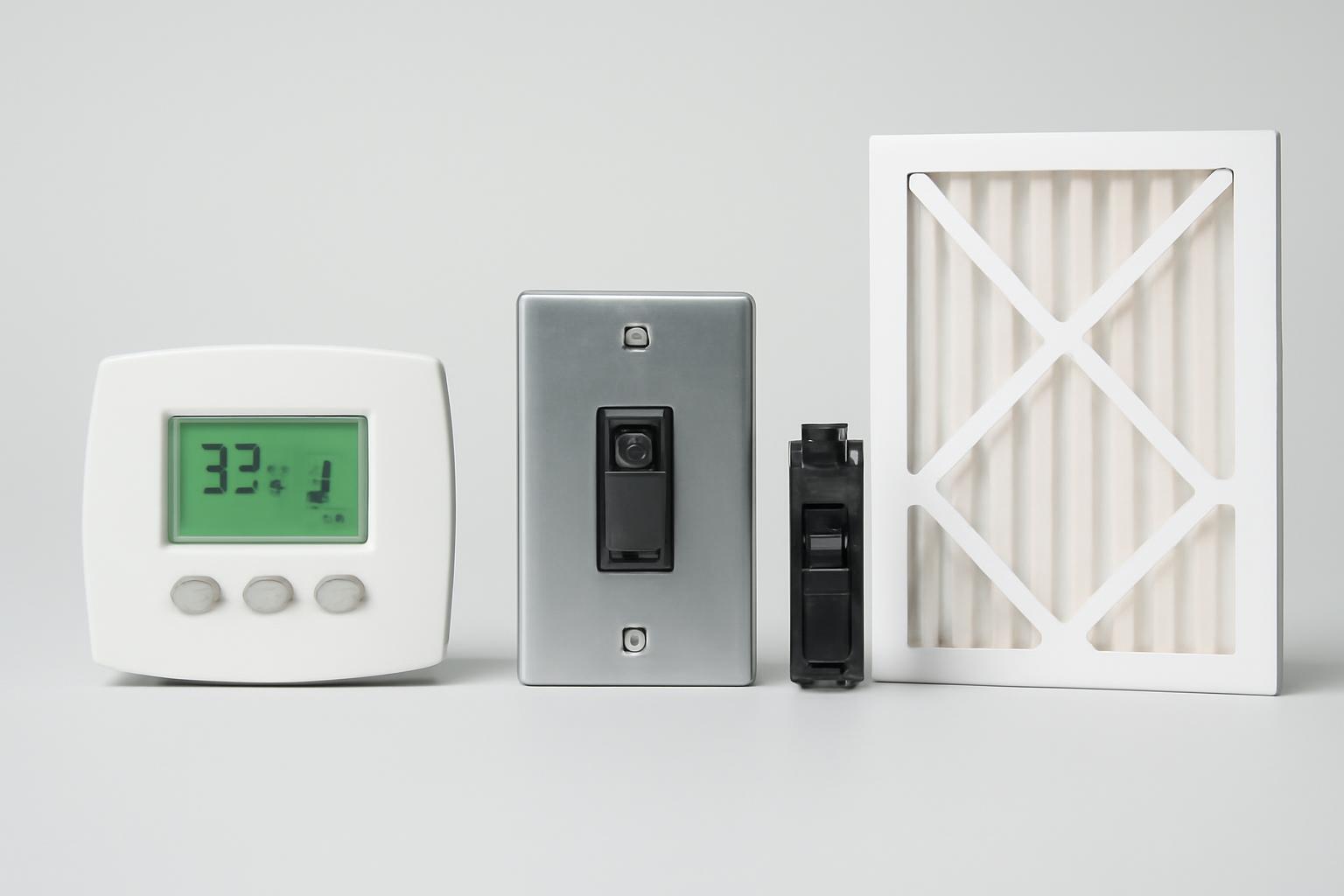
When a furnace will not turn on, start with the thermostat, the furnace power switch, the circuit breaker, and the air filter, then confirm fuel is available before anything else. If you smell gas or a carbon monoxide alarm sounds, evacuate immediately instead of troubleshooting. Most other faults fall into power, airflow, or ignition problems that the furnace’s behavior helps you narrow.
Those three categories explain most no-heat calls. Power and control problems keep the furnace from responding at all. Airflow problems can trigger a safety shutdown even when everything else works, because a restricted system overheats and modern furnaces have safety sensors that shut the unit down when it overheats, as Advantage Heating explains. Ignition and internal component failures usually show up as clicking, brief startups, or a blower running with no heat.
One honest boundary before you begin: the diagnostic evidence behind this guide, including troubleshooting pages from Bryant and Carrier, primarily addresses gas furnaces. If your home has an oil furnace, an electric furnace, or a heat pump with an air handler, the thermostat, power, and filter checks still apply, but confirm your equipment type and follow model-specific instructions before applying anything fuel-related.
Start with these safe checks
Work through the external checks first, in order, before you reset anything or open any panel. Each of these can stop a furnace from starting, each is safe to check without tools, and each takes only a minute or two. Doing them in order also means that if you end up calling a technician, you can honestly say what you already ruled out.
Here is the first pass:
- Confirm the thermostat is set to heat and the setpoint is above the current room temperature.
- Check the furnace power switch, which often looks like an ordinary light switch mounted on or near the unit.
- Check the circuit breaker (and fuse, if your panel uses them) for the furnace circuit.
- Look at the air filter and replace it if it is visibly dirty or clogged.
- Confirm fuel is available, for example by checking whether other gas appliances in the home are working.
If any of these checks turns something up, correct it and give the furnace a few minutes to respond. The two subsections below explain the power side and the airflow side in more detail, because those are the two areas where a small oversight most often masquerades as a broken furnace.
Thermostat and furnace power
Rule out the thermostat before you suspect the furnace. Bryant’s troubleshooting guide lists the thermostat as the first check: make sure it is set to “heat,” set the temperature higher than the current room temperature, and replace the batteries if the thermostat is battery-powered. A thermostat with dead batteries or one accidentally switched to “cool” or “off” produces exactly the same symptom as a failed furnace, total silence, so this check saves a lot of unnecessary worry.
Next, check the furnace’s own power. According to Advantage Heating, if the rest of your home has power, the furnace disconnect switch may simply be in the wrong position; it often looks like a light switch or a toggle switch in a box next to the furnace, and it gets flipped off by mistake more often than you would expect. After that, check the electrical panel. A.J. Perri’s guide advises that if nothing happens when you expect the whir of a blower, you should check the circuit breaker and fuse.
It is worth pausing on why electricity matters for a gas furnace at all. Even though the heat comes from burning fuel, the controls that respond to the thermostat, the ignition system, and the blower that moves warm air all run on household electricity. That is why a tripped breaker or a flipped disconnect switch can completely disable a fuel-burning furnace, and why skipping the electrical checks because “it’s a gas furnace” is a common mistake. If the breaker was tripped, reset it once. If it trips again, stop there; that pattern belongs to a technician, which we cover later.
Filter, vents, and airflow shutdowns
Yes, a dirty filter can stop a furnace from starting entirely, not just make it run poorly. Bryant calls a clogged furnace filter a primary cause of system failure: the clogged filter restricts airflow, the heat exchanger (the metal component that transfers heat from combustion to your home’s air) overheats, and a limit switch trips and shuts down the furnace to prevent damage and fire hazards. Advantage Heating describes the same mechanism: restricted airflow overheats the furnace, and safety sensors on most modern furnaces turn the unit off when that happens.
This is why filter inspection belongs near the top of the checklist rather than being filed under routine maintenance. A furnace that overheated and shut down on its limit switch can look identical to a furnace with a serious internal failure. A.J. Perri offers a simple standard: check your filter and replace it if it looks dirty, clogged, or has not been changed in the last few months.
While you are at it, walk through the house and look at the supply vents and return grilles you can see. Furniture, rugs, or storage boxes blocking vents restrict airflow the same way a clogged filter does. Carrier’s furnace cleaning guide confirms that homeowners can safely handle this level of work themselves: replacing or cleaning the air filter, dusting external surfaces, and cleaning vents and air return ducts. Keep your involvement at that level. Anything requiring you to open the furnace cabinet and work around the blower, burners, or heat exchanger is professional territory, for reasons covered in the boundary section below.
If you found and replaced a badly clogged filter, restore power and let the furnace attempt a normal start. Many airflow shutdowns clear once the restriction is gone, though a furnace that shut down hard may need a power cycle, covered later in this guide.
Checks that apply only to some furnaces
Not every cause on a typical “reasons your furnace won’t start” list applies to your furnace. Two areas in particular depend entirely on the equipment you own: the ignition design and the condensate system.
Older furnaces may have a standing pilot light, while modern furnaces generally use electronic ignition, according to One Hour Comfort. And only high-efficiency condensing furnaces produce water as a byproduct, so condensate shutdowns are a real cause on those units and irrelevant on others. Before applying either of the checks below, confirm what your furnace actually is. If you have an oil furnace, an electric furnace, or a heat pump, skip the gas-specific guidance entirely and consult your equipment’s own documentation, since the sources behind this section address gas furnaces.
Fuel supply and ignition type
A furnace with power and airflow still cannot make heat without fuel. Bryant notes that a closed gas valve or a utility interruption will prevent the furnace from producing heat, and suggests a simple external check: see whether other gas appliances in your home, such as a gas range or water heater, are working. If nothing gas-fired works, the problem is likely a supply issue rather than the furnace, and your next call is to the gas utility rather than an HVAC company. This check requires no contact with the furnace itself, which is exactly why it belongs in a homeowner’s first pass.
Ignition type matters because it determines what “not lighting” even means for your unit. One Hour Comfort draws the distinction clearly: older furnaces may have a pilot light that can go out, while modern furnaces have electronic ignition systems that can malfunction, including a defective igniter, a faulty flame sensor, or problems with the control board. Practically, this means two things. First, if your furnace is a modern unit with electronic ignition, there is no pilot to relight, so do not go hunting for one. Second, if your furnace is an older unit with a standing pilot, any relighting procedure is model-specific; follow the instructions printed on your furnace or in its manual rather than a generic internet procedure, and if the pilot will not stay lit or you are unsure at any point, stop and call a technician.
This guide deliberately does not include internal ignition troubleshooting. Igniters, flame sensors, and control boards sit inside the combustion area of the furnace, and diagnosing them is a technician’s job. Your contribution as the homeowner is identifying which ignition type you have and describing the behavior you observe, which meaningfully speeds up the professional diagnosis.
High-efficiency furnace condensate shutdowns
If you own a high-efficiency (condensing) furnace, a water-management problem can block startup even when everything else is fine. Bryant explains the mechanism: high-efficiency furnaces produce condensate, water, as a byproduct, and if the drain line becomes blocked, a float switch prevents the furnace from turning on to avoid water damage. A.J. Perri describes the same behavior, noting that if the drain pan is full or the condensate line is clogged, a safety switch may stop the furnace from turning on.
The homeowner-safe version of this check is visual only. Look at the area around the furnace for standing water, a visibly full drain pan, or a drain line that is obviously kinked or disconnected. Water where it should not be is a strong clue that the float switch is doing its job. Do not attempt to bypass the switch or improvise a fix to force the furnace to run; the switch exists specifically to prevent water damage. Clearing a clogged condensate line varies by installation, so if the pan is full or the line appears blocked, report exactly what you see to a technician. If your furnace is a standard-efficiency unit, this cause does not apply, and you can move on.
Use the furnace’s behavior to narrow the problem
What the furnace does when the thermostat calls for heat is one of your best diagnostic clues. Silence points in a different direction than clicking, and a blower running without heat points somewhere else again. None of these patterns is a conclusive diagnosis, and this guide will not pretend otherwise, but each one narrows the likely category and tells you what to check or report next.
The matrix below summarizes the four behaviors the evidence supports, along with the safest next step for each.
| What you observe | Likely fault category | Safe next check | When to escalate |
|---|---|---|---|
| Complete silence, no blower or clicking | Power or control failure | Thermostat settings and batteries, furnace disconnect switch, circuit breaker and fuse (A.J. Perri) | Breaker trips again after one reset, or silence continues with power confirmed |
| Repeated clicking without ignition | Ignition fault or gas-supply problem (A.J. Perri) | Confirm other gas appliances work to rule out a supply outage (Bryant) | Repeated clicking without ignition usually requires professional inspection |
| Blower runs but no heat comes out | Burner or ignition issue (Carrier) | Note the behavior and check for a blinking fault code | Call an HVAC technician; burners are not a homeowner repair area |
| Furnace starts, then shuts off after a few seconds | Flame-sensing trouble; Bryant identifies a dirty flame sensor as a likely cause | Record how long it runs before shutdown and any fault code | Call a technician; the flame sensor sits on the burner assembly |
A few notes on reading this table honestly. The silence row is the one where your own checks are most likely to restore heat, since a flipped switch, dead thermostat batteries, or a tripped breaker are all things you can fix in minutes. The clicking row is a hard stop after one external check: A.J. Perri states that clicking noises may indicate ignition problems, a faulty igniter, or issues with the gas supply, and that repeated clicking without ignition usually requires professional inspection. Do not keep triggering ignition attempts hoping one will catch.
The blower-only and quick-shutdown rows both point inside the combustion system. Carrier notes that if the fan works but there is no heat, the issue might be specific to the burner or ignition. Bryant explains that a flame sensor detects whether a flame is actually present, so a dirty sensor causes the furnace to light briefly and then shut itself down as a safety measure. In both cases, your most useful action is observation: how long the furnace runs, what sounds it makes, and what any indicator light displays. That record turns a vague “it’s not working” service call into a focused one.
Reset once and preserve the diagnostic clues
One controlled power cycle is a reasonable step; repeated resets are not. If you have completed the external checks and there is no gas odor, no CO alarm, and no visible damage, Bryant describes the basic restart: turn off the power, wait a few minutes, reset the thermostat, and turn the system back on, checking the breaker and filter along the way. If the furnace was shut down by a cleared condition, such as a clogged filter you have since replaced, this single reset often restores normal operation.
Treat what happens next as information, not an invitation to try again. A.J. Perri cautions that repeated resets may indicate a larger issue, and One Hour Comfort warns that a breaker that continues to trip points to a larger electrical issue that needs professional attention. A furnace that only runs after repeated resets is telling you a fault exists that the reset is masking. Repeating the cycle does not fix the fault, and in the case of a recurring breaker trip, it keeps re-energizing a circuit that is protecting itself for a reason. One reset is a diagnostic test. A second failure is your answer: the next step is a service call, ideally with the observations and fault code described below already in hand.
Record the code and match the correct model
Before you cut power for a reset, capture whatever the furnace is telling you, because a power cycle can erase it. Bryant notes that modern furnaces may display blinking error codes on a control panel, and that noting any codes or unusual sounds helps a technician diagnose the problem faster. The most reliable way to capture a blink code is a short phone video, since the meaning usually depends on the full sequence, for example how many flashes occur and whether they are short or long. A photo of a single moment can miss the pattern.
Codes are not universal. The same blink pattern can mean different things on different brands and even different models within a brand, so resist the urge to look up a code generically. Instead, identify your exact furnace model from the unit’s own labeling or the documentation that came with it, then consult the manufacturer’s material for that specific model. Do not remove an access panel or the furnace cabinet just to decode a fault; use the model-specific manual or a legend visible without opening the unit. If no legend is visible from outside, give the recorded code and model number to a technician instead. If you cannot confidently match the code to your model’s documentation, simply pass the recorded sequence, the model information, and your description of the furnace’s behavior to the technician. That combination is genuinely useful even when you never decode it yourself.
Know when to stop troubleshooting
There are two distinct stop conditions, and it helps to keep them separate: emergencies that require you to leave the house, and service conditions that require you to stop checking and book a technician. Everything in this guide up to now assumes neither condition is present.
The service threshold is reached when your external checks are done and the furnace still will not run, or when the furnace shows one of the recurring-fault patterns from the symptom matrix. A.J. Perri draws this line explicitly: call an HVAC technician if the furnace repeatedly trips the breaker, starts and shuts off quickly, runs the blower without producing heat, makes loud banging or clicking noises, or still will not turn on after troubleshooting. At that point, further homeowner attempts add risk without adding information. The two subsections below cover the emergency signals and the exact boundary between what you check and what a professional repairs.
Gas odors and carbon monoxide alarms are emergencies
A gas odor or a sounding carbon monoxide alarm ends troubleshooting immediately. Carrier’s guidance is direct: if you smell rotten eggs (the odorant added to natural gas) or your carbon monoxide detector goes off, evacuate your home immediately and contact emergency services. Do not stay inside to flip switches, open windows throughout the house, or investigate the furnace yourself. Carbon monoxide is dangerous precisely because you cannot see or smell it, which is why the alarm is your only reliable warning.
The U.S. Consumer Product Safety Commission’s residential CO incident guidance reinforces both the urgency and the aftermath. It states that immediate evacuation is necessary when a CO alarm sounds, and that when dangerous CO levels are traced to an appliance, residents should not use that appliance until the cause of the elevated CO has been identified and corrected by a qualified technician. Applied to your situation: if a CO alarm sounded while your furnace was running or trying to run, the furnace stays off until a professional has inspected it and cleared it, even if the alarm has stopped and the house feels normal. A silent alarm is not proof the source is fixed.
Homeowner checks versus professional furnace work
The boundary between homeowner checks and professional work is not arbitrary; it follows the furnace’s own structure. Everything outside the cabinet is observable and safe: thermostat, disconnect switch, breaker, filter, visible vents and returns, other gas appliances, and the area around the unit. Everything involving combustion, sealed components, or internal electrical parts belongs to a trained technician. Carrier’s cleaning guide states this plainly: homeowners can handle basic tasks like replacing the air filter, dusting external surfaces, and cleaning vents and return ducts, but deeper maintenance, like cleaning burners or inspecting the heat exchanger, should be done by a professional to ensure safety and proper function. Even cleaning a flame sensor, which some online guides present as a simple job, is described in Carrier’s guide as a professional task involving shutting down the furnace and removing the sensor from the burner assembly.
Leave these components and symptoms to a technician:
- Burners, heat exchangers, flame sensors, and gas valves, which sit in the combustion path
- Control boards, internal wiring, internal fuses, and blower motors, which Bryant identifies as complex issues requiring an expert
- Recurring breaker trips, which One Hour Comfort links to larger electrical problems
- Repeated clicking, short cycling, blower-only operation, or loud banging noises, per A.J. Perri
- Any burning odor you cannot explain, which is a reasonable stop-and-call signal even without a confirmed cause
Crossing this line does not just risk a worse repair bill. Combustion components tie directly into the gas and venting systems that keep exhaust out of your living space, so an incomplete repair can create a hazard that a failed startup never would. When you call, describe what you checked, what the furnace does, and any code you recorded; that is the most valuable contribution a homeowner can make.
Reduce the chance of another startup failure
Most of the preventable no-heat calls in this guide trace back to airflow, so filter care is the highest-value habit. Carrier notes that a clean filter improves airflow, boosts energy efficiency, protects furnace parts from dust buildup, and supports healthier indoor air quality. One Hour Comfort puts it simply: check and replace the air filters regularly. There is no single replacement interval that fits every home, since filter type, pets, dust levels, and runtime all vary, so judge by condition. If the filter looks dirty when you hold it up to light, or you cannot remember when you last changed it, replace it. Keep the supply vents and return grilles you can see clear of furniture and clutter for the same reason: the goal is unrestricted airflow so the limit switch never has a reason to trip.
The second habit is professional maintenance on a schedule rather than in a crisis. Carrier’s troubleshooting guidance recommends annual furnace maintenance that includes cleaning, lubrication, and safety inspections that catch small issues before they become major repairs, and Carrier’s cleaning guide similarly recommends annual cleaning and servicing from a trained HVAC professional, at minimum at the beginning of each heating season. That timing matters: a tune-up before the first cold snap finds the weak igniter or dirty flame sensor while the fix is still an appointment, not an emergency. Between visits, your job stays simple: keep the filter fresh, keep the vents clear, and pay attention to the clues, because a furnace that clicks, short cycles, or blinks a code is usually telling you something well before it refuses to start.