
Heating
How to Read a Silent Furnace Blower Without Taking Unsafe Risks
ON mode and heating can use different thermostat signals, relays or motor inputs. That difference gives a technician a sharper starting point.
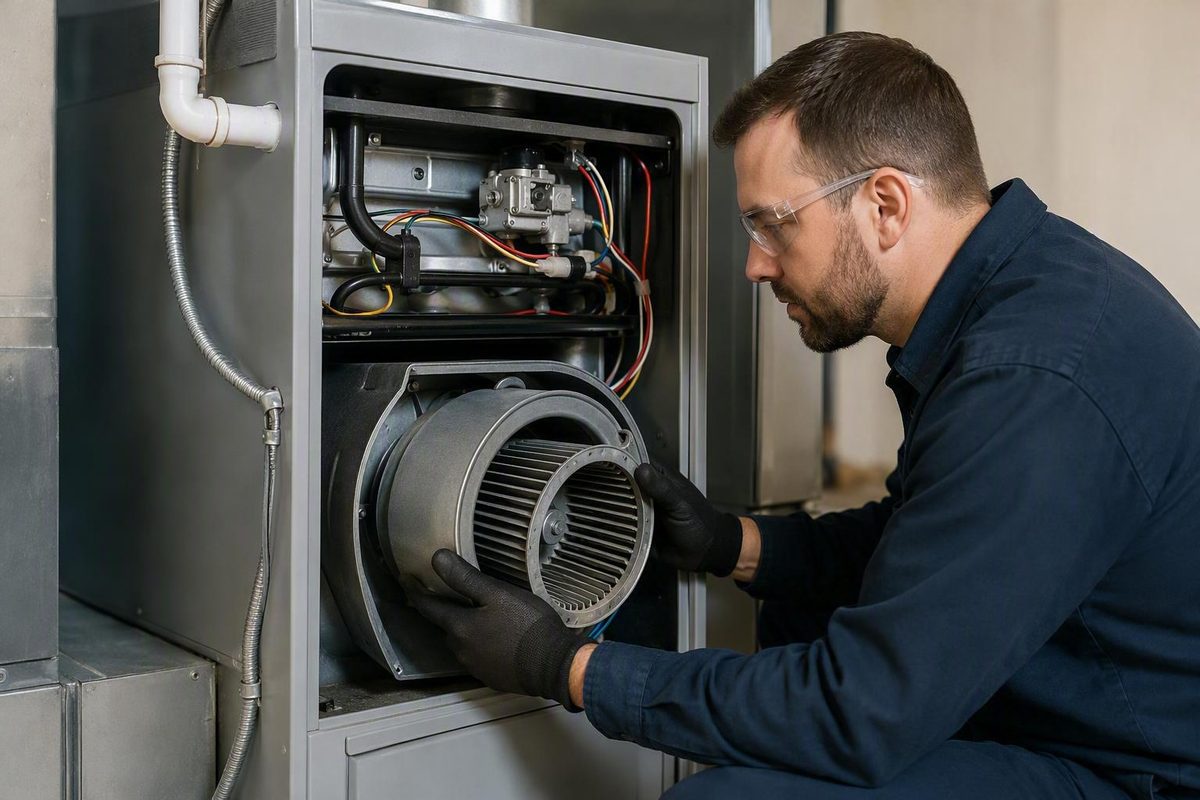
A furnace fan not working can mean no airflow, weak airflow, cold airflow, intermittent operation, or a furnace that never reaches ignition. Those symptoms do not all point to the blower motor.
The safest approach is to identify which fan is involved, observe the operating sequence, and check only accessible controls and airflow restrictions. Internal electrical and mechanical testing should be left to a qualified HVAC professional. The objective is not to guess which part failed, but to collect reliable evidence that makes the next step safer and the service call more productive.
First, identify which furnace fan is not working
A furnace may contain more than one fan. The one most homeowners mean by “furnace fan” is the main circulation blower. It draws household air through the return ductwork, moves it across the heat exchanger, and sends warmed air into the supply ducts. When a furnace shares ductwork with central air conditioning or a heat pump, the same blower may also circulate cooled air. Trane describes these heating and cooling roles in its furnace-blower guide.
The draft inducer, sometimes called the exhaust or inducer fan, has a different job. It handles combustion gases and normally operates near the beginning of a heating call, before the burners ignite. If the inducer cannot operate correctly or establish the required draft, the furnace’s safety sequence may prevent ignition. Southern Air’s overview distinguishes the draft inducer from the household-air blower.
You can often distinguish the two without removing a panel:
- A circulation-blower problem commonly produces little or no air at the room vents, even though you may hear other parts of the furnace starting.
- An inducer, venting, or early-sequence problem may keep the burners from igniting.
- Burners that ignite but shut off before air reaches the rooms may indicate that the circulation blower did not start or that airflow was inadequate.
- A small fan heard shortly after the thermostat calls for heat may be the inducer rather than the main blower.
- Steady air at the vents, even if it is cold, means the circulation blower is moving air. The heating side still has a problem, but the blower is not completely motionless.
A typical gas-furnace sequence is broadly:
- The thermostat requests heat.
- The furnace begins its safety and draft sequence.
- The inducer operates if the design uses one.
- Ignition begins and the burners light.
- After an intentional delay, the circulation blower starts moving warmed air.
- The burners stop when the heating demand ends.
- The blower may continue briefly to move remaining heat into the home.
Details and timing vary by furnace. Do not remove access panels, reach into the cabinet, or bypass a door switch merely to identify a sound. Listen from outside the equipment, feel for airflow at a nearby supply register, and consult the model-specific owner’s manual for the normal sequence.
This guide focuses on the main circulation blower. If the furnace never ignites, the relevant fault may instead involve the inducer, venting, pressure controls, ignition system, fuel supply, or another safety control.
Stop immediately when the symptoms suggest a safety hazard
If you smell gas
Do not touch the thermostat, furnace switch, circuit breaker, lights, appliances, or other electrical controls. Do not try to shut the furnace down electrically. Get everyone out of the building and contact the gas utility or emergency service from a safe location. Carrier gives the same leave-without-operating-switches instruction.
For hazards other than a suspected gas leak, stop troubleshooting and shut the furnace down using its normal control if you can do so without approaching damaged, wet, smoking, or arcing equipment. Request professional service if you notice:
- smoke or sparks;
- burning insulation or a strong electrical odor;
- visibly melted, scorched, or damaged wiring;
- water near electrical components;
- severe grinding, scraping, arcing, or electrical buzzing;
- humming without blower rotation;
- burners operating repeatedly without adequate circulation airflow;
- recurring overheating or limit-shutdown indications; or
- a circuit breaker that trips again after one reset.
These are stop-and-call conditions, not invitations to open the cabinet. Burning odors, smoke, damaged wiring, repeated shutdowns, severe noises, and stationary humming equipment can indicate electrical or mechanical trouble requiring professional diagnosis. Bryant advises professional service for internal electrical, moving-part, gas, and combustion hazards.
Do not continue operating a furnace whose burners ignite but whose circulation blower does not start. Without adequate airflow, heat can build inside the furnace. A high-limit safety control may then interrupt burner operation, producing a pattern in which the flames start, stop, and later try again. The shutdown is a protective response, not evidence that the problem repaired itself. A furnace should not be operated without its blower because the equipment can overheat and shut down. Fenwick’s furnace-blower guidance supports shutting down and seeking service for this pattern.
A single breaker reset is reasonable only when there is no smoke, burning odor, visible damage, water near electrical components, or other warning sign. If the breaker trips again, leave it off. Repeatedly resetting it can re-energize an unresolved electrical fault. First American likewise advises professional service when a furnace breaker trips again after a reset.
Do not open the cabinet to test or replace a capacitor. Capacitors can retain hazardous electrical energy after equipment power is disconnected, and not every blower design uses the same type of capacitor—or a separate run capacitor at all. The safe response to a stationary, humming blower is to turn the system off when safe and arrange professional diagnosis. This furnace blower-motor guide warns about retained capacitor charge and the differences between PSC and ECM systems.
Also avoid repeatedly cycling the furnace switch or breaker to clear a fault code or limit lockout. A reset may temporarily restore operation while leaving an overheating, wiring, motor, or control problem unchanged. Preserve the code or flashing-light pattern for the technician.
Classify what the furnace is actually doing
“Furnace fan not working” is a useful starting description. The airflow pattern and order of furnace events provide better clues.
| What you observe | What it means at a basic level | Possible categories to consider | Safe next step |
|---|---|---|---|
| No airflow and no furnace sounds | The system may not have started its sequence | Thermostat, power, access panel, control, or safety interruption | Complete the external checklist below |
| Furnace sounds active, but there is no airflow | An early-sequence component or the burners may be operating without the circulation blower | Blower command, motor-side fault, relay, board, wiring, limit control, or loss of blower power | If the burners ignite without airflow, stop the furnace and request service |
| Weak airflow | The blower may be running, but air movement is restricted or reduced | Filter, blocked registers, return restriction, ducts, blower wheel, indoor coil, or reduced blower performance | Check only the accessible filter and vents |
| Steady cold airflow | The circulation blower is moving air | Ignition, flame sensing, fuel supply, thermostat, heat-stage control, or safety shutdown | Seek heating-system diagnosis rather than assuming blower failure |
| Intermittent airflow | The blower can operate at least some of the time | Overheating, loose electrical fault, controls, motor, ECM electronics, or safety shutdown | Record the timing; stop using it if odors, overheating, or repeated shutdowns occur |
| Fan runs continuously | Continuous operation may be intentional | Thermostat set to ON, stuck relay, limit condition, thermostat fault, or board problem | Set the fan to AUTO and observe |
| Unusual sounds | The sound may identify a mechanical or electrical category | Bearings, wheel contact, debris, belt where applicable, capacitor on some motors, motor, or electronics | Shut down for humming without rotation, severe grinding, scraping, or electrical noise |
No airflow
First determine whether the furnace is completely inactive or whether part of the heating sequence occurs. If nothing happens, check the thermostat, furnace switch, breaker, and access-panel seating. If a smaller fan starts or the burners ignite, the furnace has advanced further in its sequence, making the absent room airflow more significant.
If burners light and then stop shortly afterward without air arriving at the vents, inadequate circulation and a high-limit shutdown are plausible. That is not a confirmed diagnosis: a technician still needs to determine whether the underlying problem is the blower, its command, an airflow restriction, or another control issue. Turn the furnace off instead of allowing the pattern to repeat.
Weak airflow
Weak air does not prove that the blower motor has failed. A loaded filter, obstructed return, closed or blocked supply registers, duct restriction, dirty or damaged blower wheel, indoor-coil restriction, or reduced blower performance can create a similar result.
Compare several supply registers rather than relying on one distant room.
Steady cold airflow
Steady airflow is important evidence: the circulation blower is moving air. The problem has shifted toward heat production or control rather than a completely dead fan.
Possible categories include failed or interrupted ignition, loss of fuel, flame-sensing trouble, a thermostat or heat-call issue, a safety shutdown, or a furnace control problem. Do not inspect flames, reach toward burners, or assume that a particular ignition component has failed. Record whether the air is continuously cold, briefly warm and then cold, or cold only at the beginning and end of the cycle.
Intermittent airflow
A blower that works on some calls but not others may be overheating, losing a control signal, encountering a loose electrical fault, or experiencing an intermittent motor or ECM-electronics problem. Safety controls may also interrupt operation.
This behavior is especially useful to document because the system may appear normal when the technician arrives. Note the thermostat setting, how long the furnace had operated, whether the burners were on, and whether cycling power changed the behavior. Do not use repeated power cycling as a workaround.
Continuous fan operation
Check the thermostat’s fan setting. ON usually commands continuous circulation, including periods when the furnace is not heating. AUTO normally ties blower operation to heating or cooling demand.
If the blower continues running in AUTO, or runs even when the thermostat is turned off, possibilities include a stuck relay, limit condition, thermostat problem, wiring fault, or furnace control-board issue. Continuous operation for a short period after a heating cycle is not automatically abnormal.
The circulation blower may begin after a deliberate delay rather than at the exact moment the thermostat calls for heat or the burners ignite. It can also continue after the burners stop. Trane states that post-cycle fan operation is typically one to five minutes, although actual timing depends on the furnace and its settings. See Trane’s stated post-cycle range.
Furnace never reaches ignition
If the thermostat requests heat but the burners never light, do not immediately blame the circulation blower. The furnace may be waiting on an inducer, venting, ignition, pressure, fuel, or safety-control condition. The circulation blower often is not expected to begin normal heating airflow until later in the sequence.
Run the safe, no-tools troubleshooting checklist
Complete these checks in order. Keep your hands outside sealed or energized compartments, and stop if you encounter gas odor, smoke, heat damage, water, burning smells, or severe noise.
1. Check thermostat power
Confirm that the thermostat display is active. If the thermostat uses replaceable batteries and the display is blank, dim, or showing a battery warning, install the specified replacement batteries.
A working display does not prove that the thermostat is sending the correct heat or fan command. It simply rules out an obvious loss of thermostat power.
2. Select Heat mode
Make sure the thermostat is set to Heat, not Cool or Off. On systems with several operating modes, allow the thermostat and equipment time to change modes.
3. Raise the setpoint above room temperature
Set the requested temperature above the current room temperature so the thermostat has a reason to call for heat. Avoid repeatedly raising and lowering the setting while observing the furnace.
Wait for the furnace’s normal sequence. There is no universal interval between the thermostat call, ignition, and blower startup. A short, intentional blower delay can be normal.
4. Check the furnace power switch
Many furnaces have a nearby wall-style switch that can be mistaken for a light switch. Confirm that it is on. Do not remove the switch cover or inspect its wiring.
If the switch will not stay on, feels hot, crackles, or appears damaged, do not operate it further. Request service.
5. Check the circuit breaker
Look for the furnace or air-handler breaker at the electrical panel. A tripped breaker may sit between the fully on and fully off positions.
If there are no signs of smoke, burning, water, arcing, or electrical damage, reset it once by moving it fully off and then on. If it trips again, leave it off and call a qualified professional. Do not substitute a larger breaker or keep resetting the existing one.
6. Confirm that the access panel is closed
Many furnaces have an access-panel or blower-door safety switch that interrupts operation when the door is open or incorrectly seated. A panel may have shifted after a filter change or previous service.
From outside the unit, confirm that the removable door appears flush, aligned, and properly latched. Follow the owner’s manual if it provides a model-specific panel procedure. Do not tape, hold, or bypass the safety switch. First American notes both the access-panel safety switch and the possibility that disassembling covered equipment may affect warranty handling, so check the manual and applicable coverage terms before removing panels. See its furnace troubleshooting and warranty cautions.
7. Inspect the accessible filter
Locate the filter only if it is in a normal homeowner-accessible rack, return grille, or filter cabinet.
- Turn the furnace off using the normal control specified in the manual.
- Note the existing filter’s size and airflow-arrow direction before removing it.
- Inspect it for heavy loading, deformation, collapse, moisture, or an obviously incorrect fit.
- Install the correct replacement type and size.
- Point the airflow arrow toward the furnace or air handler, following cabinet markings.
- Close the filter slot or grille securely.
- Restore normal operation and observe the next cycle.
Do not force a thicker or more restrictive filter into a cabinet that was not designed for it. The equipment manual and filter-cabinet label take precedence over generic advice.
A clogged or overly restrictive filter can reduce airflow, contribute to overheating, and produce short cycling or a safety shutdown. It does not establish why a completely silent blower failed to start. Filter loading may be the main problem, a contributing problem, or unrelated to an electrical fault.
Filter needs vary with filter depth, runtime, pets, dust, and household conditions. HVAC Lens offers background on deciding when to replace an HVAC filter, but the furnace and filter manufacturers’ instructions should control for your system.
8. Check return grilles and supply registers
Walk through the home and confirm that:
- large return grilles are not blocked by furniture, curtains, boxes, or rugs;
- supply registers are open;
- stored items are not covering floor registers;
- removable grilles do not have a severe visible obstruction; and
- recent remodeling or furniture changes have not blocked airflow paths.
Do not put objects into ducts, remove fixed duct sections, or close vents as a diagnostic experiment. If airflow changes substantially when interior doors are open, note that observation for the technician rather than attempting to redesign the airflow path.
9. Observe one complete attempt
After completing the checks, make one normal call for heat. From outside the cabinet, note:
- which sounds occur and in what order;
- whether ignition occurs;
- whether the circulation blower starts;
- whether airflow is absent, weak, normal, warm, or cold;
- whether the system shuts down;
- whether a status light is visible; and
- whether any odor or severe noise appears.
If the furnace still fails, do not proceed to internal plugs, belts, reset buttons, wiring, or electrical measurements. Model-specific instructions in the owner’s manual should take precedence over generic internet procedures.
Use the thermostat ON test as a clue, not a diagnosis
The thermostat fan control can provide one additional no-tools observation.
Temporarily move the fan setting from AUTO to ON. Wait long enough for the thermostat and furnace to respond, check several supply registers for airflow, and then return the setting to AUTO for ordinary operation unless your system instructions specify otherwise.
If the blower does not run in ON or during heating
Broad possibilities remain:
- loss of furnace or blower power;
- a thermostat or low-voltage control problem;
- an open access-panel switch;
- an applicable safety shutdown;
- wiring trouble;
- a relay or control-board fault;
- a motor-side fault; or
- ECM electronics or another speed-control problem.
The test does not identify which category is responsible. If the external checklist is complete, professional diagnosis is appropriate.
If the blower runs in ON but not during heating
This result proves only that the blower can operate under at least one command. It does not prove that the motor is healthy at every speed, torque setting, or control input.
Depending on the furnace and blower design, heat-only failure could involve:
- the thermostat’s heating signal;
- a heating-stage input;
- a heat-speed or torque command;
- a fan relay;
- a furnace limit control;
- the furnace control board;
- an ECM module or motor input; or
- wiring between those components.
An unresolved contractor-forum case illustrates the limitation. In that case, an ECM blower operated when the thermostat fan was set to ON but intermittently failed during heating, allowing a limit shutdown. Participants considered both motor-input and control-board possibilities, but the discussion did not document a confirmed final repair. The forum exchange illustrates uncertainty rather than a reusable diagnosis.
Do not copy connection-swapping procedures from a forum or video. ECM speed and torque connections are model-specific. Changing them can alter heating airflow, and correct operation must be verified against the furnace’s requirements.
If the blower runs but the air remains cold
The blower is moving air. The service question should shift toward the heating, ignition, fuel, thermostat, or safety-control side. Replacing the blower based only on cold airflow would disregard the more relevant evidence.
Record the test in exact terms:
- “No airflow in ON or AUTO.”
- “Airflow works in ON but not during a heat call.”
- “Airflow works in both settings, but it remains cold.”
- “ON works only after the furnace breaker has been reset.”
- “The blower starts in ON, stops intermittently, and makes a humming sound.”
That wording is more useful than reporting that the blower is simply “bad.”
Match sounds and behavior to possible fault categories
Sounds can narrow the next set of tests, but they cannot confirm a failed component.
| Observation | What it may suggest | What it does not prove | Appropriate action |
|---|---|---|---|
| Complete silence | No power, thermostat or command issue, open safety, relay, wiring, control board, or motor fault | That the motor itself failed | Complete the external checks; request service if it remains silent |
| Humming without rotation | Capacitor fault on an applicable PSC motor, seized or overheated motor, bearing trouble, inadequate power, or ECM electronics | That the capacitor is definitely bad | Turn the furnace off when safe and request diagnosis |
| Clicking without startup | Relay activity, attempted control sequence, motor-start issue, or another safety interruption | Which relay or component is responsible | Record the pattern; avoid repeated attempts |
| Squealing | Bearings, a belt on applicable older equipment, or wheel-related friction | That every furnace has a belt | Shut down if the sound is loud or worsening |
| Grinding or scraping | Bearing damage, blower-wheel contact, debris, or loose mechanical parts | That the motor alone requires replacement | Turn the system off promptly and request service |
| Rattling | Loose panel, debris, wheel issue, duct vibration, or another loose component | That the sound is harmless | Check only external panels and registers; call if severe |
| Motor sound with weak airflow | Filter, blocked vents, duct restriction, coil restriction, wheel trouble, or reduced motor performance | That the motor is moving the correct amount of air | Check the filter and vents; request an airflow evaluation |
| Starts and stops unpredictably | Overheating, loose electrical fault, control problem, motor or ECM issue, or safety shutdown | A specific board or motor diagnosis | Stop if accompanied by heat, odor, or repeated shutdown |
| Will not turn off | Thermostat set to ON, stuck relay, limit condition, thermostat fault, or control-board issue | That continuous operation is always a motor fault | Set the thermostat to AUTO and observe |
Bryant’s symptom guidance similarly treats weak airflow, intermittent operation, squealing, and grinding as signs requiring broader evaluation rather than proof of a particular failed part. Severe mechanical or electrical noise warrants shutdown and professional service. See Bryant’s furnace symptom guidance.
Silence is not a motor diagnosis
A silent blower can result from the motor receiving no command or no power. The thermostat, safety controls, wiring, relay, and furnace board all sit upstream of the final mechanical outcome. Without testing those circuits, silence cannot identify the failed part.
Humming does not automatically mean “bad capacitor”
On a furnace with an applicable permanent-split capacitor, or PSC, blower motor, a failed capacitor is one possibility. Humming can also accompany a motor that cannot rotate, bearing trouble, overheating, inadequate electrical supply, or an electronic motor problem. The sound may also originate from another furnace component.
Humming helps a technician decide what to test. It does not prove that the blower has correct power, that the sound comes from the blower, or that a capacitor has failed.
Mechanical noises deserve restraint
Squealing, grinding, scraping, or severe rattling can indicate bearings, wheel contact, debris, a loose part, or a belt on older equipment that actually uses one. Continued operation may worsen the problem. Do not remove the blower door to watch moving parts or reach toward the wheel.
Weak airflow can exist with a running motor
Hearing a motor does not establish that the blower wheel is delivering the required airflow. The filter, return path, supply registers, ductwork, indoor coil, wheel condition, and motor performance may all matter.
A fan that will not turn off may be following a command
Before suspecting an internal fault, verify that the thermostat fan setting is AUTO. If continuous operation persists in AUTO—or with the thermostat set to Off—controls, a relay, a limit switch, or the furnace board may require diagnosis.
Across all these symptoms, observations help define the test plan. They do not confirm a component failure by themselves.
Why internal blower repairs belong to an HVAC professional
Furnace blowers do not all use the same motor or control arrangement. A generic repair video may show equipment fundamentally different from yours.
Possible designs include:
- older belt-driven blower arrangements;
- PSC motors that may use a separate run capacitor;
- constant-torque ECM motors;
- variable-speed ECM systems; and
- manufacturer-specific integrated controls.
The correct diagnostic process changes with the design. Many ECM systems do not use a separate run capacitor, making generic “replace the blower capacitor” advice potentially irrelevant as well as hazardous. ECM motors may depend on electronic modules, programmed settings, and distinct control inputs.
A technician may need to distinguish among:
- a capacitor fault where that component applies;
- a failed or overheated motor;
- an ECM power or electronic-module fault;
- a relay that does not close or is stuck closed;
- a furnace control-board problem;
- damaged or loose wiring;
- a thermostat-circuit fault;
- an open or malfunctioning limit control;
- inadequate airflow causing a safety shutdown;
- an ignition or fuel-system problem that only appears blower-related; or
- multiple faults occurring together.
Confirming those possibilities may require model-specific electrical, airflow, and temperature testing. Those procedures are intentionally outside the scope of homeowner troubleshooting.
Opening the blower compartment can expose electrical terminals, retained capacitor energy, moving parts, sharp cabinet edges, and nearby gas or combustion components. Disconnecting power does not make every component harmless, and restoring power with a panel removed can defeat normal safeguards. Carrier recommends professional service for internal electrical, blower-motor, ignition, fuel, and combustion-related faults. See Carrier’s furnace troubleshooting boundaries.
Generic instructions are particularly risky when they refer to:
- a red motor-reset button that may not exist;
- a belt on a direct-drive blower;
- an accessible motor plug not intended for homeowner removal;
- a universal lockout-reset sequence;
- swapping ECM speed or torque wires;
- spinning the blower wheel by hand;
- testing live voltage;
- discharging or replacing a capacitor; or
- bypassing a door or limit switch.
Before removing any panel or disassembling covered equipment, check the owner’s manual and applicable warranty terms. Even when a panel is designed for filter access, that does not make components beyond it suitable for homeowner repair.
Calling a professional does not mean accepting an unverified recommendation for a blower motor or an entire furnace. Professional diagnosis is the step used to confirm the fault. Ask what test distinguished a motor problem from a capacitor, control, airflow, wiring, or safety-control problem.
Prepare a useful technician handoff and evaluate the repair
Record:
- furnace make and full model number;
- thermostat make and model, if known;
- thermostat mode, fan setting, and requested temperature;
- whether the display is active and whether batteries were replaced;
- whether the blower operates with the fan set to ON;
- whether it operates during a normal heating call;
- whether the inducer or another early-sequence fan can be heard;
- whether the burners ignite;
- whether airflow is absent, weak, normal, intermittent, warm, or cold;
- which rooms or registers show the problem;
- any humming, clicking, squealing, grinding, scraping, or rattling;
- any gas, burning, hot-metal, or electrical odor;
- whether the breaker was tripped;
- whether it tripped again after one reset;
- how long the furnace operates before shutting down;
- whether power cycling temporarily changed the behavior; and
- the exact visible status-light pattern or displayed code.
Photograph the equipment data plate and status code only if they are visible without removing a door or reaching into an energized compartment.
Write down a flashing code exactly—for example, three short flashes followed by one long flash—rather than translating it through a generic online chart. Use the furnace manual’s code table and preserve the original pattern for the technician.
Questions to ask before approving a repair
A useful repair explanation should connect the symptom to a confirmed test. Ask:
- What test confirmed the failed component?
- How was the motor distinguished from the capacitor, ECM module, relay, board, thermostat signal, or wiring?
- Was an airflow restriction the cause, a contributing factor, or a separate maintenance issue?
- Did the furnace experience a high-limit or other safety shutdown?
- Is the proposed part covered by a manufacturer, labor, or home-warranty agreement?
- Does the repair include verification of heating airflow and safe furnace operation?
- If a blower setting or motor is changed, how will correct heating airflow be verified?
- Are there other confirmed faults, or are additional recommendations preventive?
- Can the diagnosis and part numbers be provided in writing?
Replacing an accessible filter or correcting a thermostat setting is not the same as diagnosing an internal motor, ECM, relay, limit, or board fault. If a quote moves directly from “no airflow” to “replace the motor” without explaining the confirming test, ask for the diagnostic basis.
Repair versus replacement
Do not decide based on a universal online price, component lifespan, or furnace-age cutoff. Estimates vary with the equipment, motor type, programming requirements, parts availability, labor market, warranty, installation, and scope of the confirmed fault.
Instead, consider:
- the exact diagnosed failure;
- the furnace’s age and overall condition;
- warranty coverage;
- repair history;
- the condition of other major components;
- whether airflow or duct problems also need correction;
- comfort and efficiency goals;
- compatibility and availability of replacement parts; and
- written local repair and replacement quotes.
A failed relay does not create the same decision as a failed ECM assembly, and an external filter restriction does not create the same decision as multiple internal furnace faults. Equipment age is relevant context, but age alone should not decide the outcome.
Its description of HVAC Lens as homeowner guidance rather than technician training defines the appropriate boundary for using articles like this one.
Frequently asked questions
Can a dirty filter cause a furnace fan to stop working?
A dirty or overly restrictive filter can reduce airflow and contribute to overheating, short cycling, or a high-limit safety shutdown. In that sense, the filter can be part of a pattern that makes the furnace or blower appear to stop.
It does not prove why a completely silent blower failed to start. A blower receiving no power or command may have an unrelated thermostat, wiring, relay, board, safety-control, or motor-side fault. Replace an obviously loaded filter with the correct type and orientation, then observe one normal cycle. If the blower remains silent or the furnace continues shutting down, request service.
Why does the furnace fan work in ON mode but not when the heat is running?
ON mode and heating operation may use different thermostat signals, control logic, relays, or motor inputs. If ON works, the blower can operate under at least that command. It does not establish that every heating-stage input, motor speed, torque setting, or electronic module is healthy.
Possible categories include the thermostat’s heat signal, a heat-speed input, relay, limit control, ECM electronics, wiring, or furnace control board. Return the thermostat to AUTO after the temporary test, record the result, and let a technician determine which command is missing or failing.
What does it mean when the furnace blower hums but does not start?
Humming may indicate that some furnace component is energized or attempting to operate, but the sound alone does not establish that the circulation blower is receiving its intended power or command.
Possibilities include a failed capacitor on an applicable PSC motor, a seized or overheated motor, bearing trouble, inadequate power, or ECM electronics. Turn the furnace off when safe, especially if the burners ignite, an electrical odor appears, or the breaker trips. Do not keep attempting starts, spin the blower wheel, open the compartment, or handle a capacitor.
Why do the burners ignite and then shut off before warm air reaches the vents?
One plausible explanation is that the circulation blower did not start or adequate airflow was not established. Heat may then build inside the furnace until a high-limit safety control interrupts burner operation. A clogged filter or another airflow restriction can contribute, but the blower command, motor, relay, board, wiring, or limit circuit may also be involved.
Turn the furnace off if this sequence repeats. Record whether the blower worked in ON mode, approximately how long the burners remained lit, and any visible fault-code pattern. Do not repeatedly reset the furnace to keep the burners running.
How long should a furnace fan keep running after the burners turn off?
A brief post-cycle run is normal because the blower can continue distributing heat remaining in the furnace and ductwork. Trane says the typical post-cycle period is one to five minutes, but the correct duration varies by furnace design, control settings, and operating condition.
If the fan continues much longer than usual, first confirm that the thermostat is set to AUTO rather than ON. If it remains continuous in AUTO or with the thermostat off, arrange professional diagnosis. If it stops after a normal delay and no other symptoms appear, the continued operation may be part of the intended sequence.
Stop immediately for gas odor, smoke, burning electrical smells, severe noises, repeated overheating, or a breaker that trips again. For suspected gas, do not operate any switches—leave the building and call from a safe location. Otherwise, check the thermostat, furnace switch, breaker, access panel, filter, and vents, then use ON mode only as a temporary clue.
If the fan remains silent, weak, intermittent, or fails specifically during heating, leave internal diagnosis to a qualified HVAC professional. Provide the model information, code pattern, timing, sounds, airflow observations, and ON-versus-AUTO result so the service call begins with evidence rather than a guessed component.