
System Decisions
Why a Bigger Air Conditioner Can Leave Your Home Cool and Clammy
The compressor stops at setpoint before enough moisture is removed. The pattern stands out in mild, rainy weather, but short cycles don't prove oversizing.
The short answer: the thermostat is satisfied before the house is dry
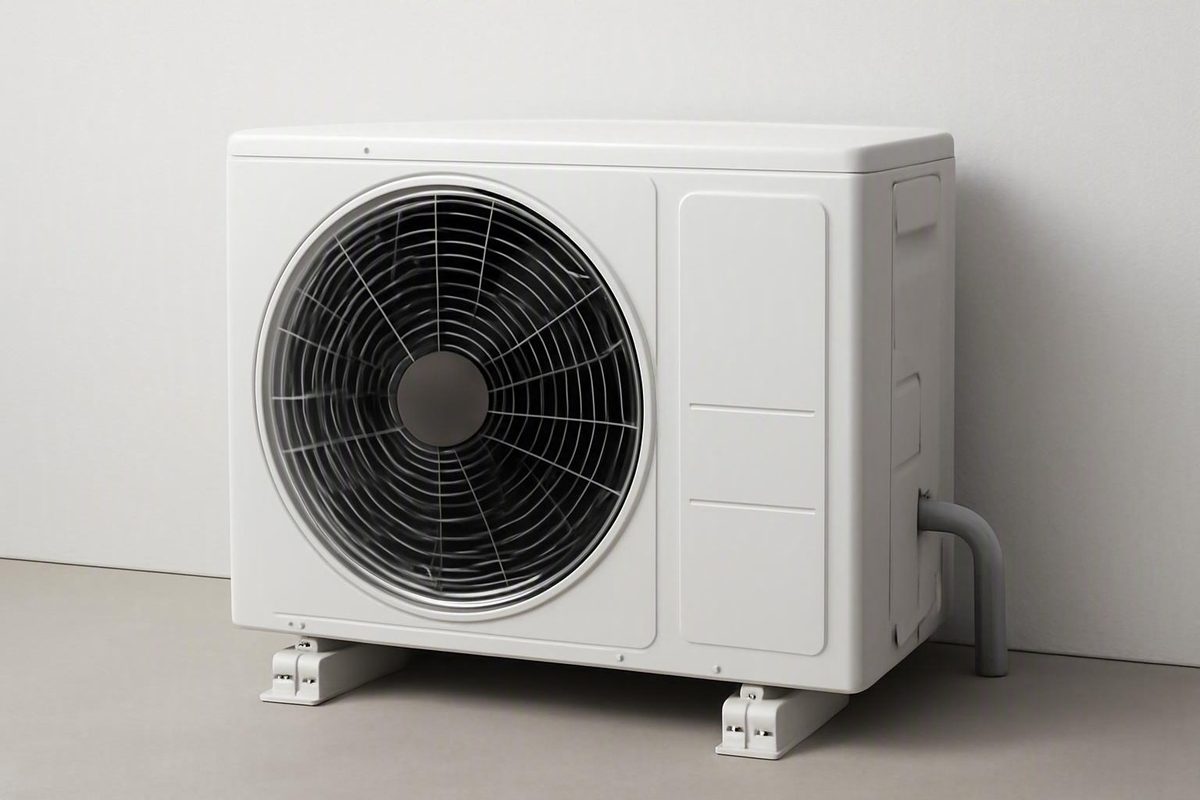
An oversized air conditioner can lower indoor temperature so quickly that the thermostat reaches its setpoint and stops the compressor before the system has removed enough moisture. Active cooling and condensation then fall away, even though water already on the coil may continue moving toward the drain. The result can be a house that reaches the requested temperature but still feels damp, sticky, or clammy.
In this context, AC size means cooling capacity, not the physical dimensions of the outdoor cabinet. Two units may look similar while having different capacities. The important question is whether the system’s capacity matches the home’s actual cooling load.
Most conventional cooling calls are controlled primarily by temperature. When the air around the thermostat reaches the setpoint, the control usually concludes that cooling is no longer needed. It may not know whether distant rooms are equally comfortable or whether the home’s moisture load has been addressed.
Excess capacity can therefore favor rapid temperature reduction over sustained moisture removal. It can also produce short cycling: repeated operation in brief bursts rather than longer, steadier cooling runs.
There is no universal cycle length or number of starts per hour that proves a sizing problem. Runtime changes with weather, thermostat settings, construction, equipment type, and the current cooling load. Staged and variable-capacity systems can also behave very differently from fixed-capacity equipment.
The homeowner-level clue is straightforward: the thermostat looks satisfied, but the rooms still feel clammy. Air near a supply outlet may feel sharply cold while bedrooms, upper floors, or rooms farther from the thermostat remain uneven or muggy.
That pattern is not a sizing verdict. Short cycling and poor humidity control can also result from dirty filters, restricted or inappropriate airflow, thermostat problems, coil or refrigerant faults, electrical problems, duct leakage, drainage trouble, incorrect setup, or humid air entering the building. Professional short-cycling guidance accordingly treats oversizing as one possible cause among several, not something that can be diagnosed from clamminess alone (Lennox’s overview of AC short cycling).
The useful first question is not “How soon should I replace this AC?” It is: Why is the temperature demand being met while the moisture demand remains?
How an air conditioner removes water from indoor air
An air conditioner removes moisture through condensation while it cools. The return system brings humid indoor air to the air handler or furnace, where the air passes across the evaporator coil.
When the coil surface is colder than the passing air’s dew point, some water vapor changes into liquid water on the coil. This is the same basic effect that causes droplets to form on the outside of a cold drink in humid weather. The analogy illustrates condensation; it does not mean the coil must be at or below water’s freezing point.
The condensed water moves from the coil into a drain pan and then exits through a condensate line. Meanwhile, the blower distributes cooled, partially dried air through the supply ducts.
Humid return air → cold evaporator coil → condensation → drain pan and condensate line → cooler, drier supply air
This process performs two related but distinct jobs:
- Sensible cooling lowers the measured air temperature.
- Latent cooling removes water vapor from the air.
A home can receive plenty of sensible cooling without enough latent cooling. That is the central oversized-AC problem: the equipment may make the thermostat reading fall quickly without removing enough water to make the house comfortable.
Useful dehumidification depends on more than nominal capacity. The coil must reach an appropriate operating temperature, airflow must be suitable for the equipment, humid air must continue passing over the coil, and condensed water must collect and drain correctly. A problem at any point can weaken moisture removal even when cold air still comes from the registers.
Operating time matters as well. Condensation can begin once the coil is below the air’s dew point, but that does not mean every brief cycle removes enough water to control humidity throughout the house. Sustained operation gives the system more opportunity to process indoor air, collect moisture, and move that liquid toward the drain. Explanations of evaporator-coil condensation also distinguish temperature-driven AC operation from humidity-driven dehumidifier operation; illustrative runtimes should not be treated as universal thresholds (Therma-Stor’s explanation of evaporator-coil condensation).
An ordinary air conditioner can therefore dehumidify while it cools, but it does not necessarily respond to humidity as an independent demand. Unless the equipment includes compatible humidity controls or a dedicated dehumidification mode, the thermostat may end the cooling call as soon as its temperature requirement is met.
That distinction becomes especially important during damp, mild weather. The home can have a significant moisture load while needing little temperature reduction. If there is little reason for the thermostat to call for cooling, the evaporator coil has little opportunity to remove moisture.
What changes when the AC has too much capacity
Consider two qualitative cooling timelines.
With a suitably matched fixed-capacity system, a cooling call can continue while return air repeatedly passes over the cold evaporator coil. Water condenses, collects, and drains. Supply air also has time to mix with air throughout the home, making the thermostat reading more representative of broader indoor conditions.
With an oversized fixed-capacity system, the temperature around the thermostat may fall much faster. The thermostat reaches its target, ends the call, and stops the compressor. That early stop reduces cold-coil operation, condensation, air circulation associated with the cooling call, and whole-house mixing.
Sustained cycle
Cooling call → coil reaches operating condition → continued condensation and drainage → broader air mixing → thermostat reaches setpoint
Oversized fixed-capacity cycle
Cooling call → rapid temperature drop near thermostat → setpoint reached quickly → compressor stops → limited mixing and moisture removal
This does not mean dehumidification waits for one fixed number of minutes before beginning. Coil cooldown, condensation, drainage, and control behavior vary by system and condition. During a very brief cycle, however, a larger share of the operating period may be spent bringing the coil toward an effective condition, leaving less sustained wet-coil time before shutdown.
Thermostat location can amplify the problem. A sensor in an easy-to-cool hallway or near a strong supply outlet may register the temperature change before conditioned air has mixed through bedrooms, upper floors, or closed rooms. The control may respond correctly to the temperature it senses without establishing that the entire house has been evenly conditioned.
Reduced cold-coil operation generally means less total opportunity for water vapor to condense. It can also leave less time for collected water to migrate into the pan and drain. The exact result depends on coil design, airflow, drainage, indoor moisture, and cycle behavior.
Some water may remain on the coil after the compressor stops. If the blower continues moving indoor air over that wet surface, part of the retained moisture may evaporate back into the airstream. The effect varies by equipment, fan controls, drainage design, retained water, and indoor conditions, so it should not be assumed to occur equally in every system (Whitney Services’ discussion of condensation and off-cycle re-evaporation).
The underlying imbalance is simple:
- The system has enough sensible capacity to meet the temperature load quickly.
- The house still has a latent load—water vapor that must be removed.
- The thermostat ends the cycle primarily in response to temperature.
- Moisture removal is curtailed before the latent load has been adequately addressed.
An oversized AC does not necessarily fail to make cold air. It can make enough cold air too quickly for moisture removal and whole-house mixing to keep pace.
Signs that point toward oversizing—and what they do not prove
No single symptom proves excessive capacity. Oversizing becomes more plausible when several related observations appear together:
- The thermostat repeatedly reaches its setpoint very quickly.
- The compressor frequently starts and stops in brief cycles.
- Rooms feel cool but damp, sticky, or clammy after cooling.
- A reliable humidity monitor shows little improvement during short runs.
- Temperatures differ noticeably among rooms.
- Areas near the thermostat or supply outlets cool much faster than distant rooms.
- Comfort improves during weather that produces longer cooling runs.
- The problem is most noticeable during mild, rainy, or otherwise damp weather.
The relationship among the clues matters more than any one observation. Brief cycles alone might indicate a control, airflow, refrigerant, electrical, or coil problem. Uneven rooms alone might point toward duct or building-envelope conditions. Persistent humidity alone could reflect infiltration, indoor moisture generation, or weather.
Quick thermostat satisfaction, repeated brief cycles, clammy air, and room-to-room differences together create a coherent reason to investigate capacity. A related guide to the signs an air conditioner may be oversized can help organize those observations before a service call.
Rooms near supply registers can cool first because they receive conditioned air sooner and more directly. If the thermostat is in one of those easy-to-cool areas, it may end the cycle before remote rooms receive enough conditioned airflow. The thermostat can therefore appear satisfied while occupants experience different temperatures and comfort levels elsewhere.
Weather comparisons are particularly useful. During very hot conditions, even an oversized system may run longer because the home has a larger sensible cooling load. Those longer runs may improve moisture removal enough that clamminess becomes less obvious.
During a mild but damp period, the home may require little temperature reduction. The thermostat may then end cooling calls quickly—or not call for cooling at all—even while moisture continues entering or being generated indoors.
Do not diagnose the system from one observed cycle. A run can be brief because the weather has cooled, the thermostat setting changed, the house was already near setpoint, or the current cooling load is simply small. Long runtime is not automatically evidence that a system is undersized or failing.
Equipment design also matters. A two-stage system may begin at lower capacity before bringing on a higher stage. Variable-capacity or inverter equipment can modulate its output and run for extended periods at low power. That long, low-output operation may be intentional and helpful because it supports steadier air mixing and moisture removal.
Nameplate capacity alone does not describe how such equipment behaves under ordinary part-load conditions. A modulating unit can still be selected or configured poorly, but long runtime by itself is not evidence of malfunction.
Repeated starts may contribute to wear or inefficient operation in some systems, but a homeowner’s cycle observations cannot establish a specific increase in utility costs or reduction in service life. Equipment design, controls, installation, load, and the underlying cause all matter.
Treat the signs as a pattern worth documenting—not as permission to order a smaller unit immediately.
Other reasons a cool house can remain humid
A cool-but-clammy home has several possible causes. Sorting them into categories reduces the chance of replacing equipment that is not actually responsible.
Airflow and equipment conditions
A dirty or inappropriate filter can restrict airflow. Supply or return grilles may be blocked by furniture, rugs, curtains, stored items, or accumulated debris. Airflow can also be wrong because of blower configuration, duct design, component mismatch, or an internal equipment problem.
Other possibilities include:
- An evaporator-coil condition that affects heat transfer
- Refrigerant faults
- Electrical or control-component faults
- An indoor and outdoor component mismatch
- Incorrect installation or commissioning settings
- A condensate-pan or drain problem
- Airflow that is unsuitable for the installed equipment and operating mode
Several of these conditions can alter cycling or reduce moisture removal while the system still produces some cool air. Refrigerant, electrical, internal coil, and blower diagnoses require suitable instruments and technical knowledge.
A filter is one of the few components homeowners can inspect without opening equipment. If its condition or replacement schedule is uncertain, consult equipment instructions and this practical guide to when an HVAC filter may need replacement.
Control problems
Thermostat placement can make the system respond to a temperature that does not represent the rest of the house.
The thermostat may also be faulty, incorrectly configured, or incompatible with the installed equipment. Fan settings can matter as well. A system controlled primarily by temperature may stop cooling even though humidity remains, while continuous blower operation may pass air over a wet coil after the compressor stops.
Some systems include humidity sensing, dehumidification logic, staging, or specialized blower profiles. Others do not.
Duct and building-envelope conditions
Humid outdoor air can enter through gaps and leakage in the building enclosure. Leaky windows or doors, unsealed penetrations, insulation weaknesses, and other envelope problems can add to the moisture and cooling loads.
Duct leakage can be important when ductwork passes through a humid attic, crawlspace, garage-adjacent space, or another unconditioned area.
These conditions can coexist with oversizing. The AC may run too briefly while the building or duct system continually admits new moisture. Replacing the cooling unit without addressing infiltration could therefore leave part of the complaint unresolved.
Indoor moisture sources
Moisture may also come from inside the home, including:
- Cooking without effective exhaust
- Frequent or long showers
- Clothes drying
- Numerous plants
- Aquariums
- Plumbing leaks
- Drainage or foundation-water problems
- Damp basements or crawlspaces
- Other activities that release water vapor
The AC must handle this moisture in addition to outdoor humidity. If indoor generation is unusually high, correctly selected and functioning cooling equipment may still need help from source control or separate dehumidification.
Mild or rainy weather
Mild, damp weather creates a difficult combination: substantial moisture may be present even though the home needs little temperature reduction. A conventional temperature-controlled air conditioner consequently receives short or infrequent cooling calls.
Oversizing, high airflow, humid-air leakage, indoor moisture generation, and mild weather can be separate or overlapping explanations for weak dehumidification (Saturn Resource Management’s review of AC dehumidification problems). That is why a house may feel clammiest during rainy nights, spring, fall, or other damp periods that are not extremely hot.
Short cycling can occur because excess capacity satisfies the thermostat quickly even when no component is broken. It can also be a symptom of an airflow, control, refrigerant, electrical, or coil fault. The observation tells you what the system is doing; diagnosis must establish why.
What homeowners can safely observe before a service call
Good notes can turn “The house feels humid” into a more useful contractor conversation. The goal is not to diagnose internal equipment. It is to document the relationship among weather, thermostat behavior, runtime, room comfort, and humidity.
Use a simple log:
| Observation | What to record |
|---|---|
| Date and weather | Hot, mild, rainy, sunny, damp, or recently stormy |
| Thermostat setting | Cooling setpoint, operating mode, and schedule changes |
| Fan mode | AUTO, ON, circulate, or another available mode |
| Cooling behavior | Approximate compressor start and stop times |
| Apparent reason for stopping | Setpoint reached, stopped before setpoint, or uncertain |
| Room comfort | Cool and dry, cool and clammy, warm, sticky, or changing |
| Room differences | Which rooms are cooler, warmer, drier, or more humid |
| Humidity trend | Reading before, during, and after a run |
| Visible moisture | Leaks, standing water, overflow, or damp materials |
| Condensate | Whether drainage is visible without opening equipment |
Collect observations under more than one weather condition if possible. Note whether the home feels better when cooling runs last longer. Also record whether cycles appear to end because the thermostat reaches setpoint or whether the equipment stops before that happens.
That distinction is useful. Rapid setpoint satisfaction may support a capacity concern, while unexplained shutdown before setpoint can point more strongly toward a fault or control interruption.
A humidity monitor can reveal trends, but one reading does not prove oversizing. Look for repeatable patterns.
Homeowners can generally make these non-invasive checks:
- Verify the thermostat mode and setpoint. Confirm that the system is in cooling mode and that a schedule or setback is not creating confusing behavior.
- Check the fan setting. In humid conditions, AUTO often limits blower operation to cooling calls and may reduce off-cycle airflow over a wet coil. Equipment-specific controls can behave differently, so follow the applicable instructions.
- Inspect the filter. Replace a clearly dirty filter with the correct size and type specified for the system.
- Check visible grilles. Confirm that supply and return grilles are open and unobstructed.
- Look for obvious water problems. Note leaks, standing water, overflowing pans, or damp building materials without removing sealed panels.
- Observe accessible drainage. Visible condensate flow is useful context, but the amount varies with weather, runtime, and indoor moisture. It is not a sizing test.
Do not close supply vents to imitate a smaller system. Closing outlets does not reduce installed cooling capacity and can create airflow and static-pressure problems (Whitney Services’ warning about closing supply vents).
Do not change blower speed, open refrigerant components, alter wiring, reconfigure ducts, or bypass safety controls yourself. Guidance on latent-performance adjustments specifically cautions that blower changes must remain within manufacturer limits and should follow professional evaluation (Keith Key HVAC’s discussion of airflow and humidity controls).
Your notes will not establish the correct AC capacity. They can, however, show a technician that the system repeatedly satisfies the thermostat quickly on mild damp days, that particular rooms remain clammy, or that the equipment stops before setpoint. That is more actionable than a general comfort complaint.
How a contractor can determine whether the unit is actually oversized
Required capacity should not be established from square footage alone, a simple rule of thumb, or the nominal size of the previous unit. Those shortcuts do not fully account for how a particular home gains heat or moisture.
A professional cooling-load calculation, commonly called a Manual J calculation, evaluates the home’s cooling requirements using factors such as:
- Climate and outdoor design conditions
- Insulation levels
- Window type, area, orientation, and shading
- Air leakage
- Building orientation
- Ceiling and construction characteristics
- Occupancy and internal loads
- Duct location, leakage, and condition
- Other features affecting heat gain
The installed equipment’s model information and rated performance should then be compared with the calculated load. The contractor should explain how the proposed or existing outdoor unit, indoor coil, blower or air handler, ducts, thermostat, and controls are intended to work together.
Sizing guidance likewise emphasizes construction, insulation, windows, infiltration, occupancy, and climate rather than square footage or automatic duplication of the existing unit (Unico’s overview of HVAC load calculations).
Ask for documentation rather than a verbal assurance. Useful deliverables include:
- A written load-calculation summary
- The design conditions and major assumptions used
- Indoor and outdoor equipment model numbers
- Matched-system performance information
- An explanation of staging or modulation
- An explanation of the intended airflow and humidity-control strategy
Ask the contractor:
- Is excess capacity satisfying the thermostat quickly, or is a fault ending the cycle?
- Is the thermostat operating correctly, appropriately located, and properly configured?
- Are the filter, supply airflow, return airflow, and duct conditions suitable?
- Are the evaporator coil and refrigerant circuit functioning correctly?
- Are electrical components or safety controls interrupting operation?
- Is condensate collecting and draining properly?
- Are duct leakage or humid outdoor-air infiltration contributing?
- Are the outdoor unit, indoor coil, blower, air handler, thermostat, and controls intended to operate together?
- Does the duct system support the installed equipment?
- What is the calculated cooling load, and how does installed capacity compare?
- If replacement is proposed, how was the new equipment selected for both sensible and latent performance?
Equipment type must be part of the interpretation. Variable-capacity equipment can reduce output under part-load conditions and may run for long periods by design.
A proper evaluation should therefore consider staging, modulation, thermostat calls, control configuration, and whether the system actually reaches low-capacity operation. Neither maximum nameplate capacity nor long runtime tells the whole story.
The result should be a diagnosis, not a sales shortcut. If a load calculation and system evaluation indicate substantial excess capacity after faults and moisture sources have been considered, oversizing becomes a defensible conclusion. If controls, airflow, drainage, ducts, refrigerant operation, or infiltration are responsible, those conditions should be addressed before capacity is blamed.
A remedy ladder: settings, professional optimization, dehumidification, and replacement
Humidity management and capacity correction are not the same thing. A measure can make the home drier without proving that the AC is oversized, and it can manage symptoms without changing installed cooling capacity.
Start with low-risk actions and move toward major changes only when the evidence supports them.
Tier one: low-risk homeowner actions
Begin with settings, source control, and visible maintenance:
- Use thermostat settings appropriate for the installed equipment.
- In humid conditions, generally avoid continuous fan operation if it moves air across a wet coil after the compressor stops.
- Use AUTO fan mode as a starting point unless system-specific instructions call for another setting.
- Replace a clearly dirty filter with the correct type.
- Keep supply and return grilles unobstructed.
- Use kitchen and bathroom exhaust appropriately.
- Reduce avoidable indoor moisture generation.
- Repair known plumbing or water leaks.
- Investigate obvious basement, crawlspace, drainage, or envelope moisture.
Do not repeatedly lower the thermostat as the only response. A colder setpoint may produce more cooling runtime, but it can also make the home uncomfortably cold without resolving the reason humidity control is weak.
Fan advice requires nuance. Continuous circulation may improve temperature mixing in some houses, but it can also encourage off-cycle re-evaporation in certain systems. AUTO is often a reasonable starting point during a humidity complaint, subject to the equipment’s control strategy.
Tier two: technician-only optimization
Before changing capacity, a qualified technician should inspect:
- Thermostat placement, operation, and configuration
- Staging or modulation controls
- Filter and return conditions
- Supply airflow and duct restrictions
- Duct leakage and distribution
- Evaporator-coil operation
- Condensate pan and drainage
- Refrigerant circuit performance
- Electrical components and safety controls
- Compatibility among indoor and outdoor components
- Humid-air infiltration and building contributors
Some compatible systems can improve latent performance through approved blower profiles, staging adjustments, or dehumidification controls. These are not universal fixes.
Reducing airflow without proper evaluation can impair heat transfer, weaken distribution, or create coil and equipment problems. Blower changes must remain within manufacturer requirements and belong with a qualified technician who can measure their effects.
Correcting a dirty filter, faulty thermostat, blocked return, refrigerant problem, drainage issue, or installation error may restore acceptable cycling and humidity control without changing AC capacity. If the system is operating as designed but consistently overwhelms the temperature load, optimization may have limits.
Tier three: supplemental moisture control
A dehumidifier can address moisture when the home needs drying but little cooling. This is especially relevant during mild or rainy weather, when a temperature-based thermostat has little reason to run the AC.
Options include portable units and integrated whole-home systems. Neither is universally required or superior. Selection depends on the area being treated, moisture load, drainage, layout, noise, duct design, installation constraints, and homeowner goals.
A portable unit may help a particular room or zone. A properly selected whole-home system may provide broader control.
Supplemental dehumidification does not prove that the cooling equipment is properly sized. It manages latent moisture independently. That can be practical when replacement is not justified, when mild-weather humidity is the main concern, or when the building has a moisture load that ordinary cooling cannot consistently handle.
Tier four: capacity and equipment changes
If professional evaluation confirms that a fixed-capacity system is significantly oversized, replacement with appropriately selected equipment may be the most direct long-term capacity correction. The replacement should follow a real load calculation and equipment-selection review rather than automatically copying the old tonnage.
Depending on the application, staged or variable-capacity equipment may improve part-load operation by running at lower output for longer periods. That can support steadier temperatures, mixing, and moisture removal.
These technologies can still be selected or configured poorly. They do not eliminate the need for appropriate capacity, compatible components, suitable controls, and adequate ducts.
Before authorizing replacement, ask to see:
- The written cooling-load summary
- The existing equipment’s model and capacity information
- Evidence that cycling is caused by capacity rather than a fault
- The proposed equipment’s stages or modulation range
- The indoor and outdoor component match
- The airflow and duct implications
- The planned humidity-control strategy
Avoid four tempting shortcuts:
- Do not close supply vents to imitate smaller capacity.
- Do not use a colder thermostat setting as the sole solution.
- Do not make unapproved blower, refrigerant, wiring, or duct changes.
- Do not authorize replacement based only on clammy rooms or one humidity reading.
Frequently asked questions
Does short cycling always mean my air conditioner is oversized?
No. Oversizing is one possible cause, but short cycling can also result from a dirty filter, restricted airflow, thermostat trouble, coil problems, refrigerant faults, electrical faults, or incorrect setup.
Pay attention to why the cycle appears to stop. If the thermostat rapidly reaches setpoint and that pattern repeatedly coincides with clammy air and uneven rooms, excessive capacity becomes more plausible. If the system stops before setpoint, produces inconsistent cooling, or behaves erratically, a fault may be more likely.
There is no universal cycle duration that proves either condition. Persistent rapid starts and stops warrant professional diagnosis rather than an immediate sizing conclusion; short-cycling guidance lists airflow, thermostat, coil, refrigerant, electrical, and capacity problems among the possible causes (Meyer & Depew’s diagnostic overview).
Should I set the thermostat fan to Auto or On when the house feels humid?
AUTO is usually the better starting point during a humidity complaint because it generally stops routine blower operation when the cooling call ends. That may reduce off-cycle airflow across a wet evaporator coil.
ON keeps the blower running continuously. This can improve room-to-room temperature mixing, but it may work against humidity control in some systems if air continues crossing a wet coil after the compressor stops.
Equipment-specific controls can change the answer. Some systems use programmed circulation, humidity modes, variable fan behavior, or other control logic. Follow the applicable manufacturer instructions and ask the technician how the installed system operates.
Why is indoor humidity sometimes worse on mild or rainy days?
Humidity load and temperature load are different. A mild rainy day can bring substantial moisture while creating little need to lower indoor temperature. Because a conventional thermostat mainly calls for cooling in response to temperature, the AC may run briefly or not at all.
An oversized system can intensify that pattern by satisfying the small temperature demand especially quickly. Meanwhile, moisture may continue entering through building leakage, duct leakage, ventilation, or door openings. Cooking, showering, plants, aquariums, and water problems can add moisture indoors.
The home may consequently feel better during hotter weather because the larger sensible load keeps the AC operating longer. That comparison is a useful clue, but it does not distinguish oversizing from infiltration, controls, or other causes by itself.
Can a dehumidifier solve an oversized-AC humidity problem?
A dehumidifier can manage the moisture problem, particularly when cooling demand is too low to keep the AC running. Because it responds to humidity rather than relying only on a temperature call, it can continue drying without requiring the home to become colder.
It does not correct installed AC capacity. If a load calculation confirms that the air conditioner has substantially more capacity than the home requires, it remains oversized.
A portable unit may suit a limited area, while a properly designed whole-home unit may provide broader control. Evaluate moisture sources and AC faults first so supplemental equipment is not used to mask a repairable leak, drainage problem, or control error.
Do I have to replace an oversized air conditioner?
Not automatically. First verify that it is actually oversized. Similar symptoms can result from airflow restrictions, thermostat placement, control configuration, duct leakage, drainage trouble, refrigerant or electrical faults, component mismatch, and excessive indoor or outdoor moisture.
If the mismatch is limited—or if the system has usable staging or modulation—professional control and airflow optimization may improve performance. Reducing moisture sources, repairing leaks, addressing duct or envelope problems, and adding suitable dehumidification may also improve comfort without immediate replacement.
A substantially oversized fixed-capacity system may ultimately warrant right-sized replacement when other corrections cannot provide acceptable performance. That decision should follow a cooling-load calculation, equipment-selection review, and verification that the proposed indoor coil, blower, outdoor unit, controls, and ducts are compatible.
An oversized AC can meet the temperature demand faster than it meets the moisture demand. A cool thermostat reading paired with clammy rooms is therefore worth investigating, but it is not a sizing verdict.
Record cycle behavior, fan mode, humidity trends, weather, and room differences. Complete only safe thermostat, filter, grille, and visible-moisture checks. Then ask a qualified professional to rule out faults and compare installed capacity with a genuine cooling-load calculation before changing airflow, adding equipment, or replacing the air conditioner.