
System Decisions
Before Approving Furnace Blower Motor Repair, Confirm What Failed
Use airflow, thermostat mode and furnace timing to distinguish a likely blower fault from a filter, capacitor, control or wheel problem.
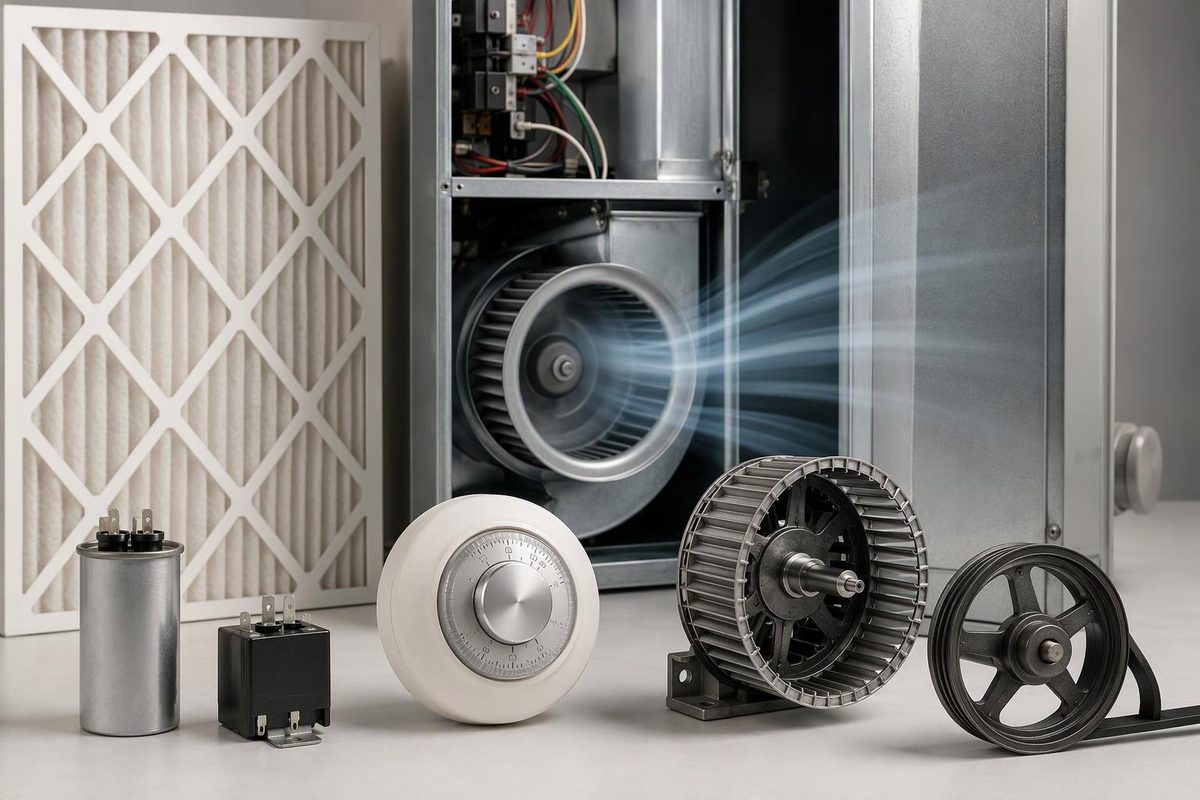
No airflow does not automatically mean the blower motor is dead. A loaded filter, failed capacitor, damaged blower wheel, loose connection, control-board fault or missing thermostat command can produce a similar symptom. Document what the furnace does before approving a motor replacement.
Stop the furnace for these warning signs
Turn the system off and arrange service if you notice:
- Smoke or a strong burning or electrical odor
- Grinding, metal-on-metal contact or violent vibration
- A breaker that trips again after one reset
- Scorched wiring or obvious heat damage
- A gas furnace repeatedly lighting and shutting down without moving air
Carrier identifies smoke, burning smells and repeated breaker trips as signs to shut the furnace down and seek professional service. Its guidance also notes that blower repair involves electrical components and moving parts (Carrier).
Treat a carbon-monoxide alarm as a separate emergency, whether the blower is running or not. Move everyone outside, call emergency services, and do not re-enter until responders permit it, as the U.S. Consumer Product Safety Commission directs.
Make four checks without opening the furnace
1. Compare Heat with Fan On
Set the thermostat system mode to Off, wait for the equipment to stop, and then select Fan On.
- The blower runs in Fan On but not during Heat: The motor can operate under at least one command. The heating-speed command, furnace control, wiring, safety circuit or sequence still needs diagnosis.
- The blower runs in Heat but not Fan On: The continuous-fan command or its configured speed may be the issue.
- The blower runs in neither mode: A motor fault is possible, but so is a power, door-switch, board, wiring or control problem.
Do not judge the motor only by airflow strength in Fan On. Speeds can differ by mode. One Lennox variable-speed furnace, for example, permits continuous-fan airflow at 28% or 38% of its selected second-stage cooling speed while using separately configured heating and cooling airflow (Lennox service literature). Your model may operate differently.
For a closer symptom comparison, use this furnace fan troubleshooting guide.
2. Check the thermostat context
Confirm that:
- The thermostat is in Heat mode and set above room temperature.
- Its display is normal and its batteries, if used, are not depleted.
- A schedule, hold, utility event or smart-home rule has not changed the setting.
- You record any alert before clearing it.
A thermostat showing a heat call does not prove the correct signal reached the motor. Professional ECM troubleshooting begins by checking the thermostat input at the furnace control, programmed airflow, delays, connections, safeties and fault codes (Genteq ECM Service Guide).
3. Inspect the filter and accessible grilles
With the system off, inspect the filter if it sits in a normal homeowner-accessible rack. Replace it if it is visibly loaded, collapsed, wet or overdue. Use the specified size and point the arrow in the correct airflow direction. Confirm that rugs, furniture and stored items are not covering supply registers or return grilles.
Restricted airflow can make delivery at the registers seem weak even when the motor runs. Genteq’s residential ECM guide also tells technicians to investigate filters, dampers, registers, the blower wheel, coil and external static pressure before condemning a running motor (Genteq).
Do not run the furnace without its specified filter as a test.
4. Record the operating sequence
From outside the cabinet, note:
- Whether the thermostat shows a heat call
- Clicking, humming, squealing or grinding
- Whether the burners ignite before the blower should start
- How long the furnace runs before stopping
- Whether airflow is absent everywhere or weak only in some rooms
- Any code visible through the furnace sight glass
- Whether the same indoor blower operates during cooling, if the home has central AC
Take a short video if the sound or code is intermittent. Avoid repeated power resets; they do not fix the fault and may erase useful diagnostic history.
What the diagnosis should establish
A sound diagnosis goes beyond “the fan does not run.” Ask which test identified the failed component. Depending on the furnace and motor, a technician may need to:
- Confirm the call and sequence: Is the thermostat command reaching the board, and is the board telling the blower to run?
- Read active and stored fault codes: A limit or other safety fault can alter furnace operation. Codes must be matched to the exact model’s service literature.
- Check power and connections: Are the specified supply voltage and control signal present under the correct operating conditions?
- Check the mechanical load: Is the blower wheel obstructed, loose, dirty or damaged, and does it rotate correctly?
- Check airflow conditions: Is a loaded filter, closed damper, dirty coil or restrictive duct system creating excessive resistance?
- Test motor-specific parts: A permanent-split-capacitor (PSC) motor may use a separate run capacitor. An electronically commutated motor (ECM) has electronic controls and may require model-specific tests, programming or a matched replacement module.
Genteq explicitly says not to assume an ECM has failed before checking thermostat inputs, board settings, connections, safeties and fault codes. It also requires a correct replacement motor or module rather than component-level repair of its ECM controls (Genteq).
That distinction matters: “blower repair” could mean replacing a capacitor, correcting a connection, cleaning or replacing the wheel, replacing an ECM module, replacing the complete motor, or repairing a control problem. Those are different jobs at different prices.
Leave electrical tests to a technician
Even after furnace power is switched off, some motor electronics can retain hazardous energy. For several ECM families, Genteq requires disconnecting power and waiting at least five minutes before opening the motor control so capacitors can dissipate. It warns that energized work can cause shock, injury, death or property damage (Genteq).
Leave voltage measurements, capacitor testing, wiring changes, wheel removal and operation with an open cabinet to a qualified HVAC technician. A blower-door interlock is not a substitute for disconnecting and verifying power.
Furnace blower motor repair cost
Published prices are broad because “blower motor” covers basic fixed-speed motors and proprietary variable-speed ECM assemblies. Carrier’s 2026 consumer guide gives an installed replacement range of $300 to $900, averaging about $560. HomeAdvisor’s 2026 furnace-parts table gives a much wider $150 to $2,000 blower-motor range (Carrier; HomeAdvisor). Use these only as national budgeting context, not as a quote for your equipment.
Before approving work, request an itemized estimate showing:
- Furnace brand, model and serial number
- The failed part and the test used to identify it
- Whether the motor is PSC, constant-torque ECM or variable-speed ECM
- Separate capacitor, module, motor, wheel and control-board prices where applicable
- OEM or approved replacement part number
- Programming or setup charges
- Labor, diagnostic fee and after-hours charge
- Parts and labor warranties
- What happens to the price if another fault appears after replacement
Ask the contractor to check the manufacturer’s parts warranty using the serial number. If the diagnosis remains uncertain or the estimate is large enough to make replacement worth considering, get a second written diagnosis rather than comparing only bottom-line prices. This furnace service shortlisting guide can help organize those calls.
A blower repair is usually easier to justify when the furnace is otherwise sound, the correct part is available and the repair has a reasonable warranty. Compare whole-furnace replacement when there are multiple costly faults, unavailable parts or a repair bill large enough to change the system economics—not merely because the blower stopped once.