
Cooling
What to Check When Your Outdoor AC Unit Will Not Start
Indoor airflow can continue if outdoor power is lost, a safety control opens or no cooling signal arrives. Sound and breaker behavior guide the next safe step.
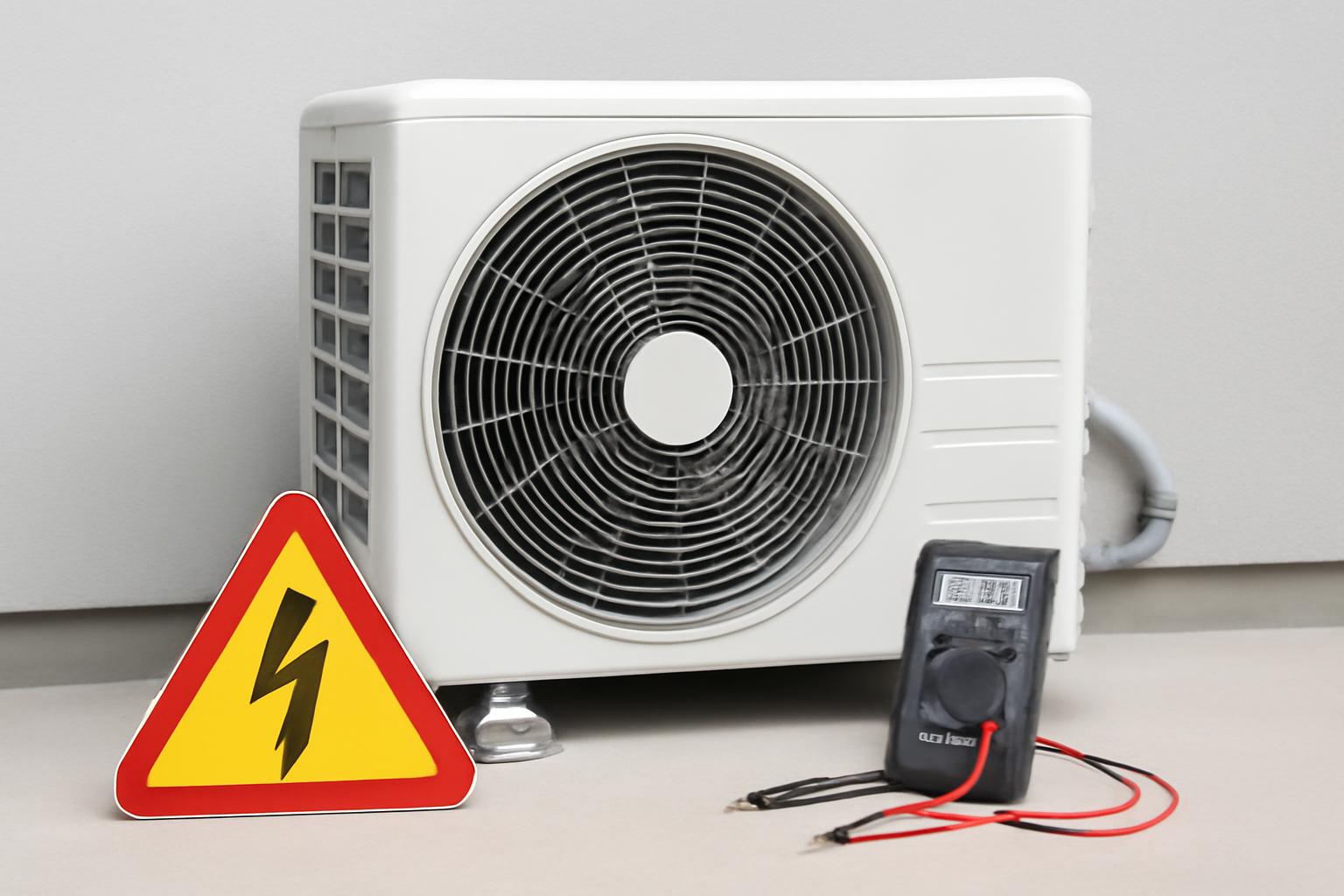
First, shut the system down if you notice an electrical warning sign
Stop immediately for electrical warning signs
Set the thermostat to OFF and stop troubleshooting if you notice smoke, sparks, a burning odor, visibly damaged wiring, severe or loud electrical buzzing, or a breaker that trips again. Leave the system off and arrange prompt professional service. If there is an active fire or immediate threat, move to safety and contact the appropriate emergency service. These warning signs require professional attention rather than routine homeowner troubleshooting (Beacon Services’ outdoor-unit safety guidance).
One-reset rule: If conditions otherwise appear safe, you may reset the correctly labeled AC or condenser breaker once. If it trips immediately or trips again later, do not reset it repeatedly. A recurring trip indicates an unresolved electrical or equipment fault (Lennox’s outdoor-unit troubleshooting guidance).
A silent outdoor unit is not automatically an emergency. If there is no smoke, burning odor, visible damage, severe buzzing, or repeated breaker trip, you can proceed with the external checks below. An unresolved cooling failure still needs diagnosis, but it is different from an active electrical warning sign.
Keep the safety boundary clear:
- Do not remove an electrical-panel cover or do anything beyond normal access to a clearly labeled breaker.
- Do not open the condenser cabinet or outdoor disconnect.
- Do not touch wiring, handle fuses, or test a capacitor or contactor.
- Do not touch refrigerant lines or internal components.
- Do not reach through the grille.
- Never try to push-start a stationary condenser fan with your hand, a stick, or a tool.
Switching off a breaker does not make internal components safe to handle. A capacitor can retain a hazardous electrical charge after system power has been disconnected. Capacitors, contactors, wiring, motors, and other internal components therefore require trained diagnosis rather than a visual DIY test (Mr. HVAC’s explanation of outdoor-unit electrical components).
Multiple failed starts are another reason to stop. If the unit hums without starting, clicks repeatedly, starts for only a moment, or trips its breaker, turn the thermostat off and arrange service. Repeated attempts do not reveal which component failed and can place additional stress on equipment already struggling to start.
Confirm what is actually—and is not—running
“Outside unit not running” can describe several different conditions. Before checking the thermostat or breaker, identify the observable state without touching the equipment.
These terms help distinguish the components:
- Indoor blower: The fan that moves air through the duct system and rooms.
- Condenser fan: The visible fan in the outdoor unit.
- Compressor: An internal outdoor component involved in circulating refrigerant through the cooling system.
- Outdoor unit: The exterior assembly that typically contains the condenser fan, compressor, condenser coil, electrical controls, and related connections.
The indoor blower and outdoor equipment may use separate circuits and controls. Air can therefore continue moving through the vents even when the outdoor circuit has lost power, a safety control is open, or the condenser did not receive its cooling signal. Indoor airflow does not prove that the outdoor unit has power or is operating.
From a safe distance, observe the outdoor unit while the thermostat is requesting cooling. Do not lean over it, touch the cabinet, or reach through the grille. Note whether the unit is:
- Completely silent, with no visible fan movement
- Humming while the fan remains stationary
- Clicking or chattering
- Vibrating even though the fan is not moving
- Starting briefly and then stopping
- Operating intermittently
- Tripping its breaker
- Running with a fan that stops unexpectedly
Also check an indoor supply vent. Is air moving? Does it feel cool, warm, or close to room temperature? These observations can confirm a cooling problem, but they do not prove that a capacitor, compressor, fan motor, or another specific part has failed.
The outdoor unit must disperse heat removed from the home. If it remains inactive, the air conditioner cannot cool properly even if the indoor blower continues circulating air. Lennox recommends checking sound, outdoor fan movement, and indoor-air temperature as initial observations—not as a component diagnosis.
Do not assume that a stationary fan means the entire outdoor unit is electrically dead. Another component may be energized or attempting to start. Conversely, sound from the cabinet does not establish that the compressor is operating normally. Report only what you can see and hear without contact.
Work through the safe checks in order
When there are no electrical warning signs, the following sequence can rule out simple external causes. Stop if you encounter damaged equipment, an abnormal electrical symptom, or anything that would require opening a cover.
1. Create a clear cooling call at the thermostat
Set the thermostat to COOL, not HEAT or FAN, and choose a setpoint clearly below the current room temperature. The goal is simply to make sure the thermostat is requesting cooling; there is no universal temperature difference that applies to every thermostat.
If the thermostat uses replaceable batteries, install fresh batteries according to its instructions. A blank or unreliable display, incorrect mode, depleted batteries, or an unexpected programming change can prevent or interrupt the cooling request.
Check the fan setting as well. With the fan set to ON, the blower may circulate air continuously and create the impression that the air conditioner is actively cooling.
2. Allow for a model-specific protection delay
Do not expect every outdoor unit to start immediately after you lower the thermostat. Thermostats, control boards, and compressor-protection devices may impose a delay after a setting change, power interruption, or recent shutdown.
There is no universal waiting period. Consult the thermostat or equipment manual for the applicable delay, and avoid repeatedly switching modes or moving the setpoint while you wait.
If the system starts after its documented delay, verify that cool air reaches the rooms and that outdoor operation remains stable. If it starts and stops almost immediately, turn it off rather than repeating the test.
3. Check the labeled AC or condenser breaker once
Locate the home’s circuit-breaker panel and identify the breaker clearly labeled for the air conditioner, condenser, outdoor unit, or heat pump. Do not guess when labels are missing, ambiguous, or inconsistent.
If the breaker is visibly tripped and there are no danger signs, reset that labeled breaker no more than once using its normal operating handle. If it will not remain set, trips immediately, or trips again when the unit attempts to start, do not reset it again. Leave the system off and request diagnosis.
A storm or power interruption can precede a one-time trip, but timing alone does not prove that the event was the sole cause. A recurring trip can involve excessive current, overheating, a short, an equipment component, the branch circuit, or a combination of problems. Trane likewise advises professional attention for persistent electrical trips (Trane’s air-conditioner troubleshooting guidance).
4. Inspect the outdoor disconnect visually
Outdoor equipment commonly has a disconnect mounted nearby. From the outside, check whether it appears intact, securely closed, and in its normal ON position if the position is externally visible.
This is a visual inspection only. Do not open the box, remove or reverse a pullout, handle fuses, remove covers, or touch wiring. Disconnect designs vary, and generic online instructions may not match your equipment. Manufacturer guidance for a specific model takes precedence over general troubleshooting advice.
If the disconnect appears open, loose, burned, corroded, damaged, or otherwise abnormal, leave it alone and report what you observed. Homeowner checks should stop at the exterior condition and visible position of the disconnect (Beacon Services’ visual-only disconnect guidance).
5. Look for exterior obstruction, debris, or ice
Set the thermostat to OFF before approaching the area around the outdoor unit. Look for accessible leaves, sticks, nests, grass clippings, vegetation, or another obvious object resting against the cabinet or grille.
Remove only loose exterior debris that can be reached without opening the cabinet, reaching through the grille, or placing your hand near internal parts. Do not attempt to free or rotate the fan blade. If an object has entered the cabinet, leave its removal to a technician.
Overgrowth and debris can obstruct airflow, and a solid object may interfere with fan movement. Ordinary debris near the cabinet, however, does not prove why a completely silent condenser failed to start.
If you see ice, note its location and operating mode, then leave it alone. Ice can accompany airflow, control, or refrigerant-side problems, while frost on a heat pump may have a different meaning during heating operation.
6. Look for an obvious condensate-drainage clue
Some systems have a float switch that interrupts cooling when water rises in a drain pan or condensate line. Depending on how the switch is wired, it may stop the outdoor equipment while other parts of the system behave differently.
Check only what is externally visible and familiar: standing water near an accessible drain pan, an overflowing condensate area, or the visible position of a known external float switch. Do not remove panels or bypass, tape down, disconnect, or manipulate a safety switch.
Not every system has the same drainage protection, and float switches are not wired identically. A condensate problem is therefore a possible system-specific explanation—not a universal cause of a dead condenser. Clogged drains and failed condensate pumps can activate a safety shutdown on equipped systems (Pippin Brothers’ outdoor-unit checklist).
7. Note the filter and indoor airflow
Inspect the homeowner-accessible air filter and compare its condition with the manufacturer’s replacement guidance. Also note whether indoor airflow is normal, weak, or absent and whether any visible indoor coil or line area appears iced.
On some installations, however, a resulting abnormal condition may activate a protective shutdown.
Replace the filter only through the normal homeowner procedure specified for the equipment. Do not open an internal service compartment solely to inspect it.
If none of these checks restores stable operation, set the thermostat to OFF. Do not continue cycling the thermostat, breaker, or other controls in the hope that the unit will eventually start.
For reset controls, disconnects, fuses, filters, clearances, and protection delays, the manufacturer’s manual takes precedence. Equipment and installations differ, and not every system has the same homeowner-accessible components.
Use the sound and behavior as clues—not a component diagnosis
The condenser’s behavior can narrow the category of the problem, but several failures can produce the same sound. Use the table to decide what to report and when to stop—not to choose a replacement part.
| Observed state | Possible fault categories | Safe response |
|---|---|---|
| Completely silent | Lost outdoor power, an off or defective disconnect, missing thermostat or low-voltage signal, open safety control, damaged wiring, or another electrical fault | Confirm the thermostat settings and model-specific delay; check the labeled breaker once and inspect the disconnect visually. If the unit remains silent, turn it off and request service. |
| Humming with no fan movement | Startup-capacitor trouble, fan-motor trouble, physical obstruction, compressor-related trouble, or another energized failure | Switch the thermostat off. Do not push the fan blade, open the cabinet, or continue startup attempts. |
| Clicking or chattering | Contactor trouble, an unstable control signal, thermostat or low-voltage trouble, startup trouble, or another switching fault | Turn the system off if the sound repeats or the unit does not start normally. Do not treat the sound as proof that the contactor failed. |
| Starts briefly and shuts down | Electrical, motor, compressor, airflow, refrigerant-control, or protective-shutdown problem | Stop repeated restart attempts and arrange diagnosis. Record how long the unit ran and what happened immediately before shutdown. |
| Fan stationary while another part seems to run | Fan obstruction, fan-motor or startup-component trouble, or abnormal compressor-related operation | Treat this differently from a completely silent unit, but shut it down. Do not touch the cabinet or refrigerant lines to verify compressor operation. |
| Breaker trips again | Excessive current, a short, overheating, motor or compressor trouble, equipment wiring fault, or branch-circuit problem | Do not reset the breaker again. Leave the system off and request prompt diagnosis. |
| Intermittent operation | Unstable control or electrical condition, a safety interruption, motor trouble, or another condition-dependent fault | Record the timing, weather, thermostat state, sounds, fan movement, and breaker behavior. Arrange service even if operation returns. |
A completely silent unit first raises questions about power, the cooling signal, and safety controls, but silence does not distinguish among them. Humming suggests that something may be energized or attempting to start, yet it cannot identify whether the cause is the capacitor, fan motor, compressor, obstruction, or another electrical component.
Clicking has the same limitation. A contactor is an electrical switch that responds to a low-voltage cooling call and controls power to outdoor loads. Repeated clicking can involve the contactor or the signal commanding it, but sound alone cannot establish which side of the sequence is failing.
A capacitor assists motor startup and operation, but humming does not prove that the capacitor is defective. A stalled motor, obstructed fan, compressor problem, or supply problem can produce an overlapping symptom. Manufacturer guidance similarly lists capacitors, contactors, fan motors, controls, power problems, and compressor concerns as possibilities requiring testing rather than sound-based diagnosis.
Intermittent behavior is especially useful to document because the unit may run normally by the time a technician arrives. Record when it stopped, the outdoor conditions, the thermostat mode and setpoint, whether a storm or power interruption occurred, and whether the breaker moved to a tripped position. A short video recorded from a safe distance can preserve sounds and visible fan behavior without requiring contact.
Understand the main fault categories behind a non-running condenser
Homeowner-observed symptoms do not provide enough information to rank one cause as “the most common.” A more reliable approach is to group possibilities by the function that failed: power supply, controls, switching and startup, mechanical operation, or protective shutdown.
Power-supply problems
The outdoor equipment needs its own electrical supply. A tripped breaker, interrupted outdoor circuit, disconnect problem, blown fuse, damaged connection, or surge-related interruption can stop the condenser while the separately controlled indoor blower continues running.
A breaker trip after a storm may be a one-time interruption, but the timing does not prove the storm was the only cause. If the breaker trips again, follow the one-reset rule and arrange service.
The fault may be inside the HVAC equipment, in the home’s branch circuit, or at a connection between them. Until voltage and current conditions are evaluated, the visible symptom cannot determine whether the final repair belongs solely to an HVAC technician or an electrician.
Thermostat and control problems
The outdoor unit starts only when the necessary control sequence occurs. Incorrect thermostat mode, depleted batteries, thermostat failure, damaged low-voltage wiring, a control-board problem, an open safety control, or loss of the cooling signal can prevent startup.
The indoor blower may still run because it has a separate command or because the thermostat fan setting is ON. A lit thermostat display and indoor airflow therefore do not establish that the outdoor unit received the proper cooling signal.
Their behavior may differ from a conventional thermostat-and-contactor arrangement, making the equipment manual particularly important.
Startup and switching-component problems
A contactor responds to the control signal and switches power to outdoor components. Either can fail, while wiring and control problems can imitate failure of either component.
Because capacitors can retain charge, homeowners should not handle or test them. The same boundary applies to contactors and associated wiring. Sounds and fan movement may give a technician a starting point, but electrical measurements are needed before identifying a failed part.
Mechanical-component problems
The condenser fan motor may be obstructed, mechanically worn, electrically failed, or unable to start. The compressor can also develop electrical, mechanical, thermal, or internal trouble that prevents normal operation.
A stationary fan does not automatically mean the fan motor has failed. The motor may not be receiving power, its startup circuit may be faulty, a control may be open, or an object may be blocking movement. Similarly, humming does not establish normal compressor operation or compressor failure.
Do not touch the cabinet to assess vibration, feel refrigerant lines, or place your head near the equipment to listen. Observation should remain visual and from a safe distance.
Protective shutdowns
Some systems stop cooling when an abnormal condition is detected. Depending on the equipment and wiring, the protective circuit may involve a condensate float switch, freezing condition, pressure control, motor protection, compressor protection, or another safety input.
A clogged filter, frozen indoor coil, drainage problem, or refrigerant-pressure issue does not universally cause the outdoor unit to go completely dead. These conditions matter to a no-start symptom when the particular system has a control configured to interrupt outdoor operation.
Even where one is installed, an open control identifies a condition in the protection circuit; it does not tell a homeowner why the pressure changed or authorize refrigerant-side work.
These categories overlap. A motor problem can trip a breaker, a control problem can cause clicking, and a protective shutdown can make an otherwise powered unit appear silent. Proper diagnosis follows the electrical and control sequence rather than choosing a component based on sound.
Know which work belongs to a qualified professional
Call an HVAC technician when the basic thermostat, delay, breaker, visual disconnect, debris, drainage, and filter checks do not restore stable operation. Professional diagnosis is also appropriate when:
- The unit hums or clicks but will not start.
- The outdoor fan remains stationary while the cabinet appears energized.
- The unit starts and stops almost immediately.
- Operation is intermittent.
- Ice returns or an apparent safety shutdown remains unresolved.
- A capacitor, contactor, fan motor, compressor, control, refrigerant condition, or internal wiring fault is suspected.
- The outdoor breaker trips again.
- You see damaged wiring or evidence of heat damage.
Smoke, sparks, a burning odor, damaged wiring, severe electrical buzzing, or a recurring breaker trip are shutdown-and-call conditions. They are not routine DIY troubleshooting situations.
Repeated trips may involve the air-conditioning equipment, the home’s branch circuit, or both. An HVAC technician can evaluate the equipment and determine whether an electrician should also inspect the circuit. The breaker symptom alone cannot assign the fault to one trade.
A professional diagnostic sequence may include:
- Verifying the outdoor unit’s electrical supply
- Confirming that the thermostat and controls produce the correct cooling signal
- Inspecting internal wiring and connections
- Checking installed safety controls
- Testing capacitor and contactor operation
- Evaluating condenser-fan and compressor behavior
- Assessing relevant pressure controls and refrigerant-side conditions
- Determining whether the fault lies in the equipment or supplying branch circuit
That work requires instruments, training, and knowledge of the system’s wiring. Outdoor equipment uses hazardous voltage, capacitors may retain charge after power is switched off, and refrigerant-side diagnosis requires specialized tools and procedures. Guidance distinguishing basic maintenance from professional repair likewise places wiring, refrigerant, and internal-component work beyond ordinary homeowner checks (Always Fair Heating and Air’s AC repair-safety overview).
Do not make a repair-versus-replacement decision before the failed part and underlying cause have been confirmed. A compressor concern does not automatically require replacing the entire system, and equipment age alone does not dictate replacement. The confirmed diagnosis, warranty coverage, overall condition, repair cost, compatibility, and available options all matter.
Ask for the test result supporting the recommendation. “It sounds like a capacitor” or “the unit is old” is not the same as a documented diagnosis.
Account for equipment differences and prepare a useful service report
A concise, specific report can shorten the path to diagnosis, especially when the problem is intermittent. Before the service visit, record what happened without opening equipment.
Include:
- Whether the outdoor unit was silent, humming, clicking, chattering, vibrating, starting briefly, or intermittent
- Whether the outdoor fan moved at all
- Whether air moved through the indoor vents
- Whether that air felt cool, warm, or close to room temperature
- Whether the breaker was tripped before you touched it
- Whether a one-time reset held or the breaker tripped again
- Any burning or unusual odor
- Visible wiring or cabinet damage
- Ice, standing water, drainage evidence, or an apparent float-switch condition
- Leaves, sticks, nests, overgrowth, or another exterior obstruction
- Recent storms, outages, surges, or utility interruptions
- Recent thermostat changes, battery replacement, or programming changes
- Recent maintenance, landscaping, electrical work, or HVAC service
- The approximate time and outdoor conditions when the failure occurred
Photograph the equipment model and serial label only if it is accessible on the outside of the cabinet. Do not remove a panel to find it. Also record the thermostat model and whether the system is a conventional central air conditioner or a heat pump.
That distinction matters. The basic thermostat, external power, and visual checks apply broadly, but startup delays, reset controls, disconnect designs, fuses, safety switches, and control logic vary by model and installation.
Heat pumps require particular care because their outdoor units also operate during heating. Frost, defrost cycles, and outdoor-fan behavior can differ from cooling-only air conditioning. Use the model-specific instructions and tell the technician which operating mode was active.
Useful contractor questions include:
- Did the outdoor unit receive the correct supply voltage?
- Did it receive the proper cooling signal?
- Was a safety control open, and what condition caused it to open?
- Which component was tested and found defective?
- What measurement or observation supports that conclusion?
- Is the fault inside the HVAC equipment or in the supplying branch circuit?
- Does an electrician need to evaluate any part of the circuit?
- Is the proposed work covered by a parts or labor warranty?
- Are there other confirmed conditions that must be corrected with the failed part?
The purpose is not to perform internal diagnostics yourself. It is to turn “the outside unit quit” into useful observations that support a sharper contractor conversation. HVAC Lens describes itself as a practical homeowner guide rather than technician training on its About HVAC Lens page. Its content is general information, not contractor advice, and major HVAC decisions should be confirmed with a qualified professional as stated in the HVAC Lens terms.
Frequently asked questions
Why is the inside AC unit running while the outside unit is not?
The indoor blower and outdoor condenser may use separate power circuits and controls. The blower can therefore circulate air while the outdoor unit has lost power, failed to receive its cooling signal, encountered an open safety control, or developed an internal fault.
Check whether the thermostat fan is set to ON. That setting can operate the indoor blower independently of active cooling. If the vent air is warm or near room temperature while the outdoor equipment is inactive, the blower may simply be circulating indoor air without the outdoor heat-rejection process.
This observation does not identify the failed part. Possible categories include outdoor power, thermostat or low-voltage controls, safety switches, switching components, motors, the compressor, or internal wiring.
Can I reset the AC breaker when the outside unit will not start?
If the correctly labeled AC or condenser breaker is tripped, there are no signs of smoke, burning odor, severe buzzing, sparking, or damaged wiring, and you can operate the breaker normally, you may reset it once.
If it trips immediately or trips again, do not reset it another time. Leave the system off and call for diagnosis. A recurring trip can involve excessive current, overheating, a short, a motor or compressor fault, equipment wiring, or the home’s branch circuit.
Do not remove an electrical-panel cover, test voltage, replace fuses, or operate an unfamiliar outdoor disconnect as part of this check.
What does it mean if the outside AC unit hums but the fan does not spin?
Humming suggests that part of the outdoor unit may be energized or attempting to start, but it does not prove which component has failed. Possibilities include startup-capacitor trouble, fan-motor trouble, an obstruction, a compressor-related problem, or another electrical fault.
Set the thermostat to OFF and do not push-start the fan. The equipment may still be energized, and a capacitor may retain charge after power is disconnected. A technician must test the electrical and mechanical components before naming the failed part.
Can a clogged condensate drain stop the outdoor AC unit?
It can on some systems. If rising water activates a condensate float switch, that safety control may interrupt cooling or outdoor-unit operation, depending on how the installation is wired.
It is not universal. Some systems lack that switch, and different installations interrupt different portions of the system. Look only for external clues such as standing water, an overflowing accessible pan, or the visible state of a familiar external float switch. Do not bypass or manipulate the switch.
A drainage clue may explain why a safety circuit opened, but the blockage, pump problem, pan condition, or wiring still needs to be corrected.
Should I leave the air conditioner off while waiting for a technician?
Yes, if the breaker has tripped again, the system hums without starting, clicks repeatedly, starts and stops immediately, has made multiple failed attempts, or shows any electrical warning sign. Do not reset a recurring trip again.
For a completely silent unit with no electrical warning signs, you may complete the low-risk external checks described above. If they do not restore stable operation, switch the thermostat off rather than repeatedly requesting cooling.
Tell the service company about smoke, sparks, burning odors, severe buzzing, damaged wiring, or recurring breaker trips when scheduling. Those details help distinguish routine no-cooling service from a potentially urgent electrical problem.
The action hierarchy is straightforward: shut the system down immediately for electrical warning signs. Otherwise, confirm the cooling call, allow for the model-specific delay, check the labeled breaker once, and complete visual-only disconnect, exterior-debris, and drainage checks. If the condenser remains inactive—or it hums, clicks, starts briefly, operates intermittently, or trips the breaker again—leave it off and call a qualified professional. Bring precise observations and ask what was tested before approving a repair or replacement.