
Cooling
Watch a breaker judge a compressor start, bend its trip curve yourself, break a simulated system three ways, then diagnose your own.
Resetting it once is fine. If it trips again immediately, leave it off. Each trip signature maps to a likely cause and a safe next step.
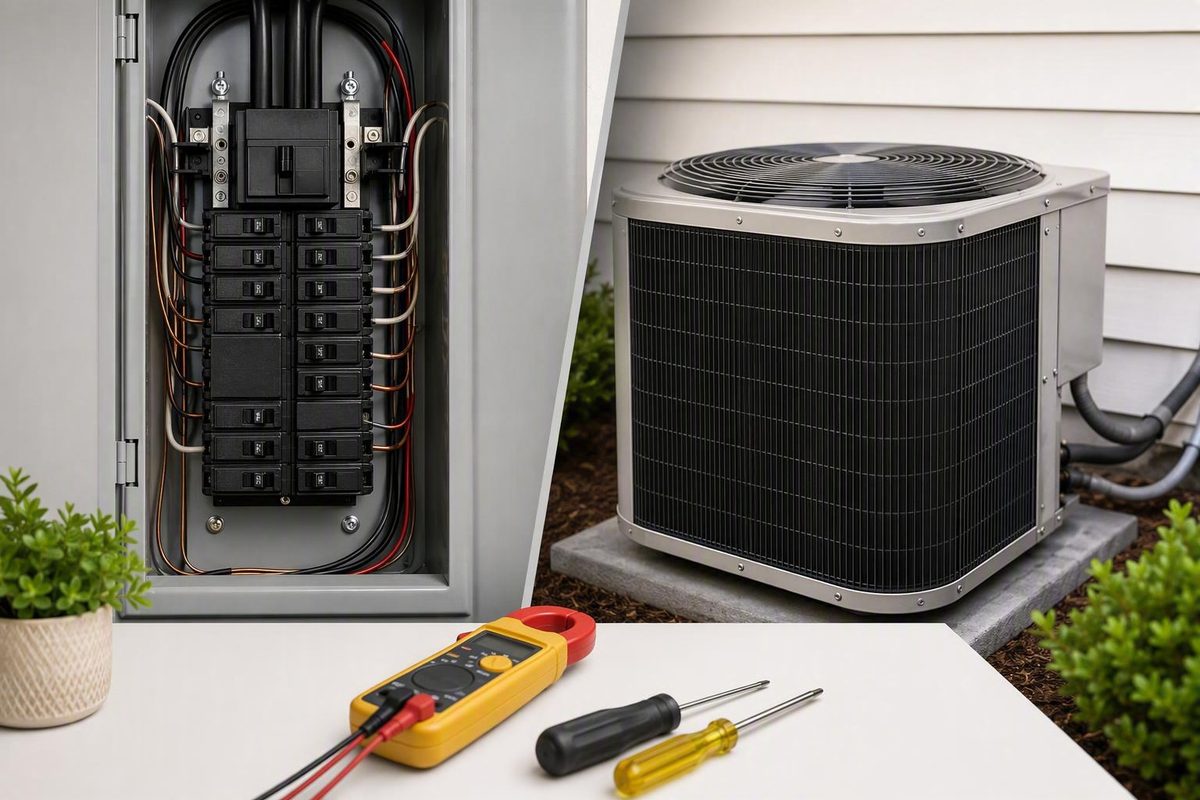
A breaker that trips when the air conditioner runs is telling you something specific — the trick is that when it trips matters more than the fact that it trips. This page is built as four acts: watch a compressor start in slow motion, play with the actual trip curve your breaker enforces, break a simulated system three different ways, then diagnose your own.
Scroll to scrub the film, drag the curve, sabotage the sandbox — everything below is live. The full decision table is at the end if you’d rather read the logic straight.
When the thermostat calls, the compressor draws up to five times its running current until the rotor spins up. The breaker's job is to tell that normal violence apart from a real fault — and it decides on heat and time. Scroll through those three seconds, slowed down.
Before anything else: resetting a breaker once is fine. If it trips again immediately, leave it off. Never hold a breaker closed, never open the disconnect or condenser with power on, and treat a burning smell or a scorched panel as a stop-everything sign.
A breaker tolerates big current briefly and small overloads for minutes; the boundary is its trip curve. Drag the breaker size and your compressor's inrush and watch where the start surge lands. Everything on the failure table below is just a region of this one picture. Curve shown is a typical residential thermal-magnetic shape, for illustration.
This is a small running model of the circuit: panel, disconnect, condenser. Arm a fault, start a cooling call, and watch the telemetry — each failure has a different fingerprint, and it is the fingerprint that tells you what to fix.
Telemetry
Objectives
The full decision table — the same logic the diagnostic walks, in one view.
| When It Trips | Other Clue | Most Likely Cause | Safe Next Step |
|---|---|---|---|
| Instantly, the moment the AC starts | Breaker will not hold even once | Shorted compressor or ground fault in the outdoor unit wiring | Leave the breaker off and call a technician — repeated resets into a short damage the compressor windings further |
| Instantly at start | Outdoor fan hums but does not spin | Failed start/run capacitor forcing locked-rotor current | Cut power, then have the capacitor tested; it is a cheap part but stores a dangerous charge |
| After 5–20 minutes of running | Outdoor coil visibly dirty, airflow weak | Overheating from a clogged condenser coil or blocked airflow | With power off, clear debris and gently rinse the coil, replace the filter, then retest on a mild day |
| After minutes, mostly on the hottest afternoons | Unit is older, breaker warm to the touch | Aging breaker derating under heat, or high head pressure at peak load | Have an electrician meter the actual draw against the breaker rating before replacing anything |
| Randomly, even when the AC is idle | Other loads share the circuit | Wiring fault or an overloaded shared circuit, not the AC itself | Map what else is on the breaker; an AC condenser should have a dedicated circuit sized to its nameplate |
| Only when a second appliance kicks in | Lights dim at compressor start | Undersized circuit or loose lug connection heating under load | An electrician should torque-check the panel connections — loose lugs are a fire risk, not a DIY job |
Background reading: why AC breakers trip, in depth · how long capacitors last · signs your AC needs service.