
Cooling
Why Air Is Moving but Your Home Is Still Hot
Turn cooling off for visible ice, repeated breaker trips, smoke, sparks, a burning or electrical odor, loud persistent humming or abnormal outdoor-unit behavior.
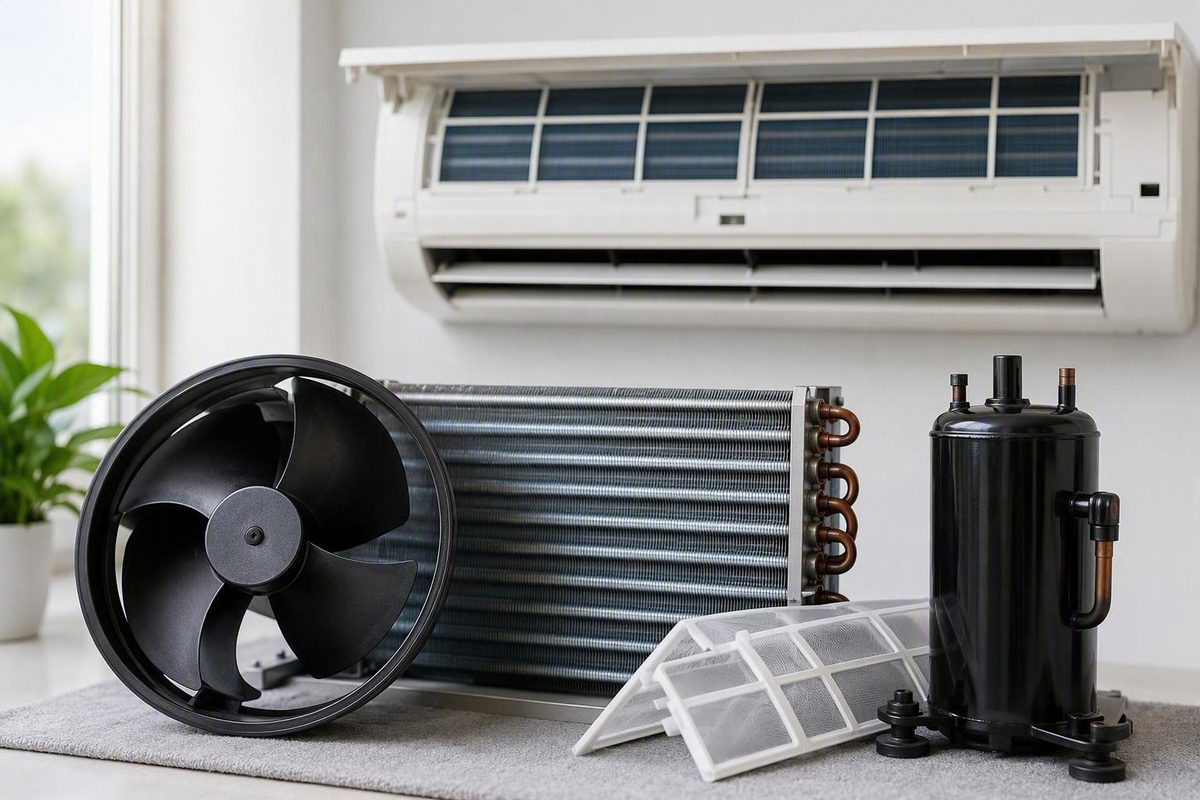
An air conditioner fan running but not cooling is not necessarily a contradiction. Moving indoor air and removing heat are separate functions. The indoor blower can circulate room-temperature air even when the outdoor equipment or refrigeration cycle is not operating.
Do not guess which component has failed. Start with a few low-risk checks and record three things: airflow strength, airflow temperature, and outdoor-unit behavior. Those observations may reveal a simple setting or airflow problem—and help you recognize when further troubleshooting would be unsafe.
Start here: the safe five-minute cooling checklist
Stop cooling and seek prompt professional service if you notice smoke, sparks, a burning or electrical odor, exposed electrical damage, or a breaker that trips repeatedly. Do not keep restarting the equipment to see whether the warning returns. These are urgent electrical warning signs, not ordinary cooling problems, as outlined in Sensibo’s air-conditioner troubleshooting guidance.
Also stop cooling if you see ice. Heavy or recurring ice, significant water, or other abnormal outdoor-unit behavior warrants professional diagnosis rather than continued testing.
If none of those conditions is present, work through these checks:
-
Confirm the operating mode. Set the thermostat or ductless remote to Cool, not Fan, Heat, Dry, or another mode. Set the target temperature below the current room temperature so the system has a reason to call for cooling.
-
Set the fan to Auto. A fan set to On may run continuously, including when the compressor is not actively cooling. The system can therefore sound operational while circulating air at or near room temperature.
-
Check the thermostat or remote batteries. Replace them if the display is blank, dim, intermittent, or apparently failing to transmit commands. A working display does not guarantee that every command is reaching the equipment, but batteries are an easy variable to eliminate.
-
Inspect the accessible air filter. Do not open sealed equipment or remove service panels. If the filter is visibly loaded with dust or debris, replace it with the correct size and type. Follow the equipment instructions for shutting off power, orienting the airflow arrow, and installing the filter. Restricted airflow can impair cooling and contribute to evaporator icing, according to Trane’s guidance on an AC not blowing cold air.
-
Check supply registers and return grilles. Make sure they are open and not covered by furniture, curtains, boxes, rugs, or other objects. Supply registers deliver air; return grilles draw it back toward the system.
-
Observe the outdoor unit from a safe distance. Without touching it, note whether it is: - running steadily; - completely silent; - humming or clicking; - starting and stopping repeatedly; or - operating while its fan remains stationary.
-
Look for visible ice. Check accessible areas around the indoor equipment and exposed refrigerant tubing. Do not remove covers to search for ice.
-
Look for loose exterior debris. Leaves, grass clippings, and vegetation can obstruct airflow around an outdoor unit. Do not open panels, reach through the guard, touch wiring, bend fins, or begin an invasive cleaning procedure.
These observations narrow the troubleshooting path. They do not confirm that a capacitor, compressor, motor, control board, refrigerant charge, or any other specific component has failed.
First determine what is actually running
A typical central split air conditioner or ducted heat pump has indoor and outdoor sections that work together:
- The thermostat calls for cooling.
- The indoor blower draws household air through the return.
- That air moves across the indoor evaporator coil and back through the supply ducts.
- Refrigerant transports absorbed heat toward the outdoor equipment.
- The outdoor unit helps release that heat outside.
The blower may therefore keep moving air even if the outdoor unit, compressor, or a control has stopped. Hearing a fan does not establish that the complete cooling cycle is operating, as explained in HomeWorks Energy’s overview of fan-without-cooling symptoms.
Thermostat settings create another important distinction:
- Fan or fan-only mode commands airflow without active cooling.
- Cool with fan Auto calls for cooling when the room is above the setpoint and normally runs the blower as needed.
- Cool with fan On may keep the blower operating between active cooling cycles.
The outdoor fan is also only one part of the outdoor assembly. Seeing it spin does not prove that the compressor is working correctly, refrigerant is circulating as intended, or enough heat is being released outside.
Organize the next steps around three observations:
- Airflow strength: strong, weak, uneven, or absent.
- Air temperature: warm, room temperature, mildly cool, or distinctly cool.
- Outdoor-unit behavior: steady operation, silence, abnormal noise, repeated cycling, or a stationary fan.
This article applies most directly to central split air conditioners and ducted heat pumps. Ductless systems use the same broad distinction between indoor airflow and outdoor cooling, but they do not have central supply registers, return grilles, or the same filter arrangement.
Heat pumps and ductless systems may also use different controls, indicators, reset procedures, and washable-filter instructions. Consult the model-specific manual before resetting power, removing a filter, or cleaning equipment.
Use the vent symptom to choose the right path
“Not cooling” can describe several different symptoms. Identify yours before deciding whether the problem appears related to airflow, system controls, or the cooling cycle.
Strong airflow that feels warm
If plenty of air comes from the vents but it is warm or close to room temperature, start with four questions:
- Is the mode set to Cool?
- Is the setpoint below the current room temperature?
- Is the fan set to Auto?
- Does the outdoor unit start when the cooling call begins?
Strong but warm airflow can occur when the blower works while the refrigeration cycle is inactive or ineffective. Possible causes include an outdoor-unit power or control fault, obstructed outdoor airflow, a refrigerant problem, a compressor fault, or—on a heat pump—a mode-control or reversing-valve problem.
Those are possibilities, not diagnoses. Vent temperature and fan noise alone cannot identify the failed part.
Weak airflow
If airflow is weak at most or all vents, inspect:
- the accessible filter;
- return grilles;
- supply registers; and
- visible equipment surfaces or refrigerant tubing for ice.
A loaded or unsuitable filter, blocked return, duct restriction, blower problem, dirty indoor coil, or frozen evaporator may reduce airflow. Ice can make an initial restriction progressively worse as it accumulates.
No airflow
No airflow is different from the usual “fan running but not cooling” symptom. A sound interpreted as the indoor fan may actually come from the outdoor fan, compressor, condensate pump, or another component.
If the thermostat calls for cooling but no air emerges from any vent, the indoor blower may not be operating. A motor, capacitor, control, safety switch, or power problem could be involved. These possibilities require testing rather than assumptions; the distinction among warm air, weak airflow, no airflow, and icing is summarized in Filterbuy’s symptom-based troubleshooting guide.
Some rooms cool but others do not
Uneven cooling may point toward:
- a closed or blocked register;
- damaged, disconnected, restricted, or poorly balanced ductwork;
- differences in sun exposure and room heat gain;
- air leakage or insulation differences; or
- insufficient airflow to part of the house.
Do not try to force air into one area by closing many other registers or changing internal dampers without a system-specific assessment.
Document which rooms are affected, when they become uncomfortable, and whether the pattern is new or longstanding.
The system runs continuously with mildly cool air
Mildly cool air and long runtime do not automatically indicate a failed component. Record the outdoor weather, indoor temperature, thermostat setpoint, approximate runtime, and which rooms are falling behind.
During exceptional heat, cooling performance may be affected by building load, air leakage, weak insulation, duct leakage, equipment condition, or improper sizing. A gradual decline also differs from an abrupt overnight loss of cooling.
Warm, weak, uneven, and absent airflow are symptom categories. None proves that a particular component has failed.
Check the filter, vents, and returns for restricted airflow
The filter is a sensible early check because it is accessible in many homes and directly affects airflow. As debris accumulates, resistance increases. Airflow across the indoor coil may fall, cooling performance may decline, and evaporator icing may develop.
A useful filter inspection involves more than asking whether the filter looks dirty:
- Note the installation or replacement date.
- Look for visible loading across the entire surface.
- Confirm that the filter fits its intended cabinet without large gaps or crushing.
- Check that its airflow arrow points in the direction specified for the system.
- Compare blower noise and vent airflow with what is normal for the home.
- Follow the equipment instructions before removing or replacing it.
Do not apply one replacement interval to every filter and home. Filter depth and design, system runtime, pets, renovation dust, household conditions, and manufacturer requirements all affect service life. HVAC Lens provides a fuller explanation of these variables in its guide to when an HVAC filter needs replacement.
A clean or recently replaced filter does not eliminate airflow trouble. Other possibilities include:
- a blocked return;
- closed or obstructed supply registers;
- a filter with incorrect dimensions;
- a filter that is unsuitable for the equipment;
- dirt on an inaccessible indoor coil;
- a duct obstruction or substantial leak;
- an internal damper problem; or
- reduced blower performance.
Do not compensate by closing many registers, altering dampers inside the equipment, or installing an arbitrary filter without checking compatibility. The correct filter must fit the cabinet and the equipment requirements.
After replacing a visibly loaded filter, note whether airflow changes. Check several rooms rather than only the nearest vent.
If airflow remains weak everywhere, report that to the technician. If only certain rooms remain weak, identify them and explain whether the condition began with the current cooling problem or has existed for years.
If you see ice, stop cooling before troubleshooting further
Stop cooling whenever visible ice is present. Do not reserve shutdown only for severe ice. Heavy or recurring ice adds urgency, but even a small visible amount indicates that the system should not continue cooling while frozen.
Ice around the evaporator area or refrigerant tubing can accompany restricted airflow, a blower problem, a dirty coil, or a refrigeration-cycle fault. Its appearance may provide useful evidence, but ice alone does not identify the cause.
Keep the system fully off if water is approaching electrical parts or if there are smoke, odor, wiring, or breaker warnings. Otherwise, follow the model-specific manual for shutdown and thawing. Instructions vary: some equipment guidance may permit fan-only operation, while other circumstances call for a complete shutdown. Do not assume one procedure applies to every central system, heat pump, or ductless unit.
There is also no universal thaw time. The ice must melt completely before any restart permitted by the manufacturer.
Never:
- chip, scrape, or strike the ice;
- strike or bend refrigerant tubing;
- use a heat gun, hair dryer, flame, or other forced heat; or
- remove service panels to accelerate thawing.
Manufacturer guidance recommends shutting down frozen equipment and obtaining professional help when the underlying problem is unresolved; see Carrier’s guide to an AC not blowing cold air.
While the equipment is safely shut down, limit your inspection to basic observations:
- Check the accessible filter.
- Confirm that return grilles are unobstructed.
- Confirm that supply registers are open.
- Note where the ice appeared.
- Photograph it from a safe position before it melts.
- Watch for water moving toward electrical equipment.
Thawing may temporarily restore airflow, but it does not repair the condition that caused the freezing. Replacing a severely loaded filter may remove one obvious restriction, yet the equipment still needs to be watched for renewed ice or weak airflow.
Arrange professional diagnosis if the ice returns, the filter and vents appear normal, cooling remains poor after complete thawing, or water threatens electrical components. Leave the system off if the icing is heavy or recurrent.
Observe the outdoor unit without opening it
The outdoor condenser helps move absorbed heat out of the home. It needs unobstructed airflow around and through the outdoor coil to do that effectively.
Follow the model instructions for shutting off the equipment before removing loose, accessible leaves, grass, or vegetation from the immediate area. Do not remove panels, insert tools or hands through the guard, bend coil fins, or touch wiring.
Avoid generic coil-rinsing instructions. Safe access and cleaning procedures differ by model, and some coil service should be performed by a technician. Trane treats visible outdoor obstructions as an initial homeowner check while directing unresolved or inaccessible problems to professional service in its air-conditioner troubleshooting guide.
What you hear and see can help classify the problem.
The outdoor unit is silent
If the indoor blower runs but the outdoor unit remains silent during a cooling call, possible explanations include:
- loss of power to the outdoor equipment;
- a control interruption;
- an activated safety switch;
- a contactor or capacitor problem;
- a wiring fault; or
- another electrical or mechanical failure.
Some systems have condensate safety controls. If water rises in a drain pan or reservoir, a float switch may interrupt cooling while allowing the indoor fan to continue. This feature is system-dependent.
The unit hums or clicks but does not start normally
Humming or clicking is an escalation clue, not a component diagnosis. Several electrical and mechanical faults can produce similar sounds.
Stop the system and arrange service if the noise is loud or persistent, especially if it occurs with heat, smoke, an electrical odor, repeated cycling, or breaker operation. Do not open the outdoor unit to identify the source.
The outdoor fan is stationary
A motor, capacitor, control, power, wiring, or other fault may be involved, and internal testing is required to distinguish among them.
If the fan remains stationary during a cooling call, stop the system and seek professional diagnosis. An inoperative outdoor fan is among the conditions that service guidance identifies as requiring professional attention.
The outdoor fan is running
A spinning outdoor fan does not prove that the compressor is running or moving refrigerant correctly. The fan and compressor are separate loads.
Record that the outdoor fan runs, but do not turn that observation into a compressor diagnosis.
A breaker appears tripped
Limit your inspection to the visible breaker position and the instructions for your specific equipment. Do not open equipment panels or repeatedly cycle electrical power.
If the manufacturer permits a one-time reset and the breaker trips again, leave the system off and call a professional. Repeatedly restoring power can expose the equipment to an unresolved electrical fault; Air Today’s split-system troubleshooting guidance likewise limits a breaker reset to one attempt before service is needed.
Know which possible causes require professional testing
After checking thermostat settings, the accessible filter, open vents, visible ice, and loose exterior debris, the remaining possibilities often require instruments and access to hazardous components.
Technician-level causes include:
- a low or incorrect refrigerant charge;
- a refrigerant leak;
- failed capacitors or contactors;
- a compressor fault;
- indoor-blower or outdoor-fan motor problems;
- damaged wiring;
- thermostat, sensor, control-board, or communication faults;
- substantial duct defects;
- dirty or inaccessible coils; and
- a heat-pump reversing-valve or mode-control problem.
Refrigerant is not normally consumed like fuel. If a system is low, the technician should determine whether there is leakage, an incorrect initial charge, or another charge-related problem instead of treating refrigerant as a routine top-off. Pruett Air Conditioning’s cooling-failure guide likewise places leak diagnosis and refrigerant work in the professional-service category.
Symptoms overlap too much to identify these failures remotely:
- Warm air can result from a control setting, inactive compressor, refrigerant fault, outdoor airflow problem, or heat-pump mode issue.
- Ice can result from restricted airflow or refrigeration-cycle trouble.
- Humming and clicking can have multiple electrical or mechanical sources.
- A running outdoor fan says little about compressor performance.
- A silent outdoor unit does not distinguish among power, control, safety, and component failures.
Do not:
- bypass thermostat wires;
- test or attempt to discharge capacitors;
- open electrical service panels;
- probe wiring or contactors;
- repeatedly reset a breaker;
- handle refrigerant; or
- attempt compressor, motor, control-board, contactor, or reversing-valve work.
Internal electrical, refrigerant, compressor, motor, and control work should remain with a qualified professional. These tasks involve electrical, mechanical, and equipment-specific hazards that cannot be managed from the fan symptom alone.
Avoid deciding between repair and replacement based only on equipment age. A useful professional discussion should consider:
- the confirmed fault;
- the complete repair scope and price;
- remaining warranty coverage;
- equipment condition and service history;
- expected reliability after repair;
- operating efficiency;
- available refrigerant and component support;
- whether the equipment is properly sized and installed; and
- how well it fits the home’s current cooling load.
Age is context, not a diagnosis or an automatic replacement rule.
Decide whether to monitor, shut down, or call—and prepare useful notes
If correcting the thermostat mode, lowering the setpoint, selecting fan Auto, replacing a visibly dirty filter, opening blocked vents, and removing loose exterior debris do not restore cooling, call for professional diagnosis. Continued experimentation is unlikely to distinguish an airflow, electrical, control, or refrigerant fault safely.
Leave the system off and seek prompt service for:
- repeated breaker trips;
- smoke or sparks;
- burning or electrical odors;
- exposed electrical damage;
- substantial water near electrical parts;
- loud or persistent abnormal humming;
- an outdoor fan that remains stationary during a cooling call; or
- visible ice, especially when it is heavy or recurring.
These conditions can involve electrical, mechanical, water, or freeze-related hazards. They should not be tested repeatedly.
Consider how the problem began:
- Sudden loss of cooling: A power, control, electrical, mechanical, or refrigerant-side fault may be involved, although the symptom cannot identify which one.
- Gradual underperformance: Accumulating dirt, declining airflow, duct leakage, equipment condition, or a developing fault may contribute.
- Failure only during extreme weather: Building load, air leakage, insulation, duct performance, equipment sizing, and system condition may all matter.
- One or two rooms affected: Local registers, ducts, sun exposure, or room-envelope differences deserve attention.
- The whole home affected: A system-wide airflow or cooling-cycle problem becomes more plausible.
Before the service visit, write down:
- thermostat mode and setpoint;
- fan setting;
- thermostat or remote battery condition;
- filter type, condition, orientation, and replacement date;
- airflow strength in each room;
- whether the vent air feels warm, room temperature, mildly cool, or cold;
- indoor-unit and outdoor-unit activity;
- whether the outdoor fan runs;
- the location and extent of visible ice;
- any water or drain-pan overflow;
- humming, clicking, buzzing, grinding, or other sounds;
- unusual odors;
- breaker position and whether it tripped again after a permitted reset;
- outdoor weather and indoor temperature;
- whether the problem began suddenly or gradually;
- approximate cooling-cycle duration; and
- whether performance changes by time of day.
Take photos of visible ice, water, the thermostat display, filter condition, and outdoor obstructions when you can do so without approaching electrical damage or opening equipment. A photo captured before ice melts can be particularly useful.
Ask the technician:
- What measurements support the diagnosis?
- Is the problem primarily on the airflow, electrical, control, duct, or refrigerant side?
- What caused the failed condition?
- Does the proposed repair address that underlying cause?
- Is further testing needed after the repair?
- Are installation, sizing, or airflow conditions likely to make the problem recur?
HVAC Lens helps homeowners observe and document residential HVAC behavior so maintenance decisions and contractor conversations are clearer. Its information does not provide a remote diagnosis or replace advice from a qualified professional.
The decision rule is simple: verify Cool, a setpoint below room temperature, and fan Auto; inspect the accessible filter, vents, visible ice, and outdoor-unit behavior; then stop. If cooling does not return—or if there is visible ice, a repeated breaker trip, an electrical warning, significant water, or abnormal outdoor-unit behavior—leave hazardous testing to a qualified HVAC professional. Your most useful next step is a precise symptom record, not a guessed component diagnosis.
Frequently asked questions
Why is the fan blowing when the thermostat is set to Cool but the air is not cold?
The indoor blower may be operating while the outdoor cooling equipment or compressor is not. The fan may also be set to On, allowing it to circulate air between active cooling cycles.
Other possibilities include restricted airflow, frozen equipment, a control interruption, an outdoor-unit fault, or a refrigerant-cycle problem. Check that the setpoint is below room temperature, select fan Auto, and observe the outdoor unit without touching it. Do not assume that the sound of a fan means the complete cooling system is operating.
Should the thermostat fan be set to Auto or On for cooling?
For normal cooling troubleshooting, use Auto. That setting makes it easier to determine whether blower operation corresponds with an active cooling call.
With the fan set to On, the blower may continue circulating room-temperature air after active cooling stops. Continuous fan operation may suit some systems or household preferences, but it can make this particular symptom harder to interpret.
Should I turn off an air conditioner that is running but not cooling?
Turn cooling off if there is visible ice, a repeated breaker trip, smoke, sparks, a burning or electrical odor, substantial water near electrical equipment, exposed electrical damage, loud persistent humming, or abnormal outdoor-unit behavior. Do not keep restarting the system to see whether the condition returns; manufacturer guidance recommends shutdown and professional diagnosis when frozen equipment or unresolved cooling faults are present.
If there are no warning signs, complete only the brief thermostat, filter, vent, and exterior-debris checks. If cooling still does not return, arrange service instead of allowing the system to run indefinitely.
Does a running outdoor fan mean the compressor is working?
No. The outdoor fan and compressor are separate components. The fan can spin even if the compressor is not starting, is operating incorrectly, or the refrigeration cycle is not moving heat effectively.
Outdoor-fan movement alone cannot provide that diagnosis.
Can a clean filter rule out an airflow problem?
No. A clean or recently replaced filter does not eliminate blocked returns, closed vents, dirty coils, duct restrictions, blower trouble, incorrect filter fit, or an unsuitable filter.
Record whether airflow is weak throughout the home or only in certain rooms. If the problem began after installing a new filter, verify its dimensions, orientation, and compatibility rather than assuming that “new” means correct.