
Cooling
What a Repeated AC Breaker Trip Is Telling You
If there are no danger signs, make no more than one reset attempt. If it trips again, leave the cooling system and breaker off pending service.
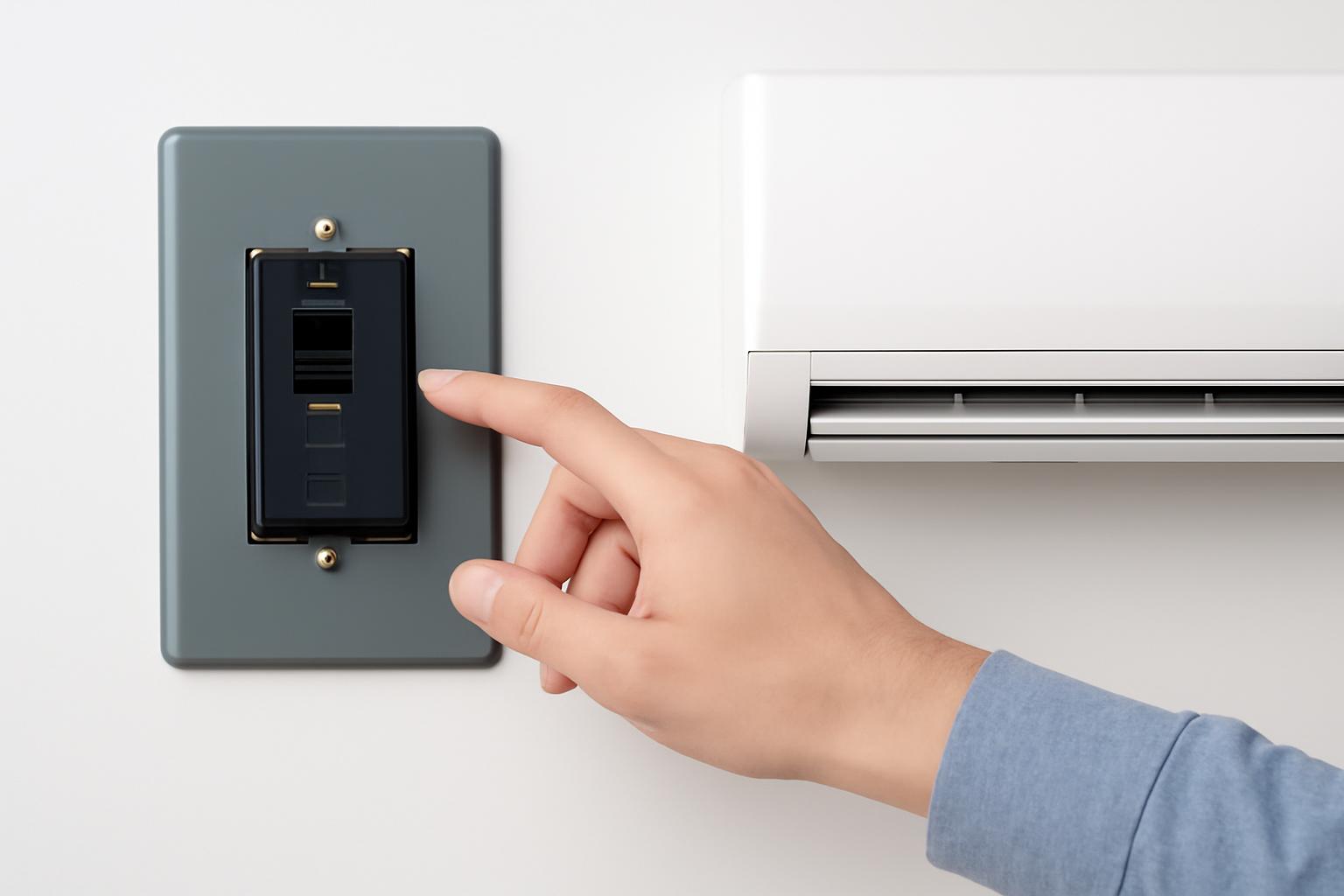
What to do immediately when the AC breaker trips
Immediate action
- Set the thermostat to OFF so the air conditioner does not keep attempting to restart.
- If you notice smoke, a burning odor, sparks, popping, visible scorching, damaged wiring, or loud abnormal buzzing, stay clear and obtain urgent professional help.
- Do not keep resetting the breaker. If there are no danger signs, make no more than one reset attempt. If it trips again, leave the cooling system and breaker off pending service. Beacon Services gives the same basic shutdown and one-reset guidance.
A circuit breaker is a protective device. It interrupts power when excessive current or an electrical fault creates an unsafe condition for the circuit. One isolated trip may follow a temporary event, but an air conditioner circuit breaker that keeps tripping is warning you that the underlying condition has not been resolved.
Start at the thermostat, not the electrical panel. Switching the thermostat to OFF prevents another cooling call while you assess what happened. Smoke, heat-related odors, unusual sounds, sparking, or visible panel damage are sufficient reasons to stay away and request urgent help.
If there are no danger signs, general contractor guidance supports no more than one reset attempt. A tripped handle may sit between ON and OFF; depending on the panel, it may need to be moved fully to OFF before it can be returned to ON. If the breaker trips again immediately or within minutes, set the thermostat to OFF, leave the breaker off, and arrange service rather than repeating the cycle. United Air Temp describes the fully-OFF reset position and advises stopping if the breaker trips again.
Do not attempt even one reset when danger signs are present. Keep the system off and seek urgent professional assistance if you observe:
- Smoke or a burning electrical odor
- Sparking or popping
- Visible scorch marks
- Exposed, melted, frayed, or otherwise damaged wiring
- Loud or abnormal buzzing from the equipment or panel
- Damage centered on the breaker, panel, disconnect, or nearby wiring
This guide principally addresses central split air conditioners with separate indoor and outdoor equipment. Follow model-specific instructions where available.
This is general homeowner information, not an equipment-specific procedure or a substitute for licensed professional diagnosis. Air conditioners, panels, disconnects, and circuit arrangements vary, so major repairs or changes should be confirmed with an appropriately qualified professional, consistent with HVAC Lens’s informational-only scope.
Why a breaker trips—and why repeated resetting is unsafe
A breaker is intended to interrupt overcurrent before branch-circuit conductors remain exposed to unsafe heating. Its relationship to equipment protection depends on the complete installation and the equipment’s requirements. It is not merely an inconvenience that happens to stop the AC.
The possible electrical patterns fall into three broad categories:
- Overload: The equipment or circuit experiences sustained current beyond the conditions it is intended to carry. A struggling motor, mechanical load, impaired heat rejection, or deteriorating component may contribute.
- Short circuit: Current takes an unintended low-resistance path instead of following its designed route. Damaged insulation, shorted motor windings, or wiring faults are among the possibilities.
- Ground fault: Current escapes to a grounded path, potentially through a failed component, damaged conductor, or metal enclosure.
These definitions help explain what a professional may investigate; they are not homeowner diagnoses. A tripped breaker alone does not reveal which electrical pattern occurred or where the problem originated. Contractor troubleshooting guidance identifies overloads, short circuits, and ground faults as distinct possibilities that require further evaluation. Thomas & Galbraith provides a high-level explanation of these fault categories.
An air conditioner’s compressor normally has a brief increase in electrical demand when it starts. The equipment and its protective circuit should accommodate normal startup and operation. A startup trip therefore should not be dismissed as “the compressor just uses a lot of power.” The equipment, wiring, supply conditions, connections, or breaker response needs to be measured.
Breaker behavior cannot be reduced to one universal current number. The magnitude and duration of the current, the breaker’s characteristics, the condition of conductors and connections, and the equipment requirements can all affect what happens. Avoid rules claiming that every breaker must trip at one exact amperage or after one exact interval.
Repeated resetting is unsafe because each reset re-energizes a circuit that may still contain an overload, short, ground fault, loose connection, damaged conductor, failing motor, or hard-starting compressor. It also permits another startup attempt before the fault has been identified. General HVAC guidance therefore recommends finding the cause rather than continuing to reset a repeatedly tripping breaker. Ragsdale’s troubleshooting guide warns against repeatedly energizing the unresolved circuit.
The breaker is the warning mechanism, but it is not automatically defective. Possible contributors include:
- Indoor or outdoor AC equipment
- Motors, capacitors, contactors, controls, or the compressor
- Internal or external wiring
- Loose, corroded, or damaged connections
- The disconnect and branch circuit
- The electrical panel
- The breaker itself
Replacing the breaker simply because it trips can leave an equipment or wiring fault in place. Conversely, assuming the AC must be defective can overlook a breaker, connection, conductor, disconnect, or panel problem. A proper diagnosis considers the full path supplying the equipment.
Use trip timing as a clue, not a diagnosis
Record what happened before power was cycled. Trip timing and accompanying symptoms can help a professional decide where to begin testing, but neither an immediate nor a delayed trip uniquely identifies a component.
The following guide is non-diagnostic:
| When the trip occurs | Possible areas a professional may consider | Symptoms worth recording |
|---|---|---|
| Immediately when cooling starts | Starting-component trouble, a struggling or shorted motor, compressor trouble, damaged wiring, a short circuit, a ground fault, or abnormal breaker behavior | Humming, clicking, struggling, stationary outdoor fan, indoor/outdoor unit mismatch, no cooling, buzzing, odor, or visible damage |
| Shortly after startup | Sustained overload, deteriorating motor operation, poor heat rejection, restricted airflow, loose connections, or equipment overheating | Weak cooling, declining airflow, humming, fan stopping, outdoor unit shutting down while the indoor unit continues, ice, or unusual odor |
| After extended operation or during hot conditions | An airflow or heat-transfer weakness exposed by demanding operation, deteriorating components, connection heating, fan trouble, or sustained abnormal electrical load | Outdoor conditions, runtime before the trip, cooling strength, vent airflow, outdoor-fan behavior, ice, buzzing, or repeated cycling |
| While the thermostat is off or the AC is not attempting to run | Breaker, branch-circuit, disconnect, panel, wiring, or another electrical fault; equipment-side faults may still need to be excluded | Whether the breaker remained set after the original event, panel-centered noise or odor, recent electrical work, visible damage, and the labeled circuit involved |
If it trips immediately at startup
An immediate trip draws attention to the electrical and mechanical events occurring when the compressor or fan starts. Possible concerns include a weak starting component, a motor or compressor drawing abnormal current, damaged wiring, a short circuit, or current leaking to ground.
Humming or struggling is useful to report, but it does not prove that a capacitor or compressor has failed. A stationary fan can reflect a motor, capacitor, control, obstruction, wiring, or power-supply problem. A rapid trip can also involve the breaker or branch circuit rather than the air conditioner alone.
If it runs briefly and then trips
A trip after several minutes may lead a technician to consider conditions that build during operation: sustained abnormal load, a motor heating as it runs, a loose connection, deteriorating heat rejection, restricted airflow, or a component that fails after warming.
Record the approximate runtime rather than repeatedly testing the system. “It tripped after about 8 to 10 minutes, following weaker airflow and buzzing from the outdoor unit” is more useful than “it sometimes trips.” Do not run extra cycles merely to make the timing more precise.
If it happens mainly in extreme heat
Demanding outdoor conditions can expose an existing weakness because the system may run longer and reject heat under more difficult conditions. That does not establish that hot weather alone caused the trip. An obstructed outdoor unit, dirty coil, weak fan, deteriorating electrical component, airflow restriction, or connection problem may become apparent only under heavier operation.
Record the approximate outdoor conditions, time of day, runtime, and whether cooling weakened first. These observations can reveal a repeatable operating pattern without claiming a diagnosis.
If it trips while cooling is off
A trip while the thermostat is OFF deserves particular attention to the branch circuit, disconnect, panel, wiring, and breaker. The same applies when the breaker will not remain set with cooling off or when odors, buzzing, scorching, or visible damage appear centered on the panel.
Do not repeatedly test whether the breaker will hold. Leave it off and contact a qualified professional. Depending on where the symptoms appear, that may be an electrician, an HVAC technician, or both. Startup behavior, fan operation, wiring, capacitor, compressor, and breaker conditions can produce overlapping symptoms, so timing remains only a clue.
Airflow and heat-rejection problems that can increase system strain
Airflow and heat-transfer problems have an indirect relationship to breaker trips. They do not necessarily create an electrical short. Instead, they can make equipment operate under greater strain, interfere with cooling or heat rejection, and contribute to abnormal temperature or electrical-load conditions.
Finding a dirty filter or blocked outdoor unit does not prove that it caused the trip. It also does not rule out a capacitor, motor, compressor, wiring, connection, branch-circuit, or breaker fault.
A severely clogged air filter
A filter loaded with dust can restrict air moving through the indoor system. Depending on the equipment and the severity of the restriction, that can reduce cooling performance, contribute to icing, or place abnormal demands on system operation.
If the filter is visibly dirty, replace it with the correct size and a compatible type. Confirm the airflow direction shown on the filter or filter rack.
Replacing a dirty filter is sensible maintenance, but it is not permission to continue resetting the breaker. If the circuit has already tripped again, leave the system off and arrange diagnosis even after correcting the filter.
Blocked return grilles or supply vents
Furniture, rugs, boxes, curtains, or closed covers can obstruct accessible return grilles and supply vents. Restore normal clearance without dismantling ductwork or equipment.
Do not assume that one closed supply register caused the trip. System airflow depends on the complete duct and equipment arrangement. The homeowner-safe goal is to remove obvious accidental obstructions, not to rebalance or modify the system.
Debris or vegetation around the outdoor unit
Leaves, grass clippings, stored objects, and vegetation can interfere with airflow around the condenser. With cooling switched off, remove only loose exterior debris that is accessible without opening the cabinet, reaching through a guard, or touching wiring or internal components.
Advice about homeowner condenser cleaning varies. The conservative approach is to inspect the exterior and clear obvious surrounding obstructions only. Do not remove panels, use a pressure washer, bend coil fins, contact electrical parts, or assume that one cleaning method is appropriate for every model.
Dirty condenser coils
The outdoor coil releases heat collected from the home. Heavy contamination may impair that process and increase system strain. Its condition still needs to be assessed in context: surface dirt does not prove why the breaker opened, and a clean-looking coil does not eliminate an electrical fault.
If cleaning requires cabinet access, chemical products, electrical-component protection, or manipulation of coil surfaces, use an HVAC professional. Contractor guidance lists filters, condenser contamination, electrical connections, fan faults, capacitors, and compressors as separate possible contributors rather than interchangeable explanations. Coolray discusses these overlapping airflow, electrical, and mechanical possibilities.
A nonworking condenser fan
The outdoor fan moves air through the condenser coil. If the unit hums while the fan remains stationary, the fan starts and stops abnormally, or the outdoor equipment shuts down while the indoor blower continues, leave the system off.
Do not push the fan blade, reach through the guard, or attempt to help it start. A stationary fan can involve the motor, capacitor, controls, wiring, obstruction, or another failure. Distinguishing among them requires access and measurements.
Visible ice
Ice on accessible refrigerant lines or equipment surfaces is a clue, not a diagnosis. Restricted airflow is one possibility, but coil conditions, controls, system performance, and other faults may also be involved.
Turn cooling off and allow the ice to thaw naturally. Do not chip, scrape, or heat it. Arrange diagnosis, particularly when ice appears alongside weak cooling, low airflow, fan trouble, or a breaker trip. Beacon Services also advises leaving visible ice to thaw without chipping or scraping it.
Component and electrical faults a professional may find
The following possibilities are organized by component, not by likelihood. The available evidence does not establish which cause is most common across different homes, climates, and systems.
Capacitors
A capacitor assists motor or compressor operation. If it weakens or fails, a motor may struggle to start or run, potentially producing humming and abnormal current. A breaker trip does not prove capacitor failure, and capacitor failure does not automatically prove compressor damage.
Homeowners should not open a compartment to inspect, test, or discharge a capacitor. Capacitors can retain a hazardous electrical charge after power is disconnected, so this work belongs to a qualified technician. Mr. HVAC’s diagnostic overview reserves capacitor and current testing for professionals.
Outdoor fan and indoor blower motors
Possible observations include:
- Humming without normal rotation
- Weak indoor airflow
- A stationary outdoor fan
- A fan that starts and stops
- One part of the system running while the other stops
- A trip after several minutes of operation
These signs overlap with capacitor, control, airflow, compressor, wiring, and power-supply problems. Current measurements, component testing, and inspection of the operating sequence are needed before attributing the trip to a motor.
Compressor
A hard-starting, mechanically locked, electrically shorted, or grounded compressor can produce abnormal current and may trip the breaker at startup or during operation. An immediate trip does not automatically mean the compressor is grounded, and a delayed trip does not exclude compressor trouble.
Do not disconnect compressor leads or test its terminals yourself.
Contactors, controls, and internal wiring
Contact deterioration, chattering, or an internal fault can interfere with operation. Loose or corroded connections may generate heat, while damaged insulation or shorted wiring may create unintended current paths.
A professional inspection may cover the contactor, terminals, disconnect, wire insulation, control circuit, conductors, and signs of heat or arcing. These checks require equipment access; homeowners should not remove access panels or handle wiring.
The circuit breaker and branch circuit
A worn or malfunctioning breaker can trip incorrectly or fail to remain set under normal operating conditions. It remains one possible contributor, but it should not be treated as the default explanation.
Before replacing a breaker, a qualified professional should evaluate equipment current, conductor and connection condition, breaker rating, disconnect, and relevant panel conditions. The replacement must be appropriate for the panel and the circuit. Arbitrarily increasing amperage can leave conductors or equipment without the intended level of protection; contractor guidance likewise warns against treating a larger breaker as a substitute for finding abnormal current draw. Aire Serv recommends professional evaluation when an AC breaker continues to trip.
Refrigerant and broader performance problems
Some contractor sources mention refrigerant-side problems in connection with abnormal operation. The relationship is system-specific and may be indirect. A refrigerant leak should not be presented as a simple or universal direct cause of breaker trips.
A technician may assess refrigerant-side performance when cooling is weak, ice is present, or operating conditions are abnormal. That assessment does not replace electrical testing. Performance and electrical findings may both be needed to explain why the protective device opened.
Hard-start kits
A hard-start kit is a conditional tool intended for certain measured startup problems. It is not a universal repair, proof that the compressor is healthy, or a guaranteed way to extend compressor life.
Before approving one, ask what startup measurement supports it, whether the existing capacitor and supply conditions were tested, and whether the compressor was evaluated for mechanical or electrical failure. A kit should not be installed merely to suppress the symptom without identifying why starting is difficult.
The DIY boundary is firm: do not remove equipment covers, handle wiring, bypass switches, test or discharge capacitors, test compressor terminals, replace breakers, or work inside the electrical panel.
Safe checks and observations to make before the service call
The most useful homeowner work is external observation. It preserves clues without exposing you to energized parts or creating another forced restart.
Use this checklist:
- [ ] Set the thermostat to OFF.
- [ ] Identify which labeled breaker tripped without removing the panel cover.
- [ ] Inspect the air filter and replace it if visibly dirty, using the correct type and orientation.
- [ ] Confirm accessible supply vents and return grilles are not accidentally obstructed.
- [ ] Look for leaves, vegetation, or stored objects blocking the outdoor unit.
- [ ] Remove only loose, accessible exterior debris after switching cooling off.
- [ ] Look for visible ice without opening a compartment.
- [ ] Note whether the indoor unit, outdoor unit, or both stopped.
- [ ] Observe outdoor-fan behavior from a safe distance.
- [ ] Record humming, buzzing, clicking, popping, or other unusual sounds.
- [ ] Record burning or unusual odors without approaching damaged equipment.
- [ ] Note whether cooling or airflow weakened before the trip.
- [ ] Record model and serial information only if the label is externally accessible.
- [ ] If already known from the original event or the single reset attempt, note whether the breaker remained set while the thermostat was OFF.
Do not reset or cycle the breaker solely to complete the checklist. Do not bypass a switch or safety device, remove an access panel, touch exposed or damaged wiring, reach through a fan guard, or take live electrical measurements. A photograph of an externally accessible label, visible ice, or the unobstructed equipment exterior may help, but do not approach smoke, sparking, scorching, or damaged wiring to obtain one.
Service-call worksheet
Copy the following information into a note for the technician or electrician:
| Observation | What to record |
|---|---|
| Tripped circuit | Exact label on the affected breaker |
| Equipment affected | Indoor unit, outdoor unit, both, or uncertain |
| Trip timing | Immediately, after several minutes, after extended runtime, during hot weather, or while idle |
| Thermostat state | Cooling call active or thermostat OFF |
| Outdoor conditions | Approximate temperature, sun exposure, storm, outage, or other relevant event |
| Sounds | Humming, clicking, buzzing, chattering, popping, grinding, or none |
| Odors | Burning, hot-plastic, unusual, or none |
| Visible conditions | Ice, debris, stationary fan, scorching, damaged wiring, or none |
| Cooling performance | Normal, weak, warm air, uneven, or stopped |
| Fan behavior | Indoor and outdoor fan observations |
| Filter | Condition and date last replaced, if known |
| Recent work | HVAC service, breaker or panel work, equipment replacement, or renovation |
| Reset history | Whether one reset was attempted and how quickly the breaker tripped again |
| Equipment information | Model and serial numbers, if externally accessible |
Preserving these observations is more useful than repeatedly cycling power. It can help a professional choose initial measurements and determine whether the fault is associated with startup, sustained operation, equipment performance, or the supply circuit.
If you rent the home, stop using the air conditioner, document what happened, and report the condition and any warning signs promptly. Do not attempt internal equipment or panel repairs.
Should you call an HVAC technician or an electrician?
The best first call depends on when the trip occurs and where the accompanying symptoms appear. These are practical routing clues, not definitive rules.
An HVAC technician is a reasonable first call when the breaker trips specifically as cooling starts or runs and the event is accompanied by:
- Hard starting or humming
- Weak or absent cooling
- Visible ice
- Weak airflow
- A stationary or abnormal outdoor fan
- The indoor unit running while the outdoor unit stops, or vice versa
- Trips that consistently follow a similar amount of AC runtime
These observations direct attention toward equipment operation, although they do not exclude a branch-circuit or breaker problem.
A qualified electrician may be the more appropriate first call when:
- The breaker trips while the thermostat is OFF
- It will not remain set with cooling off
- Odor, buzzing, scorching, or visible damage is centered on the panel, breaker, disconnect, or nearby wiring
- The panel, breaker, disconnect, or circuit was recently modified
- The available signs appear electrical rather than tied specifically to AC operation
If smoke, sparks, popping, burning odors, or visible electrical damage are present, stay clear and seek urgent assistance rather than trying to decide which component failed.
An HVAC technician may find abnormal equipment startup or running current, while an electrician evaluates the breaker, conductors, disconnect, panel, or branch circuit. An electrician may instead verify the supply circuit and refer the remaining equipment fault to HVAC service.
What an HVAC technician may check
An equipment-focused diagnosis may include:
- Startup and running current
- Capacitor values compared with component ratings
- Indoor blower and outdoor fan operation
- Motor condition
- Compressor startup and operation
- Compressor winding insulation or grounding
- Contactor and control condition
- Internal wiring and connections
- Filter, airflow, and coil condition
- Cooling performance and relevant refrigerant-side operation
What an electrician may check
An electrical evaluation may include:
- Breaker type, rating, condition, and panel compatibility
- Terminal and connection integrity
- Conductor and branch-circuit condition
- Disconnect and supply wiring
- Voltage under appropriate test conditions
- Signs of heat, damage, corrosion, or arcing
- Agreement among the breaker, conductors, disconnect, and equipment requirements
Before approving a repair, ask objective questions:
- What measurement identified the fault?
- Was the component tested against its labeled rating or manufacturer requirement?
- What were the startup and running-current readings?
- Do the breaker, conductors, disconnect, and equipment requirements agree?
- What evidence supports replacing the breaker rather than repairing the equipment or circuit?
- What measured startup problem supports a hard-start kit?
- If compressor or system replacement is proposed, what test confirmed compressor failure?
- Were airflow and heat-rejection problems corrected or excluded before the final diagnosis?
The breaker-trip symptom alone cannot determine whether repair or replacement makes sense. Do not approve a capacitor, hard-start kit, compressor, breaker, or complete-system replacement based solely on trip timing.
Preventing avoidable strain without promising the breaker will never trip
Maintenance can reduce avoidable airflow and heat-transfer strain, but it cannot guarantee that a breaker will never trip. Shorts, damaged wiring, loose connections, motor or compressor failures, and worn breakers can develop even in maintained systems.
Inspect the filter regularly and replace it when dirty according to the filter type, equipment requirements, household conditions, and manufacturer guidance.
Keep accessible supply vents and return grilles free of accidental obstructions. Maintain exterior clearance around the outdoor unit by removing leaves, grass clippings, vegetation, and stored objects without opening the cabinet.
Use professional maintenance for work requiring internal access or measurements, including:
- Thorough internal coil cleaning
- Electrical-connection inspection
- Capacitor testing
- Motor and compressor evaluation
- Contactor inspection
- Current and voltage measurements
- Diagnosis of icing or weak cooling
- Breaker, disconnect, or branch-circuit evaluation
Respond early to new humming, difficult starts, fan trouble, weak cooling, ice, burning odors, or unexplained trips. Waiting for repeated shutdowns does not make the underlying fault safer or easier to identify.
Increasing breaker amperage, repeatedly resetting the circuit, or installing a hard-start kit without measurements is not preventive maintenance. Maintenance should reduce avoidable strain and identify deterioration—not defeat or work around the protective device.
Frequently asked questions
Is it safe to reset an AC circuit breaker once?
If there are no danger signs, general contractor guidance supports no more than one reset attempt. Set the thermostat to OFF first. A tripped handle may need to move fully to OFF before returning to ON; follow the panel labeling without removing the cover.
Do not reset the breaker if there is smoke, a burning odor, sparking, popping, visible scorching, damaged wiring, or loud abnormal buzzing. If it trips again immediately or within minutes, leave the thermostat and breaker off and arrange professional service. Mr. HVAC likewise advises stopping after a breaker trips again following one reset.
Why does the AC breaker trip immediately when cooling starts?
An immediate trip suggests that the fault appears during startup. Possible areas include a weak starting component, struggling motor, compressor problem, damaged wiring, short circuit, ground fault, or abnormal breaker behavior.
Humming, clicking, or a stationary fan can help direct testing, but none proves which component failed. A qualified professional needs to measure startup conditions and inspect both the equipment and its supply circuit.
Why does the breaker trip only after the air conditioner runs for several minutes?
A delayed trip can occur when abnormal load or heat develops during operation. Possible contributors include restricted airflow, impaired outdoor heat rejection, deteriorating motor operation, loose connections, fan trouble, or another sustained abnormal condition.
Record approximately how long the system runs, whether airflow or cooling declines, what the fans do, and whether ice, noise, or odor appears. Do not keep reproducing the trip to refine the estimate.
Does repeated tripping mean the circuit breaker itself is bad?
No. A worn or malfunctioning breaker is possible, but so are equipment, wiring, connection, motor, compressor, capacitor, disconnect, and branch-circuit faults. The breaker should not be replaced on assumption.
A professional should compare actual equipment operation with the condition and requirements of the protective circuit. The breaker is one possible contributor, not proof of the diagnosis.
Can I solve the problem by installing a larger breaker?
No—not without qualified verification that the equipment, conductors, disconnect, panel, and applicable requirements support that rating. A larger breaker can leave inadequately rated wiring or equipment without the intended protection. Breaker size is not a remedy for unexplained abnormal current.
The practical decision rule is simple: turn cooling off, do not keep resetting a breaker that trips again, and limit homeowner action to external checks and careful observation. A dirty filter or blocked condenser may contribute to strain, but recurring trips can also involve hazardous component, wiring, circuit, or breaker faults. Record when the trip occurs and what the system does beforehand, then ask a qualified professional to support any proposed capacitor, hard-start kit, compressor, breaker, or system replacement with measured findings.