
Heating
Water Leaking From a Furnace Humidifier? Follow the Water Path
Stop the leak safely, distinguish normal drainage from overflow, and use the wettest location and timing to prepare for an HVAC service call.
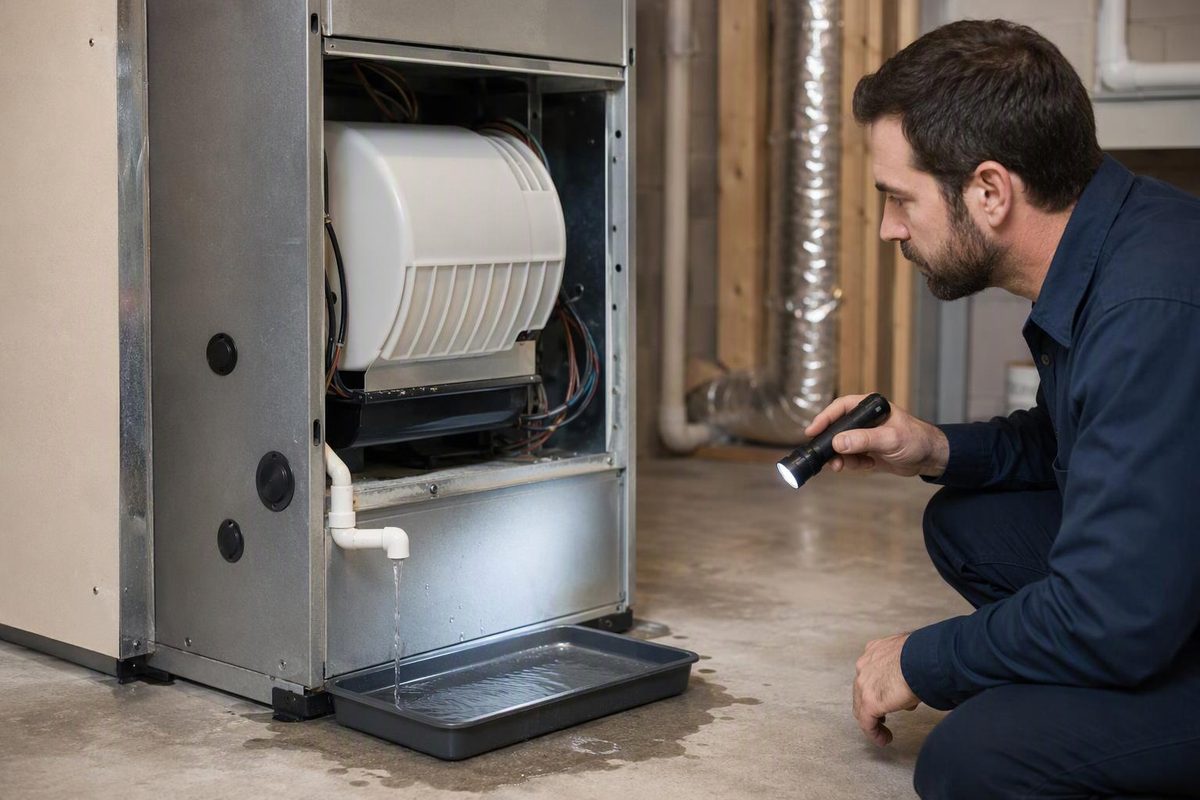
Water leaking from a furnace humidifier can point to a blocked drain, a mineral-clogged water panel, a misplaced feed tube, or a damaged component. The useful distinction is water flowing through its intended drain versus water escaping onto the cabinet or floor. AprilAire identifies these drainage, panel, and assembly problems among the causes of leaks in its evaporative drain-through humidifiers. AprilAire troubleshooting FAQ
Start by stopping the leak. Then record where the water first appears—not just where the puddle ends up.
1. Shut down the humidifier safely
Do not touch wet plugs, switches, controls, or equipment. Take these steps only from safely accessible, dry locations:
- Set the humidifier control to OFF. This may be a separate humidistat on a duct or wall, rather than the heating thermostat.
- Close the humidifier’s water-supply valve if you can positively identify and safely reach it. Do not force a seized valve or loosen a water fitting.
- If water is entering the furnace cabinet, reaching wiring, or coming from an unclear source, turn the heating/cooling system off. Disconnect equipment power only at a safely accessible, dry disconnect or breaker.
- Contain water only where it is safe to do so, and arrange service if the leak continues, you cannot safely shut it down, or electrical parts may have become wet.
Turning a thermostat off is not electrical isolation. AprilAire’s owner’s manual requires power and water to be disconnected before servicing powered humidifiers and warns of scalding from hot supply water. Carrier advises against operating a furnace when leakage could expose electrical components to water. AprilAire owner’s manual; Carrier leak safety guidance
2. Identify the model and distinguish drainage from leakage
Read or photograph the humidifier’s model label. The checks below concern evaporative water-panel humidifiers; do not apply their maintenance steps to a steam or reservoir/drum unit.
On many drain-through models, some incoming water evaporates and the remainder carries minerals down the drain. For example, AprilAire’s 500, 600, and 700 series normally discharge a small, steady stream while humidifying. Its 400 series is different: the owner’s manual says its overflow drain should normally remain dry. A drain hose alone does not tell you what is normal. AprilAire owner’s manual
Record the thermostat mode, fan setting, humidistat setting, and any indicator lights. Water flow after the burner stops does not automatically mean a stuck valve: some controls intentionally keep the HVAC fan and humidifier operating to satisfy a humidity demand. Continuous fresh water flow with the humidifier control OFF, however, warrants service; ask the technician to check the water valve and controls rather than assuming either one is defective. AprilAire owner’s manual; troubleshooting FAQ
3. Match the wet location to the next check
With the humidifier shut down, inspect the outside first. Remove its cover only if your model’s owner-maintenance instructions permit it and you have completed the specified shutdown. Do not open the furnace cabinet to trace water internally.
| First wet location | What to observe | Next step |
|---|---|---|
| Water-supply tubing or valve | A drip at a fitting, damaged tubing, or a wet valve body | Leave the water supply off; request repair. Do not tighten fittings by guesswork. |
| Bottom outlet or drain hose | A flattened hose, upward loop, visible deposits, or disconnected hose | Compare the routing with the manual. A backed-up drain needs clearing or replacement. |
| Around the water-panel assembly | Heavy mineral buildup, a blocked outlet, or an assembly not seated in its base | Follow only the model’s routine maintenance procedure, or have it serviced. |
| Top distribution tray | A feed tube outside its intended position, cracking, or uneven overflow | Check the manual’s placement diagram; damaged parts need replacement. |
| Housing or panel holder | Cracks or an apparently tilted installation | Request component or mounting correction. |
AprilAire lists clogged drains and panels, improper seating, cracked feed tubes or panel holders, and an installation that is not level and plumb as leak causes. Its owner’s manual specifies a constantly downward-sloping, unblocked drain hose for the applicable models. Troubleshooting FAQ; owner’s manual
If the leak began immediately after a water-panel change, seating and feed-tube placement deserve attention before another part is purchased. The humidifier water panel is not the furnace’s air filter; replacing an HVAC air filter does not address these water-path faults.
Do not throttle the supply valve to disguise excessive flow. AprilAire specifies that its saddle valve is fully open or closed; a separate orifice meters the water. A missing or enlarged orifice is a technician check, not a reason to improvise a restriction. Owner’s manual; troubleshooting FAQ
4. Know when the humidifier diagnosis is incomplete
A puddle beside the humidifier does not prove it caused the leak. High-efficiency furnaces also produce condensate, and a blocked drain or faulty condensate pump can put water in the same area. If leakage persists after the humidifier’s supply is closed and residual water has drained, request diagnosis of the other water sources. Carrier For cooling-related clues, see normal AC condensation versus a warning sign.
For the service call, send the model number, photos of the first wet location and drain routing, the leak’s timing, and any recent maintenance. Ask: “Can you verify the drain path, panel seating, feed-tube position, metered flow, and valve shutoff before recommending replacement?”
Leave the humidifier off if the cause remains uncertain. If water may have reached electrical parts, obtain qualified service before restarting. Otherwise, after any manual-approved routine maintenance, reassemble it completely and observe the next operating cycle according to the manual. If it leaks again, stop and obtain qualified service.