
System Decisions
What the Unsettled 2028 Furnace Rule Means for Your Replacement
See whether old-stock 80% furnaces may remain available after 2028, how the Supreme Court remand affects the rule, and when 95% pays back.
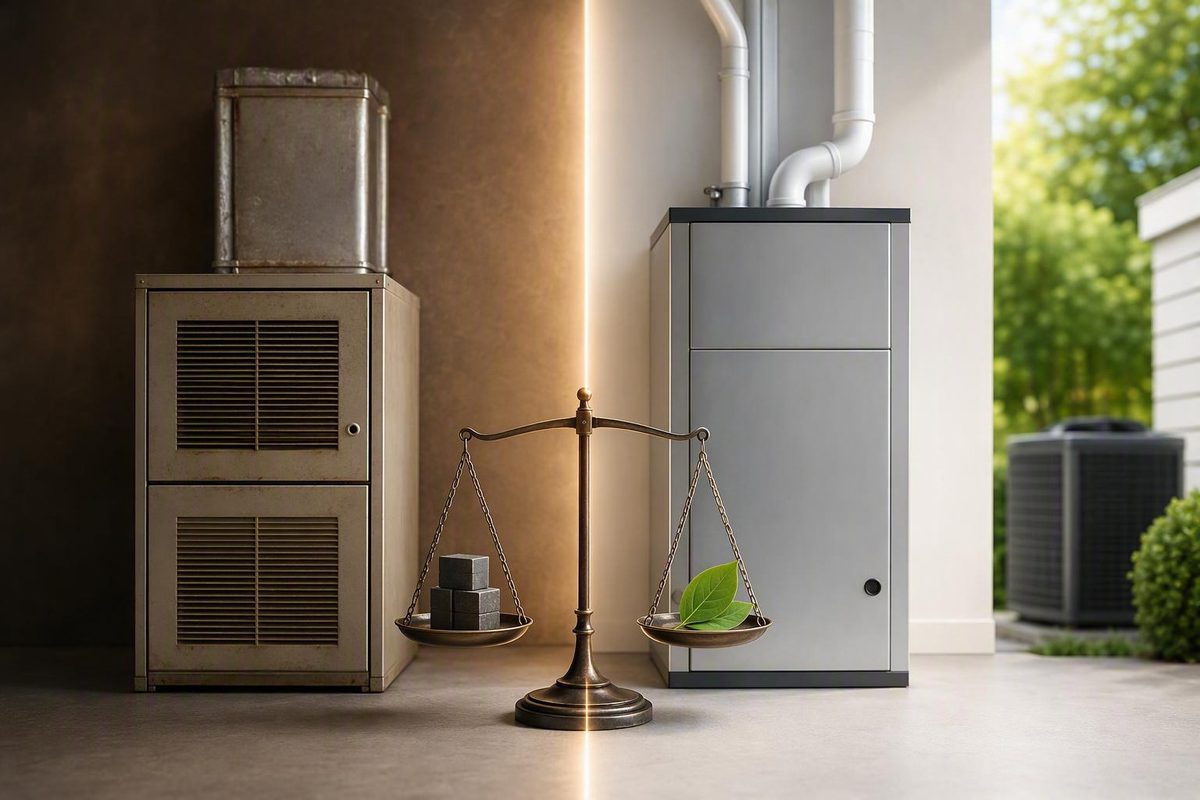
Yes, possibly—but do not count on finding or installing a suitable 80% furnace after 2028. The published DOE rule requires covered furnaces manufactured after the late-2028 compliance deadline to reach at least 95% AFUE. Manufacturer guidance says previously manufactured 80% units may remain available while inventory lasts. However, the Supreme Court’s June 2026 remand put the rule’s legal future back in play, and neither old-stock availability nor approval for a particular installation is guaranteed.
Enter your actual heating use and conversion premium; the tool estimates 95% fuel savings, simple payback, and the venting issues to resolve.
Use furnace-only annual gas consumption when possible. The calculation holds delivered heat constant and compares the two AFUE ratings; it does not estimate installation cost.
Result: Enter annual heating therms and gas price to calculate savings.
- Venting result: choose the shared-flue and PVC-route answers.
- Rule result: late 2028 is the published compliance timing, but rehearing leaves the outcome unsettled.
| Path | Availability or Rule Issue | House Issue to Resolve | Cost Evidence Needed |
|---|---|---|---|
| Buy an 80% furnace before the deadline | Current legality and model classification still require verification. | Existing vent condition, sizing, and installation approval. | Complete installed 80% proposal. |
| Buy old-stock 80% after the deadline | Manufacturer guidance says pre-deadline stock may remain for sale; supply and controlling conditions are uncertain. | Documented manufacture date, exact class, local approval, warranty, and storage condition. | Complete quote plus written return and compliance terms. |
| Convert to a 95% condensing furnace | Matches the published minimum for covered post-deadline production. | PVC intake/exhaust, condensate, chimney, shared appliances, and restoration. | Complete conversion proposal and its premium over the 80% scope. |
| Keep a serviceable existing 80% furnace | No automatic federal shutdown date is established by the reviewed material. | Safety, condition, repair feasibility, and property-specific requirements. | Repair assessment and a planned-replacement quote. |
| Date | Track | Milestone | Meaning for a Homeowner |
|---|---|---|---|
| September 29, 2023 | Rulemaking | DOE announced finalized furnace standards. | DOE described a future 95% minimum for covered categories. |
| December 18, 2023 | Rulemaking | Final rule published as 88 FR 87502. | The official record set out the rule and future compliance timing. |
| February 16, 2024 | Rulemaking | Rule’s stated effective date. | This was not the date every installed or stocked 80% furnace disappeared. |
| June 8, 2026 | Court | Supreme Court vacated the D.C. Circuit decision upholding the rule and remanded the case. | The appellate court must rehear the dispute; the rule’s future is unsettled. |
| August 2026 | Congress | A legislative proposal created another possible path affecting DOE appliance standards. | The supplied material does not establish enacted legislation changing this furnace rule. |
| Late 2028 | Published compliance timing | Covered furnaces are scheduled to meet at least 95% AFUE. | Verify later court, congressional, and DOE action before purchasing. |
Sources: DOE final furnace-standard announcement; Federal Register 88 FR 87502; ACHR News reporting on the Supreme Court remand; manufacturer guidance on pre-deadline inventory. Calculator values use only the 80% and 95% AFUE ratings plus figures entered by the user.
The calculator uses an 80%-versus-95% efficiency comparison, not a prediction based only on furnace age or climate. Heating degree days describe climate severity, but they cannot establish a house’s fuel consumption without information about heat loss and operation. Actual furnace-only gas use provides a firmer starting point.
The 2028 Requirement Is Unsettled, Not Automatically Gone
DOE’s final rule sets a minimum 95% AFUE for covered non-weatherized residential gas furnaces and mobile-home gas furnaces beginning in late 2028. The official rule is 88 FR 87502, document 2023-25514, under docket EERE-2014-BT-STD-0031. It was published December 18, 2023, with a stated effective date of February 16, 2024. The Federal Register record provides the rule, docket, dates, and official GovInfo edition.
The February 2024 effective date was not the product-compliance deadline. The new efficiency requirement was scheduled to apply in late 2028.
Litigation then changed the rule’s posture. On June 8, 2026, the Supreme Court vacated the D.C. Circuit decision that had upheld the furnace standard and returned the case for rehearing. ACHR News reports the remand and the new hearing.
That action vacated the appellate decision, not necessarily the DOE regulation itself. It did not substitute a different AFUE requirement or conclusively eliminate the published late-2028 date. The D.C. Circuit must reconsider the case, so the standard’s ultimate validity and implementation remain unresolved.
An August 2026 legislative proposal added another possible route for changing or preserving DOE’s appliance-standard framework. The supplied material does not include a bill number or enacted text, so it does not establish that Congress has changed the furnace rule. A proposal matters to planning, but it is not the same as enacted law.
The practical position is therefore:
- Late 2028 remains the compliance date written into the published final rule.
- The Supreme Court remand reopened judicial review of the rule.
- Later court action, legislation, or DOE action could alter the outcome before the deadline.
- A homeowner making a purchase near 2028 should verify the current rule rather than relying on an older contractor handout.
Old-Stock 80% Furnaces May Remain Available
The rule is principally a standard for covered equipment manufactured after the compliance deadline. American Standard says furnaces manufactured before the deadline may continue to be sold after it, subject to remaining inventory. Its buying guide describes the requirement as a manufacturing transition and addresses pre-deadline stock.
That is useful manufacturer guidance, but it is not controlling federal text or a promise that every dealer can sell old stock indefinitely. The federal materials reviewed here do not settle every condition governing import, distribution, retail sell-through, or installation of remaining units.
Four separate questions matter:
| Question | What Can Be Said Now |
|---|---|
| Could a covered 80% furnace be manufactured after the deadline? | Not if the 95% requirement takes effect as published and the model falls within a covered class. |
| Could a dealer sell a unit manufactured before the deadline? | Manufacturer guidance says possibly, while inventory remains; verify the current federal position. |
| Could a contractor install that unit at a particular house? | Saleability alone does not establish approval under applicable installation requirements. |
| Will an appropriate unit still be available? | Unknown. Capacity, configuration, dimensions, venting, location, and distributor inventory all affect availability. |
A warehouse unit is not automatically a viable replacement. It still must match the home’s heating load, fuel, airflow orientation, cabinet constraints, vent design, electrical requirements, and listed application.
If one day around the deadline determines a unit’s status, obtain the serial number and documented manufacture date. Manufacturer summaries describe the transition as either after December 17, 2028, or after December 18, 2028. Verify the operative language in the official rule rather than resolving that distinction from marketing copy.
Existing 80% Furnaces Do Not Have an Automatic Shutdown Date
Nothing in the reviewed materials requires every homeowner to remove a functioning 80% furnace in 2028. The rule addresses efficiency requirements for covered equipment, not a universal retirement date for installed furnaces.
It also does not establish a blanket federal prohibition on repairing or operating every existing 80% unit after the deadline. An existing furnace must still be safe, serviceable, and lawful for the property. Its condition, parts availability, manufacturer instructions, insurance requirements, property alterations, and state or local rules may affect whether continued operation or repair is practical.
The phrases “80% furnace ban” and “95% furnace mandate” can obscure these distinctions. Manufacture, import, distribution, retail sale, installation, repair, ownership, and operation are different events. A contractor who says a unit was legal to manufacture has not necessarily established that it may currently be sold and approved for installation at your address.
The 95% Standard Covers Specific Furnace Classes
DOE identifies two covered categories in its announcement:
- Non-weatherized residential gas furnaces
- Mobile-home gas furnaces
DOE’s announcement identifies those categories and the late-2028 95% requirement.
An 80% AFUE label alone does not establish the federal product class. The supplied evidence does not justify extending the same conclusion automatically to every weatherized, commercial, oil-fired, propane, or specialty furnace.
| Furnace Type | What Requires Verification |
|---|---|
| Non-weatherized residential gas | Exact model classification, capacity, fuel, and manufacture date |
| Mobile-home gas | Listing for the specific mobile-home application and exact classification |
| Weatherized | Applicable product definition and efficiency standard |
| Commercial | Capacity, classification, and commercial-equipment requirements |
| Oil-fired | Standard specifically applicable to oil equipment |
| Propane | Regulatory definition and treatment of the exact model |
| Specialty application | Listing, classification, and any application-specific requirements |
Ask the dealer for the complete model number, including suffixes, rather than accepting “80% gas furnace” as a complete description.
A 95% Furnace Can Require a Condensing Conversion
An 80% residential gas furnace is commonly a non-condensing design. A 95% furnace is normally condensing: it recovers additional heat from combustion gases, cooling the exhaust enough to produce liquid condensate. EIA explains the operating and installation differences between condensing and non-condensing furnaces.
That change can make a 95% installation substantially different from a cabinet swap.
Intake and Exhaust Routing
A condensing furnace may need new intake and exhaust piping instead of the existing metal vent or chimney. The contractor should identify the pipe route, termination locations, permitted lengths, and included finish work in the proposal.
A difficult route does not make conversion universally impossible. It means the route must be designed for the selected furnace and house rather than assumed from the AFUE rating.
Condensate Disposal
The installation needs a plan for liquid condensate. The quote should identify the drain route and state whether pumps, neutralization equipment, freeze protection, electrical work, or surface restoration are included when applicable.
The reviewed sources do not provide universal requirements or costs for those items. They depend on the equipment and property.
Shared Chimneys and Remaining Appliances
If the existing furnace shares a chimney with a water heater or another appliance, removing the furnace changes the venting system. The remaining appliance may need evaluation rather than being left connected without analysis.
Do not assume the chimney can be reused unchanged, abandoned without work, or safely left serving a smaller appliance. The appropriate solution is property-specific.
Trane identifies new PVC intake and exhaust piping and condensate drainage as possible conversion requirements. Its replacement guide outlines those potential scope items.
Replace Now, Wait, or Prepare for 95%
The court remand does not create one correct purchase date for every homeowner. The decision depends on equipment condition, failure risk, available installation options, and the complete price difference between proposals.
Replace Now When the Existing Furnace Is Failing
Waiting solely for legal clarity may be a poor trade if the furnace has a serious safety problem, unreliable operation, or a repair that cannot be justified. The supplied evidence does not provide a universal furnace-age cutoff, so age alone should not decide the replacement.
If an 80% replacement is currently allowed and appropriate, compare it with a complete 95% conversion before signing. A present purchase avoids relying on uncertain old-stock availability after 2028, but that does not make an 80% unit automatically preferable.
Wait When the Furnace Is Sound and Both Paths Remain Open
A serviceable furnace does not need replacement merely because the published compliance deadline is approaching. Waiting may preserve cash and allow time for the rehearing, legislation, or DOE action to clarify the rule.
Use that time to determine whether PVC venting and condensate disposal are feasible. Waiting until a no-heat emergency to investigate those issues can leave fewer equipment and routing choices.
Plan a Condensing Conversion When Venting Is Feasible
A 95% furnace uses less fuel to deliver the same modeled useful heat. If an 80% furnace currently uses 1 therm, an idealized equal-load comparison requires about 80/95 therm at 95% AFUE. That is approximately 15.8% less furnace fuel, based only on the two ratings.
Actual savings depend on furnace-only gas use and gas price. AFUE does not account for every duct, sizing, control, weather, maintenance, financing, or installation effect. The calculator therefore treats its result as a simple efficiency comparison, not a utility-bill guarantee.
No general conversion price or payback period is provided in the supplied evidence. Obtain the installed-price premium for your house and enter that figure in the calculator.
Verify Any Old-Stock Unit Before Paying
A proposal for a pre-deadline 80% furnace should identify:
- Manufacturer and complete model number
- Serial number and documented manufacture date
- AFUE, fuel, input capacity, and output capacity
- Airflow orientation and cabinet dimensions
- Federal regulatory product class
- Listed installation application
- Warranty start date and registration terms
- Return rights if the installation cannot be approved
- Contractor labor coverage
Photograph the nameplate and retain the proposal, invoice, permit records, startup report, serial number, and warranty registration. A warehouse receipt or oral statement is not a substitute for documenting the specific unit’s manufacture date.
Ask whether the furnace was previously installed, registered, returned, damaged, or exposed to moisture. Old stock should not be assumed defective, but it should not be assumed equivalent to untouched current inventory without inspection and written warranty terms.
Compare Complete Installation Scopes
Request two itemized proposals when both options are practical: one for the 80% installation and one for the 95% conversion. Both should serve the same heating load and address:
| Scope Item | 80% Proposal | 95% Proposal |
|---|---|---|
| Furnace and controls | Included model and compatibility | Included model and compatibility |
| Venting | Existing vent evaluation and required work | Intake, exhaust, terminations, and restoration |
| Condensate | Usually not a furnace requirement; verify related equipment | Drain route and all required components |
| Chimney | Condition and shared-appliance effects | Abandonment or remaining-appliance plan |
| Electrical and sheet metal | Itemized | Itemized |
| Permit and inspection | Itemized | Itemized |
| Warranty and labor coverage | Written terms | Written terms |
Do not compare an 80% equipment-only price with a turnkey 95% proposal. The useful price difference is the difference between complete, approvable installations.
Before purchasing near or after the deadline, put five questions in writing:
- When was this specific unit manufactured, and what document proves it?
- What federal product class is the exact model?
- What current federal rule permits its manufacture or sale?
- Can the proposed installation obtain any required approval at this address?
- What venting, chimney, condensate, warranty, return, and labor terms are included?
The answer after 2028 may therefore be yes for documented pre-deadline inventory, but it is not a dependable long-term purchasing strategy. Treat the published 95% requirement as the planning baseline while the rehearing proceeds, verify later legal developments, and price the actual condensing conversion before deciding whether to replace or wait.