
Airflow
What to Do When You Find Water Under Your House
Water depth alone does not decide safe entry; contamination, wiring, access and crawl-space layout can matter more. Then match the fix to the source.
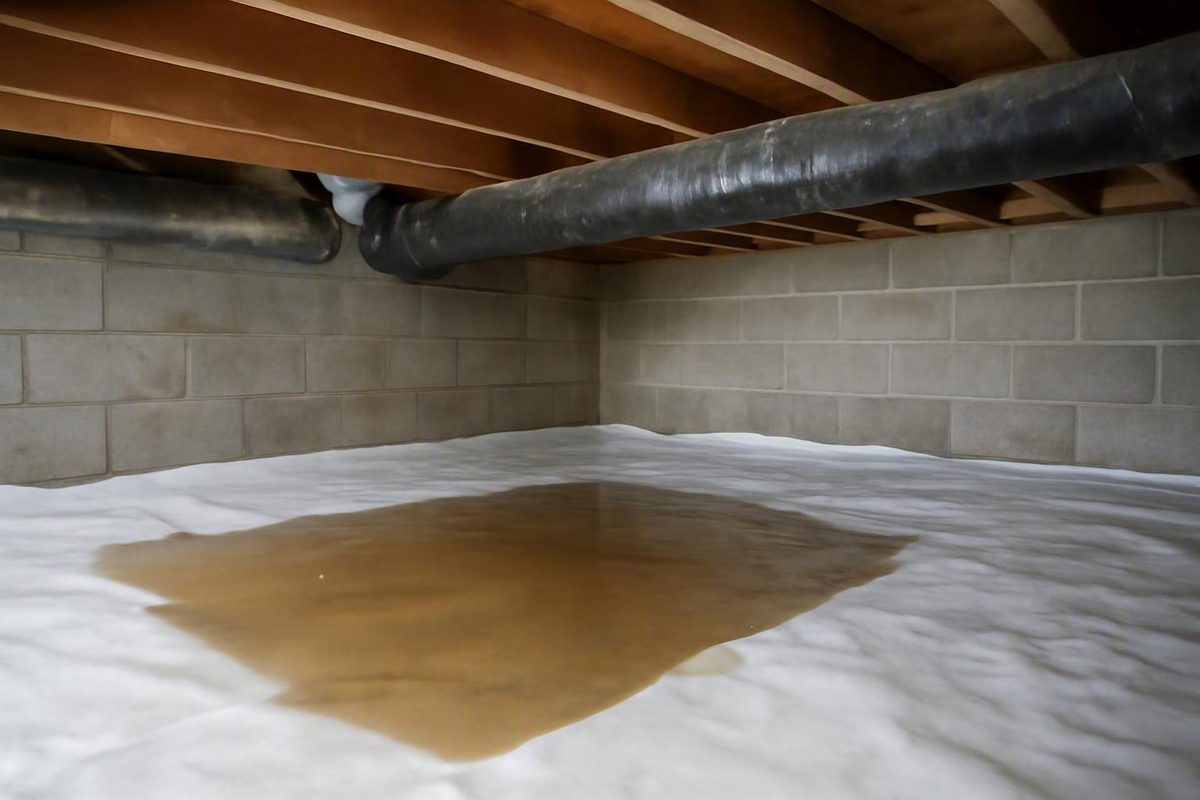
Finding crawl space water does not automatically mean the foundation is failing. Still, recurring standing water and persistent dampness should not be accepted as normal background conditions.
The right response begins with safety and source identification—not with buying a sump pump, dehumidifier, or encapsulation package. Water beneath a house may come from roof runoff, poor grading, saturated soil, groundwater, plumbing, HVAC condensate, or condensation on cool surfaces. Several sources can be active at once.
First determine whether the area is safe to approach. Document what you can see without entering, and stop an obvious source only from a dry, safely accessible location. Water removal and drying come next. A permanent remedy should be chosen only after you understand how the water is getting there.
Start With Safety, Not the Puddle
Use this rapid decision sequence:
- Stay out if electrical contact, contamination, visible mold, unsafe access, or structural instability may be present.
- Photograph or record what you can see without entering the affected area.
- Stop an obvious source only if the control is dry and safely accessible.
- Arrange extraction, drying, and qualified assessment according to the source and extent of the water.
Shallow-looking water is not automatically safe. A crawl space may contain wiring, outlets, junction boxes, pumps, extension wiring, or heating and cooling equipment in or above the affected area. Do not approach or handle wet electrical or HVAC equipment. If water may have contacted energized components, stay out until an electrician or another professional qualified to assess the electrical conditions confirms that entry is safe. Electrical and contamination checks should come before entry or cleanup in a wet crawl space (crawl-space water safety guidance).
Do not crawl through water to reach a breaker, disconnect, shutoff, pump, or equipment switch. An ordinary control may be used only when it is in a dry, safely accessible location that does not require approaching wet equipment, exposed wiring, or standing water.
Avoid DIY entry when the water may contain sewage, drainage backup, storm flooding, strong contamination odors, or material of uncertain origin. Commercial restoration guidance similarly recommends professional help for sewage, floodwater, electrical or HVAC contact, extensive water, and existing mold (standing-water response guidance).
Access conditions matter as much as water depth. Do not enter through a damaged hatch or proceed where low clearance, mud, loose wiring, unstable insulation, damaged supports, or deteriorated flooring makes movement uncertain. If you can see sagging floors, displaced supports, damaged framing, or unusual foundation movement, stop and seek a building or structural assessment rather than crawling in to investigate.
When documentation is possible from a safe location, photograph or record:
- The visible extent and approximate depth of the water
- Where the water appears to enter or collect
- Water marks on walls, piers, ducts, pipes, or liners
- Wet, sagging, or fallen insulation
- The sump basin and visible discharge piping
- Nearby HVAC or electrical equipment
- Damaged belongings or building materials
- Exterior ponding, gutters, downspouts, and discharge outlets
Record the date, recent weather, when the water was discovered, and whether plumbing or cooling equipment had been operating. Do not assume that extraction, mold work, drainage improvements, equipment repairs, or structural work will be covered.
HVAC Lens provides general homeowner education intended to support safer observations and better contractor questions. It cannot remotely determine electrical safety, contamination, structural condition, or the drainage design appropriate for a particular property. That limit is consistent with the publication’s stated role of helping homeowners understand maintenance calls and estimates rather than training them as technicians (about HVAC Lens).
Trace the Water to Its Most Likely Source
Do not assume that the most visible puddle identifies the source. Rainwater and groundwater may enter during the same storm, while humid air creates condensation on top of an unrelated drainage problem.
Timing, location, and distribution provide useful clues:
| What you observe | Possible source | What to check without unsafe entry | Important limitation |
|---|---|---|---|
| Water appears during or shortly after rain | Gutters, downspouts, runoff, grading, foundation openings, or saturated soil | Overflowing gutters, disconnected downspouts, exterior ponding, or soil sloping toward the house | Timing alone does not distinguish surface runoff from rising groundwater |
| Water seeps through floor areas or along several wall edges and persists after rain | Groundwater or saturated soil | Whether the wet area is broad, whether a sump operates, and where its discharge goes | Plumbing water can also spread beneath a liner or across low areas |
| A localized wet area sits below supply or drain piping | Plumbing leakage | Recent fixture use, visible dripping, staining, or an accessible active leak | Water may travel along piping before it drips |
| Water is concentrated near an air handler, drain pan, condensate line, or condensate pump | HVAC condensate drainage or equipment leakage | Whether cooling was running, whether a visible pan appears full, and whether an accessible drain termination flows | Internal inspection is needed to confirm the failure |
| Droplets form across cool ducts, refrigerant-line insulation, or pipes | Condensation | Whether surfaces become wet during humid weather or cooling operation | Condensation can coexist with bulk-water entry |
| Water gathers despite an existing sump | Pump, basin, power, collection, or discharge problem | Whether the pump ran, whether an alarm activated, and whether water visibly discharged | A pump’s presence does not prove that water can reach its basin |
| Water sits on top of or creates bulges beneath a liner | Continuing inflow, trapped water, or liner and drainage defects | Where the liner is lowest, punctured, detached, or visibly holding water | A vapor barrier is not a liquid-water drainage system |
Surface runoff, groundwater pressure, plumbing or HVAC leakage, and condensation are distinct but potentially overlapping crawl-space moisture sources (overview of crawl-space water sources).
When water follows rain, start outside. These observations usually do not require crawl-space entry:
- Are gutters clogged, overflowing, sagging, or leaking at joints?
- Are downspouts disconnected, crushed, blocked, or ending where water ponds?
- Does soil visibly slope toward the house?
- Are there depressions beside foundation walls, vents, or the access door?
- Does roof runoff cross a walkway or planting bed and return toward the house?
- Is sump discharge flowing back toward the foundation?
- Is the discharge outlet visibly blocked, frozen, eroded, or underwater?
- Are foundation openings or utility penetrations receiving direct runoff?
Avoid applying a universal downspout distance or grading formula. A workable route depends on terrain, soil, roof area, nearby structures, erosion risk, and the available discharge location.
Next consider plumbing. Did the water appear after using a shower, dishwasher, washing machine, or particular fixture? Is there an active drip visible from a dry location? Does the puddle recur during fair weather? These observations make plumbing more plausible but do not identify the failed pipe or fitting.
Then consider HVAC operation. A visibly full drain pan, disconnected condensate line, blocked drain termination, failed condensate pump, or wet area beneath an air handler may point toward an equipment-related source. Distributed droplets on cool ducts are more consistent with condensation than with one drain leak. These are clues, not permission to open equipment or handle wet wiring.
A vapor barrier can complicate the pattern. Its primary job is to limit moisture vapor moving from exposed soil into the crawl-space air; it does not give liquid water a route to a drain. Water entering from above can remain on the liner. An uneven or incorrectly installed liner can also make puddling more visible, as commercial crawl-space guidance notes (water accumulation on a crawl-space liner).
Use this worksheet after each rain or recurrence:
- Date and weather: When did rain begin, and was it brief or prolonged?
- Appearance: When was the water first noticed?
- Location: Where did it appear first, and where is it deepest?
- Distribution: Is it at one point, along several walls, or across most of the floor?
- Sump operation: Did the pump activate or an alarm sound?
- Discharge: Was water visibly leaving, and did it appear to return toward the house?
- Plumbing: Which fixtures or appliances had recently operated?
- HVAC: Was cooling running? Was a visible drain termination flowing?
- Change over time: Did the water rise, recede, or remain after the rain stopped?
A sequence recorded across several events is generally more informative than one fair-weather inspection.
Why Persistent Moisture Deserves Attention
A small isolated puddle is not proof of structural failure. It may result from a minor leak that has already been stopped. At the same time, recurring standing water, wet insulation, persistent dampness, or a musty crawl space should not be normalized.
Prolonged moisture can contribute to deterioration of wood, damaged insulation, mold growth, pest activity, corrosion, persistent odors, and additional moisture around HVAC equipment. These are possible outcomes, not guaranteed consequences in every house. Their likelihood and severity depend on how long materials remain wet, what materials are affected, whether contamination is present, and whether the source continues.
Look for observable warning signs:
- Puddles that return after rain or equipment operation
- Water stains or mineral deposits on walls, piers, pipes, or framing
- A persistent musty odor
- Visible fuzzy, spotted, or discolored growth
- Wet, compressed, detached, or sagging insulation
- Condensation on ducts, piping, fasteners, or equipment surfaces
- Softened, flaking, cracked, or visibly deteriorated wood
- Sagging or soft-feeling floors above
- Doors or windows that recently began sticking
- Increased pest activity
- Corroded metal components or fasteners
- Frequent or nearly continuous sump operation
- A pump that runs without lowering the water level
These symptoms do not identify the source or prove that the foundation has failed. Floor movement can have causes unrelated to crawl-space moisture. Nevertheless, damaged supports, notable floor deflection, displaced piers, soft floors, or concerning foundation changes justify assessment by a structural engineer or another locally qualified structural professional. Soft floors and sticking doors or windows are among the possible indicators associated with prolonged crawl-space moisture damage (crawl-space damage indicators).
Wet insulation needs more than a glance from the access opening. Depending on its type and condition, insulation may lose effectiveness, collapse, hold moisture against other materials, or become physically damaged. Whether it can remain depends on the material, contamination, attachment, physical condition, and whether drying can be verified. Commercial restoration guidance recommends inspecting wet insulation and replacing it when its condition warrants it rather than applying one rule to every material (wet crawl-space insulation guidance).
The same caution applies to wood. For a significant or long-undiscovered event, ask the restorer or building professional what will be measured, where readings will be taken, and what criteria will be used to determine that drying is complete.
Remove the Water, Dry the Space, and Verify the Result
DIY cleanup should be limited to a small amount of apparently clean water from a known source that has been stopped, with safe access and electrical conditions already confirmed. There is no universal water depth that makes entry safe. Contamination, wiring, access, unstable materials, and crawl-space configuration can matter more than depth.
Under those limited conditions, a wet/dry vacuum may be suitable for minor puddles. Extensive water, recurring flooding, an unknown source, suspected contamination, delayed discovery, or water near electrical and HVAC systems calls for professional extraction and assessment. Home-service guidance similarly distinguishes small isolated puddles from extensive or recurring events that require professional help (water-removal and escalation guidance).
Follow this sequence:
- Stop the source when safely possible. Shut off a plumbing supply from a dry, accessible control, stop using the affected fixture, or turn off HVAC operation from an ordinary dry control. Do not approach wet equipment to do so.
- Extract liquid water. Remove pooled water only when the equipment, access, and conditions are appropriate.
- Inspect affected materials. Check more than the visible floor or liner.
- Dry the area. Use controlled air movement and dehumidification only when contamination and visible growth do not make those methods inappropriate.
- Verify that moisture is declining. Do not declare success because the top of a liner looks dry.
Air movers and dehumidifiers are drying tools. They are not repairs for a leaking pipe, overflowing drain pan, recurring runoff, rising groundwater, or blocked discharge. Running a dehumidifier while water continues to enter may reduce some airborne moisture while leaving the main problem unchanged.
In those conditions, material handling, cleaning, containment, and air management should be determined by a remediation professional; restoration guidance specifically cautions that fans may spread material where visible mold is present (cleanup and air-movement precautions).
Inspect the complete affected assembly as far as it can be assessed safely:
- Floor joists, beams, posts, and subfloor
- Fiberglass, foam, or other insulation
- Duct surfaces, joints, supports, and liners
- Pipe insulation and hangers
- Ground liners and seams
- Masonry walls and piers
- HVAC cabinets, drain pans, and visible drain lines
- Stored boxes, fabrics, wood, and other porous belongings
- Rim areas and concealed low points where practical
Do not rely on a universal drying deadline, relative-humidity target, or wood-moisture percentage. Conditions and materials vary, and no single value in the available evidence proves that every crawl space is safe and dry. For a significant event, ask the restorer or building professional to document initial conditions, measurement locations, progress readings, affected materials, and the criteria used to close the drying phase.
Material-removal decisions should consider four questions:
- Was the water contaminated or of uncertain origin?
- What material became wet?
- Is it physically damaged, delaminated, compressed, sagging, or deteriorated?
- Can drying throughout the material be verified?
This framework avoids both unnecessary demolition and the assumption that every damp porous material can remain.
Match Each Fix to the Problem It Can Actually Solve
Each moisture-control system has a specific job. A useful proposal should explain the complete water path—from entry to collection to final discharge—rather than merely naming a product.
| Remedy | Problem addressed | What the system does | What it cannot fix | Site-specific questions |
|---|---|---|---|---|
| Gutters and downspouts | Roof runoff near the foundation | Collect and redirect roof water | Plumbing leaks, HVAC condensate, or a high water table | Are gutters overflowing? Where does each downspout end? Can water return toward the house? |
| Grading and surface drainage | Ponding and runoff moving toward the foundation | Creates an exterior route away from vulnerable areas | Internal leaks or every groundwater condition | Where can the water go without returning or causing erosion? |
| French or perimeter drain | Water entering along multiple edges or across a broad area | Collects and conveys water toward an outlet or basin | Does not mechanically lift water uphill or repair leaks | Is it interior or exterior? Where is the outlet? How will failure be detected? |
| Gravity drain | Collected water where a lower outlet is available | Uses elevation difference to discharge without a pump | Cannot work without a suitable lower outlet | Who will verify that the outlet and route are acceptable for the property? |
| Sump basin and pump | Collected water that cannot leave by gravity | Mechanically lifts water through a discharge line | Does not collect water from isolated areas unless they drain to the basin | Why is the basin located there? How was the pump selected? Where does discharge go? |
| Vapor barrier | Soil-vapor movement | Separates exposed soil from crawl-space air | Does not pump out standing water or stop active intrusion | What happens to liquid water above or beneath it? How are seams and penetrations handled? |
| Dehumidifier | Elevated airborne humidity after bulk water is controlled | Removes moisture from the air | Cannot pump out puddles or prevent continuing inflow | How will condensate drain? How will operation be monitored? |
| Encapsulation | Broader environmental control | May combine a sealed liner, air sealing, insulation strategy, and humidity management | Cannot repair an unresolved leak or replace necessary drainage | How is bulk water controlled first? How does the design account for the building and equipment? |
Gutters, downspouts, grading, and surface drainage primarily address runoff. They are logical early checks when water follows storms, but they will not repair a drainpipe, condensate line, or water-supply leak. They also may not control groundwater.
A French or perimeter drain is a collection and conveyance system. A sump pump is a mechanical removal system. They often work together, but they are not interchangeable. Commercial drainage guidance describes perimeter drains as directing water toward a sump basin or a suitable gravity outlet, while the pump removes collected water when gravity drainage is unavailable (French-drain and sump-pump functions).
A pump’s usefulness depends on more than its sales label. A pump at one low point may not help water trapped in areas divided by footings or higher soil.
A vapor barrier limits soil-vapor movement. It does not make pooled water disappear or create a collection route. A dehumidifier manages airborne moisture after bulk-water entry is controlled; it cannot prevent a storm from sending water through a foundation opening.
Encapsulation is a broader environmental-control approach that may include a sealed liner and managed humidity. It can be part of a well-designed solution, but it should not conceal active water entry. A proposal for encapsulation should explain how liquid water will be stopped, collected, or removed before the liner is installed.
Selection logic generally works like this:
- One localized low point: A properly designed basin and pump may sometimes serve the area if water can reliably reach it.
- Water entering along several walls or in multiple areas: A collection route may be needed to convey water toward an outlet or basin.
- A suitable lower outlet: Gravity drainage may be possible if the site and applicable requirements allow it.
- No suitable gravity outlet: Mechanical pumping may be needed.
- Runoff, groundwater, and humidity together: Layered controls may be required because no single component performs all three jobs.
Do not accept universal drain dimensions, pipe slopes, barrier thicknesses, pump capacities, or vent instructions without a property-specific basis. Foundation configuration, supports, soil, climate, equipment, discharge options, and applicable requirements affect the design. Ask the contractor to identify any permits, inspections, electrical requirements, or discharge approvals that apply rather than assuming that a generic detail is acceptable everywhere.
Give HVAC-Related Water Its Own Diagnostic Track
Heating and cooling systems can contribute to crawl space water through condensate drainage problems, equipment or line leakage, and condensation on cool duct surfaces exposed to humid air.
The pattern can help determine whom to call:
- A concentrated wet area near an air handler, drain pan, condensate line, or pump points more strongly toward equipment drainage.
- Distributed droplets across multiple cool duct surfaces are more consistent with condensation.
- Broad pooling after storms, including periods when cooling is off, points more strongly toward runoff or groundwater.
Make external observations only:
- Note whether cooling was operating before the water appeared.
- Record whether wetness is localized or distributed.
- Look from a safe location for an obvious overflow indication.
- Check whether an accessible, visible condensate drain termination is flowing.
- Note whether a condensate pump is silent, running repeatedly, or associated with visible leakage.
- Record whether the problem stops when cooling is not operating.
- Photograph equipment model information only if it can be reached without entering a wet or unsafe area.
Do not open equipment panels, remove covers, test internal components, handle wet wiring, clear internal drain assemblies, or work on a condensate pump in a flooded area. HVAC Lens classifies work involving electricity, sealed compartments, motors, internal wiring, and protective controls as technician-only rather than a homeowner external check (HVAC troubleshooting safety boundaries).
An HVAC repair can stop an equipment-related water source. It will not correct runoff flowing toward the foundation or groundwater rising beneath a liner. Conversely, encapsulating a crawl space will not repair a cracked drain pan, blocked condensate line, or failed condensate pump.
For internal equipment, wiring, pumps, and drain assemblies, use the model-specific manufacturer documentation and a qualified HVAC contractor.
Know When DIY Ends and How to Evaluate Professional Proposals
Call for qualified help when:
- Water is extensive, recurring, or rising
- The source is unknown
- Sewage, floodwater, drainage backup, or other contamination is possible
- Water is near electrical or HVAC equipment
- Visible mold or extensive suspicious growth is present
- Insulation is wet or damaged across a broad area
- Access is cramped, unstable, obstructed, or otherwise unsafe
- The event was discovered after an uncertain or prolonged period
- Floors sag, supports appear damaged, or foundation movement is concerning
- An existing sump, drain, outlet, or pump has failed
- Water returns after extraction
- The crawl space contains isolated low areas that do not drain toward the basin
Match the professional to the suspected issue:
- Restoration or remediation contractor: Significant extraction, controlled drying, contamination, or affected porous materials
- Plumber: Supply, fixture, drain, or sewer-line leakage
- HVAC contractor: Condensate drainage, drain pans, pumps, equipment leakage, or persistent duct condensation
- Electrician: Wet wiring, outlets, junction boxes, pumps, controls, or other electrical systems
- Drainage or foundation specialist: Exterior runoff, groundwater, collection drains, or sump-system design
- Structural engineer or locally qualified structural professional: Damaged supports, notable floor movement, or concerning foundation changes
Ask each bidder to provide the diagnosis and supporting observations before discussing a package.
Use this comparison checklist:
- What source or combination of sources was identified?
- What observations or measurements support that conclusion?
- Where does water enter?
- How will it be collected?
- Where will the basin be located, and why?
- How can water from each affected area reach the basin?
- What is the proposed discharge destination?
- How will visible recirculation, erosion, blockage, or freezing be addressed?
- What is the basis for pump selection?
- Are alarms, backup power, or redundant components offered?
- What electrical work is included, and who performs it?
- Which permits, inspections, utility-location steps, or approvals does the contractor say apply?
- What maintenance will the system need?
- What warranty is included, and what is excluded?
- How will drying and long-term performance be verified?
- What happens if water returns during the next comparable storm?
Ask contractors to separate costs for:
- Initial extraction
- Drying and monitoring
- Contaminated or damaged material removal
- Plumbing repair
- HVAC repair
- Exterior drainage or grading
- Interior collection drains
- Sump basin, pump, alarms, and backup components
- Electrical work
- Vapor control
- Encapsulation
- Mold remediation
- Insulation replacement
- Structural assessment or repair
Broad prices are not directly comparable when one bid covers extraction and a pump while another includes drainage, electrical work, insulation removal, encapsulation, or structural repairs. Access, contamination, drainage length, soil, outlet routing, region, and material replacement can all change the scope.
Treat an encapsulation proposal cautiously if it does not explain what will happen to active liquid water. A new liner can hide a defective collection system until another major rain. Reported French-drain installation failures include disconnected sections, poor routing, and drains without a functional outlet (crawl-space drain functions and installation failures).
Crawl spaces divided by footings, piers, or isolated pits need a site-specific collection plan. Do not assume one sump can receive water from areas with no path to it. Cutting through footings, excavating around supports, or trenching beside piers is not a generic homeowner project. Ask the relevant contractors to identify the structural, utility-location, electrical, and approval requirements before work begins.
Prevent a Repeat and Confirm That the Repair Worked
Prevention begins with basic water management and continues with verification under the conditions that originally caused the problem.
Use this sequence:
- Keep gutters clear and repair leaking or overflowing sections.
- Confirm that downspouts remain connected and do not visibly return water toward the foundation.
- Watch for ponding beside the house after heavy rain.
- Correct plumbing leaks and HVAC condensate defects.
- Inspect the crawl-space access area after storms.
- Confirm that drains and visible outlets remain open.
- Check that any sump activates and actually lowers the water.
- Test installed alarms and backup components according to their instructions.
- Track whether affected insulation, framing, and other materials remain dry.
- Reassess if odors, condensation, staining, or puddles return.
Observe a sump pump as a complete system, not simply as a motor that makes noise. Confirm that water reaches the basin, the pump activates, discharge occurs, and water does not visibly return toward the house. Follow the equipment manufacturer’s instructions rather than adopting a universal testing or battery-replacement schedule.
Discharge design is property-specific. Ask the installer to explain how the route addresses return flow, erosion, freezing, blockage, and applicable local requirements. Do not assume that a street gutter, storm drain, sewer connection, neighboring property, or any downhill area is an acceptable destination.
Keep a simple log containing:
- Weather and recent rainfall
- Puddle locations and approximate extent
- Musty or contamination-like odors
- Visible condensation
- Humidity trends if a monitor is used
- Sump activity and alarm events
- Discharge observations
- Plumbing and HVAC operating conditions
- Completed repairs
- Photographs from the same viewpoints
Successful remediation means more than a clean-looking liner on a dry day. Look for four outcomes:
- No continuing inflow from the corrected source
- No recurring pooling under the conditions that previously triggered it
- Verified drying of affected materials
- Reliable operation of installed collection and removal equipment
Inspect again during later storms or when cooling operation recreates the earlier conditions. Fair-weather dryness alone does not demonstrate that runoff, groundwater, or condensate control is working.
Frequently Asked Questions
Is a little water in a crawl space normal?
An isolated puddle is not automatically a structural emergency, but recurring standing water or persistent dampness should not be accepted as normal. Document the condition, look for a source, and determine whether affected materials are drying. Escalate if the water returns, the source is unknown, or insulation, framing, equipment, or electrical components are involved.
Will a dehumidifier remove standing crawl-space water?
No. A dehumidifier removes moisture from the air; it does not pump out pooled water or prevent continuing inflow. Standing water must be extracted under safe conditions, and the leak or drainage source must be corrected. Dehumidification may then support controlled drying or longer-term humidity management.
Do I need both a French drain and a sump pump?
Not always. A French or perimeter drain collects and conveys water. A sump pump mechanically removes water from a basin.
One localized low point may sometimes be managed by a properly designed sump system. Water entering along several edges may require a collection drain leading to the basin. A drain may be able to discharge by gravity where a suitable lower outlet exists. The water source, crawl-space layout, terrain, and discharge options determine the configuration.
Why is water collecting on or beneath my vapor barrier?
A vapor barrier restricts soil-vapor movement but does not provide a liquid-water drainage route. Water can collect on top after a leak, condensation, or wall-edge intrusion. Water may also become visible beneath a liner when groundwater or another leak affects the soil below it.
Uneven ground, low areas, punctures, poor seams, and continuing inflow can affect where water becomes visible. The liner may reveal the water problem without being its original source.
When should I call a professional about crawl-space water?
Call when water is extensive or recurring, the source is unknown, contamination is possible, visible mold is present, access is unsafe, or water is near electrical or HVAC equipment. Broadly wet insulation, delayed discovery, failed drainage equipment, damaged supports, sagging floors, or concerning foundation movement also justify qualified assessment.
Choose the professional according to the problem: restoration, plumbing, HVAC, electrical, drainage, and structural expertise address different parts of the situation, and some events require more than one trade.
Source-First Conclusion
Stay out when electrical contact, contamination, access, visible mold, or structural conditions make entry uncertain. Document the problem from a safe location, then determine whether the pattern points toward runoff, groundwater, plumbing, HVAC condensate, or condensation. Remove and dry water only when the conditions and equipment are appropriate.
Choose the remedy for the source rather than the symptom. Drains collect water. Pumps remove collected water. Vapor barriers limit ground-vapor movement. Dehumidifiers manage airborne humidity. Encapsulation combines broader environmental controls but does not replace leak repair or necessary drainage.
The strongest evidence that a repair worked is verified drying plus no renewed pooling when the original trigger—such as heavy rain, plumbing use, or cooling operation—returns.