
Heating
How to Read the Light Without Guessing at the Fault
Continuous blinking may be normal on some controls. Before resetting power, record every flash and match it to the exact model's diagnostic legend.
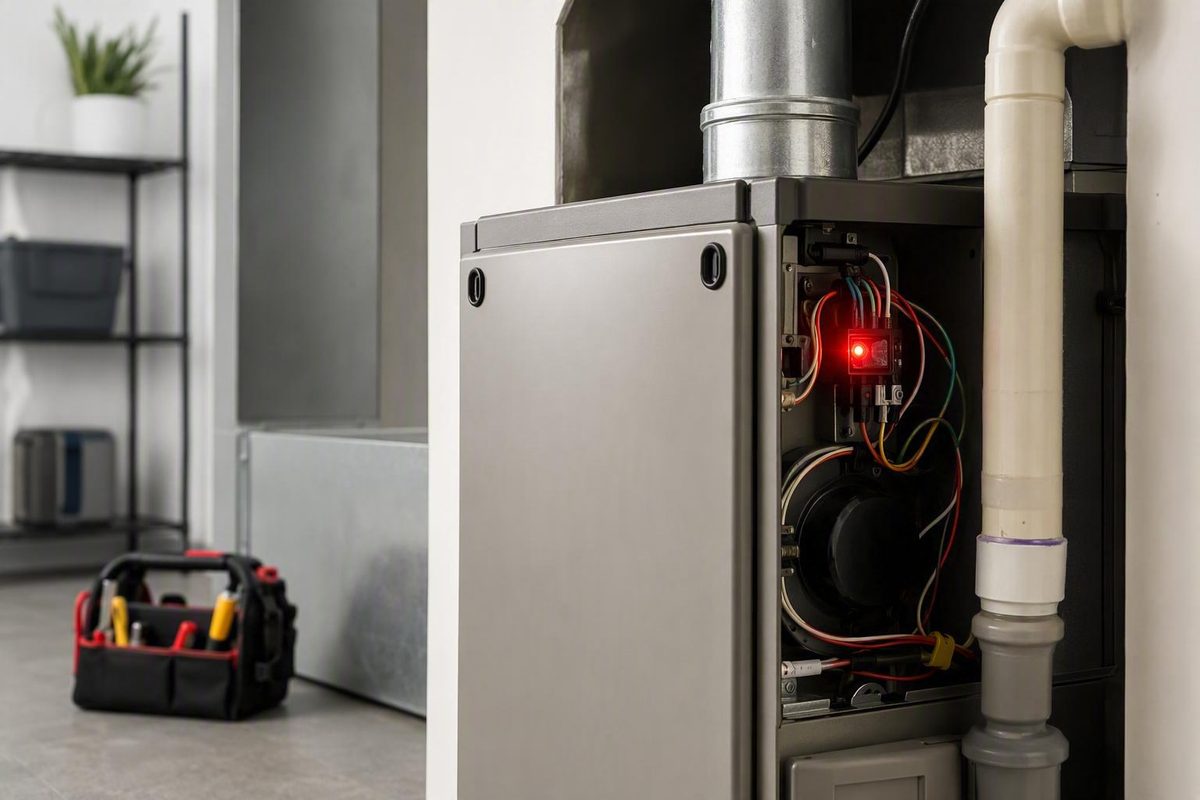
How to read the light without guessing at the fault
The short answer: flashing does not automatically mean failure
A Lennox furnace red light flashing does not have one universal meaning. Depending on the furnace and its control, the light may indicate standby, a thermostat call for heat, a stage in the heating cycle, or a detected fault.
Color alone cannot identify the condition. Correct interpretation depends on:
- The complete furnace model and series
- The control board installed in the furnace
- Whether the control has one LED, two LEDs, or an alphanumeric display
- Whether the light is solid, continuously blinking, or flashing in counted groups
- The speed and timing of the flashes
- The pause between repeating groups
- Whether two LEDs flash together or alternate
- What the furnace was doing when the pattern appeared
Third-party contractor guidance illustrates how differently selected Lennox controls can communicate status and faults. Some use continuous or simultaneous flashing, while others use counted sequences or combinations of two LEDs. Those examples are not official or complete Lennox documentation and should not override the diagnostic legend attached to the furnace or its model-specific instructions.
If the furnace is heating normally, airflow seems typical, and there are no unusual sounds, odors, shutdowns, alarms, or electrical symptoms, the light may be an ordinary operating-status signal. Normal heat lowers the immediate level of concern, but it does not prove that the furnace is fault-free. An intermittent problem can disappear before you inspect the unit, and a status light can remain active during normal operation.
Use this immediate sequence:
- Observe the furnace. Is it producing heat, running only the blower, starting and stopping, or failing to start?
- Record the entire light pattern. Capture several repetitions rather than calling it simply “blinking.”
- Photograph the complete model label.
- Find the diagnostic legend attached to the furnace or the documentation for that exact model and control.
- Compare your observation with that specific legend.
Do not assume that continuous blinking is universally normal. Do not assume that a solid light is universally normal either. Third-party discussions have assigned both descriptions to normal operation on different or incompletely identified controls, which is why the exact model and legend matter.
Check the situation before trying to decode the light
Before counting flashes, assess what the furnace is doing. The same visible light calls for a different response when the furnace completes normal cycles than when it repeatedly loses heat or shows an electrical or combustion-related warning sign.
1. The furnace appears to be producing heat normally
From outside the cabinet, note whether the furnace completes an apparently normal cycle:
- The thermostat calls for heat.
- The furnace starts without repeated attempts.
-
The burners appear to operate.
-
Warm air reaches the rooms.
- The burners and blower eventually stop without an abrupt interruption.
You do not need to open the burner compartment to make these observations. Listen from outside the cabinet, feel the air at a normal supply register, and watch the thermostat.
A stable blinking pattern during otherwise normal cycles could be a status indication. In one forum report, the owner of a Lennox ML193E said the furnace heated normally despite continuous blinking, and one respondent characterized the pattern as normal. Another response in the same discussion supplied a list saying a solid light meant normal operation, so the thread cannot establish a universal rule for Lennox furnaces.
Record whether the pattern changes when the thermostat begins or ends a call for heat. That relationship may be more informative than the light’s color.
2. The furnace fails to heat or repeatedly loses heat
Arrange more prompt evaluation if the furnace:
- Tries to start repeatedly without establishing heat
- Produces heat briefly and then shuts down
- Runs only the blower
- Stops before satisfying the thermostat
- Enters a recurring lockout
- Requires repeated resets
- Produces unusually weak airflow
- Starts and stops unexpectedly
Record the order of events without trying to name a failed part. “The blower runs, but the air remains cool” is more useful than “the furnace is broken.” Likewise, “it makes three startup attempts and then displays a repeating sequence” gives a technician more information than “the red light flashes.”
A diagnostic indication generally reports a condition detected by the control. It does not necessarily identify why that condition occurred or prove that the named component has failed.
3. There may be an electrical or combustion-safety concern
Stop experimenting and obtain qualified help when you observe:
- A breaker that trips again after one check or reset
- Smoke, soot, scorching, or melted wiring visible from outside the cabinet
- A burning or unusual combustion odor
- Signs of overheating
- A carbon-monoxide alarm
- A furnace-specific indication involving flame rollout, overheating, gas operation, polarity, wiring, or recurring ignition lockout
A third-party Lennox network dealer advises against repeatedly resetting a heating-system breaker that promptly trips again and recommends technician involvement instead for that condition.
If a carbon-monoxide alarm activates, stop using this article as a troubleshooting guide and follow the alarm manufacturer’s instructions and the directions of your local emergency authority. Do not continue cycling the furnace merely to observe whether the light changes.
These observations are not repair instructions. Do not bypass a safety switch, probe live terminals, disturb burner components, adjust gas equipment, or force the furnace through another cycle.
Find the model, LED arrangement, and diagnostic legend
“Lennox furnace” is not specific enough to decode a light. Start by photographing the complete rating or model label. Capture the whole label clearly so that suffixes and revision details are not lost.
Next, determine which diagnostic interface you have:
- One LED: The control may use continuous status blinking, counted flashes, or both.
- Two LEDs: Meaning may depend on each LED’s state and whether the lights flash together or alternate.
- Alphanumeric display: The control may show a letter-and-number code rather than a simple flash sequence.
Some third-party guides organize selected Lennox families into single-LED and two-LED groups, but the available evidence does not include model-specific Lennox manuals confirming those classifications across all revisions. Do not apply an online family chart to an unverified furnace or control.
The controlling reference should be the diagnostic legend attached to the furnace or model-specific documentation matching the installed equipment. Look for a label on an access panel, near an inspection window, or in the installation and service material left with the unit. Photograph the entire legend, including its headings and notes—not only the row that appears to match.
Third-party guidance commonly places the control board in a lower furnace compartment and notes that its light may be visible through a clear inspection port. Use an existing viewing port when available. Removing a panel can expose electrical components, and a panel-operated door switch may interrupt furnace power and cause the active indication to disappear.
If you cannot see the pattern without opening the cabinet, do not reach inside or touch components. A qualified technician can safely verify the board and control model.
Use this note-taking template:
Furnace model: Serial number, if legible: Control type: One LED / two LEDs / alphanumeric display LED color or displayed code: Left or first LED: Off / solid / slow / fast / counted Right or second LED: Off / solid / slow / fast / counted Flash count: Pause length: Sequence: Simultaneous / alternating / repeating Thermostat setting and demand: Operating stage: Standby / startup / ignition / burners operating / blower operating / shutdown Heating behavior: Normal heat / weak heat / no heat / intermittent heat / blower only Other observations: Noise / odor / soot / scorching / breaker trip / alarm / none Date and time recorded:
Do not try to assign an exact flashes-per-minute value to “slow” or “fast.” The supplied sources do not establish one numerical definition across Lennox controls.
Record the complete pattern before switching off power
A continuous blink is different from a counted sequence.
For example, a counted observation should be recorded like this:
- Flash
- Flash
- Flash
- Noticeable pause
- The same three-flash group repeats
By contrast, a light that turns on and off steadily without a longer pause may be communicating an operating state. Watch several repetitions before deciding which type you see.
For a two-LED control, document each light separately:
- First LED solid; second LED flashing slowly
- Both LEDs flashing together
- First LED fast; second LED slow
- LEDs alternating
- Both LEDs off
“Both lights blink” omits the timing relationship that may define the indication. Also note which LED is on the left or right, or which is labeled first and second, because reversing their positions may change the interpretation.
Record several complete cycles on a phone. Keep enough of the furnace in view to show both lights, but do not place the phone inside an open compartment. If the indication changes during startup, record from before the thermostat call through blower operation when you can do so from a safe viewing position.
While watching, ask:
- What does the light show while the furnace is idle?
- Does the rate change when the thermostat calls for heat?
- Is there a different pattern during startup or ignition?
- What happens while the burners operate?
- Does the indication change when the circulation blower begins?
- Does a counted sequence appear only after the furnace stops trying to heat?
Record the pattern before switching off furnace power. The contractor guide cited earlier reports that interrupting power clears the current error indication on the controls it discusses. That claim is not established for every Lennox control, but preserving the visible pattern before a reset is the safer diagnostic approach.
Clearing an indication is not the same as correcting the condition that produced it. Repeated power cycling can also remove evidence that would help a technician understand what happened.
If you already reset the furnace, write that down. Note whether the light returned immediately, after the next thermostat call, or only after several cycles.
How to separate a normal status blink from a fault sequence
No single visual feature proves that a Lennox furnace light is normal. The distinction comes from combining the exact furnace legend with the way the pattern behaves.
For example, a control might show one regular pattern during standby and another when the thermostat calls for heat.
A fault sequence is more likely to have a defined structure, such as:
- A counted group followed by a pause
- Alternating LEDs
- One LED held solid while another flashes
- A sequence that appears after failed startup attempts
- A recurring indication associated with heat loss or lockout
These are clues, not universal definitions.
The third-party evidence conflicts:
- A technician consultation and one forum response describe continuous blinking as normal for the individual furnaces being discussed.
- Another response in that forum discussion says a solid light represents normal operation.
- Contractor articles describe simultaneous flashing as a normal operating signal on some controls.
- Some of those same articles use very similar slow-flashing or “flickering” descriptions for a blower-related problem without clearly defining the terms or identifying every applicable control.
One consultation concluded that a continuous blink was normal in the customer’s case and recommended consulting the furnace’s internal status label. The model was redacted, and the page contains contradictory supplemental material, so its conclusion cannot be generalized to another furnace.
Use the following distinctions as observation prompts:
| Observation | What it may suggest | Next step |
|---|---|---|
| Stable, continuous pattern while the furnace heats normally | Possible operating-status indication | Confirm it on the furnace-specific legend |
| Pattern changes predictably with thermostat demand | Possible operating-stage signal | Record standby and heating patterns separately |
| Counted flashes followed by a pause | Defined code on controls that use flash counts | Count several repetitions and consult the exact legend |
| Two LEDs alternate or operate at different speeds | Combination code on a compatible control | Record each LED separately |
| Pattern appears after failed starts or loss of heat | Detected fault or lockout is more likely | Preserve the pattern and arrange evaluation |
| Light disappears after a reset but returns | The underlying condition may remain | Stop repeated resets and obtain service |
Do not classify a solid, slow, fast, simultaneous, alternating, or continuously flashing light as universally normal—or universally faulty.
What reported Lennox code families can—and cannot—tell you
Online code lists can show the kinds of conditions a furnace control may report. They cannot identify the problem unless the list matches the exact installed furnace and control.
Third-party references associate Lennox diagnostic indications with broad categories such as:
- Unexpected flame sensing
- Pressure-switch states
- Open temperature-limit or rollout circuits
- Ignition lockout
- Repeated flame loss
- Line-voltage polarity concerns
- Blower or control-circuit conditions
Some reported controls use counted flashes. Others use combinations of solid, off, simultaneous, alternating, slow, and fast LED states. Because the supplied evidence does not include matching Lennox manuals for the named families and code examples, this article does not reproduce those third-party mappings as a diagnostic table.
Even a correctly matched code does not prove that the component named in the description has failed. A pressure-switch indication, for example, describes an input detected by the board at a particular point in the sequence. It does not by itself establish whether the underlying issue involves the switch, tubing, wiring, inducer operation, venting, or another condition.
Apply the same caution elsewhere:
- A flame-signal indication does not automatically mean the flame sensor must be cleaned or replaced.
- An open-limit indication does not identify the cause of overheating.
- Ignition lockout does not prove that the ignitor or gas valve failed.
- A polarity indication does not identify a particular wire or supply defect.
- A blower-related indication does not prove that the blower motor failed.
- A rollout indication should not be treated as permission to reset or bypass a safety device.
Those tasks belong with a qualified HVAC professional.
Why changing the filter or resetting power may not stop the light
Checking the filter is reasonable maintenance, but the supplied evidence does not establish a Lennox control-board LED as a universal dirty-filter indicator.
The light may be showing:
- A normal standby state
- A call for heat
- An active fault unrelated to the return-air filter
- A lockout
- A recurring condition
- A pattern that existed before you noticed it
Two homeowner reports illustrate the limitation. In one consultation, changing the filter did not stop continuous blinking on a furnace that was heating without unusual noise. In the ML193E forum report, replacing a lightly soiled filter also did not change the indication, and the homeowner said power cycling did not prevent the continuous blinking from returning after operation resumed.
Those reports do not establish what the light means on another furnace. They show only that filter replacement and power cycling are not reliable methods of decoding a diagnostic light.
After checking the filter, keep your conclusions observational:
- Is it the correct size?
- Is it installed in the intended direction?
- Is it visibly loaded?
- Has airflow changed?
- Did furnace behavior change after replacement?
- Did the LED pattern remain exactly the same?
For general maintenance guidance, see how to assess HVAC filter replacement timing. Do not conclude that the filter caused the light merely because it was dirty, and do not conclude that it is irrelevant to furnace operation merely because changing it did not stop the light.
A reset has similar limitations. Power interruption may remove an active indication from view without correcting its cause. A normal status pattern may also reappear as soon as the control powers back up.
Avoid repeatedly cycling power just to suppress the light. Record the pattern first, consult the furnace-specific legend, and arrange service if the condition returns or heat remains unreliable.
Safe checks and what to tell an HVAC technician
Homeowner checks should remain observational and accessible. The goal is to describe the system accurately, not to perform component-level troubleshooting.
Safe preliminary observations include:
- Thermostat demand: Confirm that the thermostat is in heating mode and set above room temperature when checking for a call for heat.
- Furnace switch: Verify that the ordinary furnace service switch is in its normal on position.
- Breaker or fuse status: Look for a clearly tripped breaker or failed accessible fuse. Do not repeatedly reset a breaker that trips again.
- Filter condition: Check that the filter is present, correctly positioned, and not visibly loaded.
- Heating behavior: Note whether the furnace produces heat, runs only the blower, stops unexpectedly, or completes a normal cycle.
- Exterior terminations: From a safe position, look for an obvious visible obstruction at accessible intake or exhaust openings. Do not dismantle the venting or insert tools.
- Visible diagnostic information: Record the LED through an existing viewing port and photograph accessible labels.
Some third-party two-LED charts describe both lights being off as a possible no-power indication. That is model-dependent. Treat it only as a reason to check ordinary external power controls—not as an instruction to open the furnace or probe voltage.
Do not:
- Bypass or hold down a door or safety switch
- Repeatedly reset a tripping breaker
- Probe live voltage
- Touch control-board terminals
- Jumper thermostat or safety connections
- Clean or reposition internal combustion components
- Adjust gas pressure or gas valves
- Disconnect pressure tubing
- Reset rollout or limit switches
- Remove burner or combustion-system parts
- Dismantle intake or exhaust venting
- Replace a part solely because a generic online chart names its circuit
Arrange professional evaluation when the furnace does not produce reliable heat, repeatedly attempts to start, enters lockout, or displays a model-specific indication involving ignition, rollout, a temperature limit, pressure-switch operation, polarity, wiring, gas operation, or the control system.
Give the technician a concise evidence package:
- Exact furnace model and serial number
- Photo of the complete model label
- Photo of the diagnostic legend
- Video showing several complete flash cycles
- Number of LEDs and the behavior of each one
- Whether the sequence is counted, simultaneous, or alternating
- When the pattern appears during the heating cycle
- Thermostat mode, setting, and room temperature
- Whether the furnace produces heat
- Whether only the blower runs
- Filter type and observed condition
- Breaker or fuse behavior
- Whether power was reset and when the pattern returned
- Any unusual noise, odor, soot, scorching, weak airflow, or alarm
- Approximate time and frequency of the problem
The useful question is not simply, “Why does my Lennox furnace have a flashing red light?” It is: Which model is displaying which exact sequence under what operating conditions?
Record the pattern before interrupting power, compare it with the diagnostic legend attached to that furnace, and limit homeowner action to safe observations.
HVAC Lens provides general homeowner information, not contractor advice. Equipment-specific decisions and major changes should be confirmed by a licensed professional, consistent with the site’s general-information notice.
Frequently asked questions
Is a continuously flashing red light normal if my Lennox furnace still heats?
It can be normal on some controls, but normal heating and continuous blinking do not establish the meaning by themselves. Record the pattern, identify the exact model and LED arrangement, and compare the observation with the furnace-specific legend.
Arrange service if the pattern is not identified or accompanies unreliable heat, abnormal cycling, repeated startup attempts, or lockout.
Does a flashing furnace light mean the air filter is dirty?
Not necessarily. The available evidence does not establish the control-board light as a universal dirty-filter indicator.
Check whether the filter is correctly installed and visibly loaded, but do not assume it caused the light or expect replacement to clear an unrelated status or fault indication.
Should I reset the furnace to clear the red light?
Record the pattern first. Switching off power may clear an active indication from view without correcting the condition that produced it.
Do not reset the furnace repeatedly merely to make the light disappear. If a breaker trips again after one check or reset, stop resetting it and obtain qualified service.
Where do I find the Lennox furnace diagnostic light and code legend?
The diagnostic light may be visible through a clear inspection port, commonly on a furnace panel near the control compartment. The legend may be attached to a panel, positioned near the viewing port, or included in the model-specific documentation.
Use an existing inspection window when possible. Removing a panel may interrupt power through a door switch or expose electrical components.
When does a flashing red light require professional service?
Obtain professional evaluation when:
- The furnace does not produce reliable heat
- It repeatedly attempts to start or enters lockout
- Only the blower runs without heat
-
A breaker trips again
-
The furnace-specific legend identifies an ignition, rollout, limit, pressure, polarity, wiring, gas, or control condition
- You observe smoke, soot, scorching, unusual odors, or signs of overheating
- A carbon-monoxide alarm activates
Do not bypass safety devices or attempt gas, combustion, venting, live-electrical, or internal control repairs. Preserve the model information, diagnostic legend, and flash video for the technician.