
Heating
Use the Right Heat-Pump Setting Without Mistaking Backup Heat for a Boost
Keep Heat selected while the heat pump is functioning. EM Heat is a temporary fallback only when the outdoor unit cannot or should not operate.
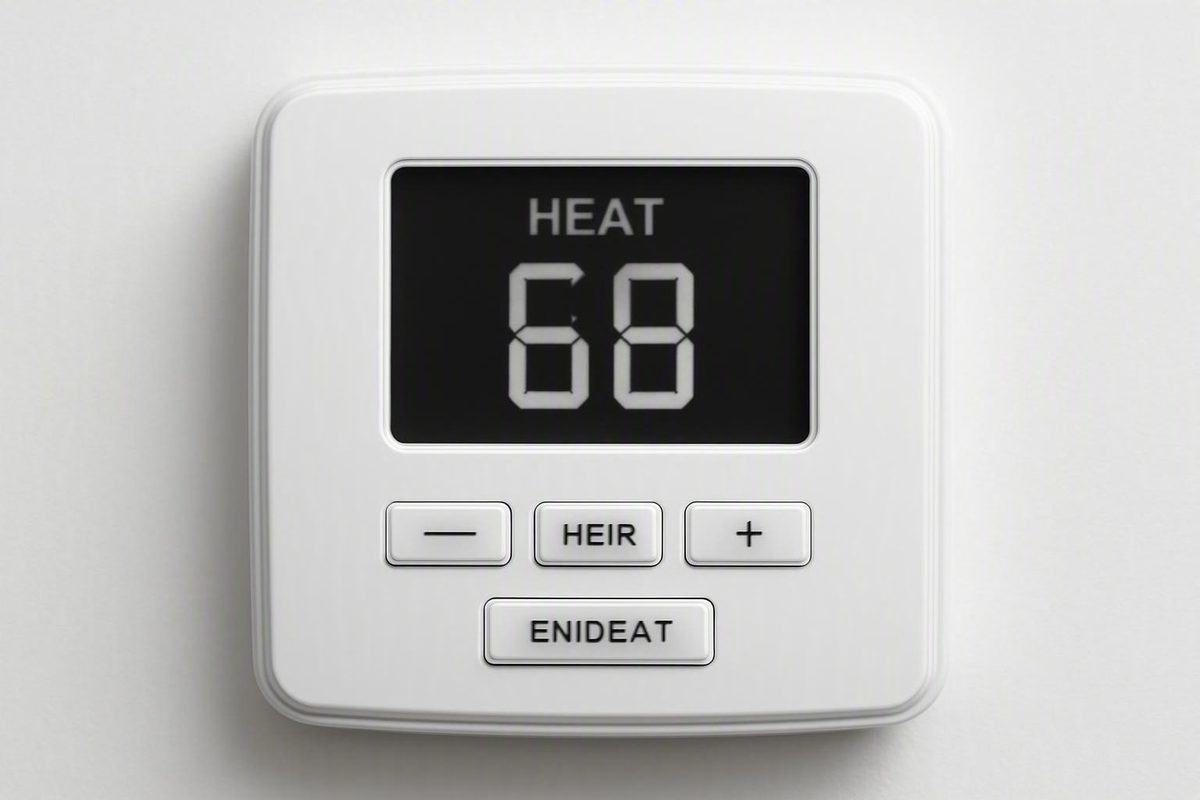
The short answer: Heat is routine; EM Heat is a temporary fallback
For ordinary winter operation, select Heat and let the system’s controls manage the heat pump and any supplemental heat it needs. Select EM Heat, short for Emergency Heat, only as a temporary fallback when the outdoor heat pump cannot operate normally, is being serviced, or your equipment documentation or technician directs you to use it.
In a typical system, Heat mode operates the outdoor heat pump as the primary heating source. The controls may add AUX Heat or SUPP Heat automatically when heat-pump output alone is temporarily insufficient. By contrast, EM Heat generally disables or bypasses the outdoor heat pump and relies on the installed backup source. That source may be electric resistance equipment or, in some systems, a gas or oil furnace (Lennox’s emergency-heat explanation).
Electric resistance backup commonly takes the form of heat strips in or near the indoor air handler, but this configuration is not universal. A dual-fuel system may use a furnace instead. Before drawing conclusions about operation or cost, identify the backup equipment installed in your home through accessible documentation or a qualified technician.
| Thermostat state | Activation | Equipment commonly operating | Main purpose | Cost tendency |
|---|---|---|---|---|
| Heat | Selected for routine heating | Outdoor heat pump and indoor blower; backup may be added automatically | Normal everyday heating | Usually the preferred operating mode |
| AUX Heat or SUPP Heat | Commonly requested automatically by the controls | Heat pump usually remains primary while backup supplements it | Help during high demand, recovery, or defrost | May increase energy use while active, especially with electric strips |
| EM Heat | Usually selected deliberately, although labels and control behavior vary | Outdoor heat pump is generally bypassed; installed backup carries the heating load | Temporary fallback when the heat pump cannot or should not run | Often more expensive with electric resistance backup; other backup types require a system-specific comparison |
The cost tendencies in this table are general rather than universal. Electric resistance backup normally uses more purchased electricity than heat-pump operation for the same heating need, while gas- or oil-backup economics depend on the equipment and fuel involved (Craighead Electric Cooperative’s emergency-heat guide).
EM Heat is not a turbo setting. It ordinarily does not combine full heat-pump output with backup output to warm the house faster. Instead, it substitutes the backup source for normal outdoor heat-pump operation. If the backup source has limited capacity, is unavailable, or cannot keep pace with the home’s heat loss, the house may warm slowly or remain cold.
Do not select EM Heat solely because the outdoor temperature has fallen below freezing. Heat-pump capability, controls, climate, equipment sizing, and building load vary. A functioning system may remain in Heat and add auxiliary heat as needed. Fixed instructions such as “always use EM Heat below 30°F” or “below 40°F” do not apply reliably to every installation.
Use this immediate decision guide:
- The home is maintaining temperature and nothing appears damaged: Leave the thermostat in Heat.
- AUX or SUPP appears briefly: Continue monitoring in Heat.
- The outdoor unit is visibly damaged, will not operate, remains heavily iced rather than returning to normal operation, or is being serviced: Use EM Heat temporarily only if your system documentation or technician permits it and backup heat is available.
- The system repeatedly shuts down, the home continues getting colder, or the display shows an unresolved alert: Arrange professional evaluation rather than trying to identify a failed part from the thermostat.
What changes inside the system when you select each mode
An air-source heat pump does not produce all of the home’s heat through electric resistance elements. In Heat mode, it uses a refrigerant cycle to collect available heat outdoors and release it indoors. This process can continue even when the outdoor air feels cold because that air still contains thermal energy.
A typical Heat-mode sequence looks like this:
- The thermostat detects a need for heating.
- The outdoor compressor and fan operate as the refrigerant circuit collects heat outdoors.
- Refrigerant carries that heat to the indoor coil.
- The indoor blower moves household air across the coil and through the ducts.
- If the controls determine that additional heat is needed, they may request an auxiliary source.
This is a simplified operating sequence, not a diagnostic test. Variable-speed compressors, staged heaters, communicating controls, zoning systems, and dual-fuel installations may behave differently.
In a system with electric backup, the supplemental source is commonly a bank of resistance coils or heat strips in or near the indoor air handler. Electrical current heats those elements, and the blower distributes the resulting heat through the duct system. The important energy distinction is that resistance elements convert electrical input directly into heat, while a heat pump uses electricity to transfer existing heat through a refrigerant cycle.
When EM Heat is selected on a conventional thermostat, the sequence generally changes in two ways:
- The thermostat prevents or bypasses normal outdoor heat-pump operation.
- It directs the heating request to the installed backup equipment.
The outdoor compressor and fan will therefore usually remain off while the backup source and indoor blower operate. This is why EM Heat generally does not add emergency output on top of normal heat-pump output: it removes the outdoor unit from the heating sequence.
A dual-fuel system is different from a heat pump with electric strips. Do not assume that advice written for electric heat strips describes the operating sequence or cost of a dual-fuel installation.
The words shown on a thermostat are not a complete system diagram. One display may say AUX, another SUPP, and another Stage 2. Some interfaces distinguish supplemental and emergency operation clearly; others use overlapping labels. Smart thermostats may also present a notification differently from a selectable mode.
For a particular home, the governing information is:
- The thermostat’s model-specific manual
- The outdoor heat pump’s documentation
- The indoor air handler or furnace documentation
- The installer’s configured control strategy
- The backup equipment actually installed
Do not assume you have electric heat strips merely because the thermostat offers an EM Heat setting. Likewise, gas service to the home does not establish that a gas furnace is the heat pump’s backup. Use accessible records or ask a qualified technician; do not open equipment panels merely to investigate the configuration.
AUX Heat is not the same operating state as EM Heat
The clearest way to understand these controls is as three operating states, not two:
- Normal Heat
- Heat with automatic auxiliary or supplemental assistance
- Emergency backup operation that bypasses the heat pump
Auxiliary heat commonly turns on automatically while the heat pump remains the primary source. It supplements normal operation. Emergency Heat is generally a backup-only state in which the outdoor heat pump is disabled or bypassed.
AUX or SUPP may appear because:
- Heating demand temporarily exceeds the heat pump’s current output.
- The thermostat setting was raised substantially, prompting faster recovery.
- Outdoor conditions have reduced available heat-pump capacity.
- The system is completing a defrost cycle.
- A staged or communicating control has requested additional capacity.
A brief AUX or SUPP indication therefore does not, by itself, prove that anything is broken. If the home is maintaining temperature, the indication clears, and the system returns to its usual sequence, the controls may simply be managing temporary demand. Automatic supplemental heat during higher demand and defrost is a recognized operating pattern, although the exact logic varies (Keith Key Heating & Air’s auxiliary-versus-emergency overview).
A large set-point increase can be particularly confusing. Depending on its programming, the thermostat may interpret a substantial temperature difference as a request for additional stages and activate electric strips or another backup source. That does not necessarily mean the heat pump could not maintain the eventual set point; the controls may simply be responding to a large recovery demand.
The practical contrast is:
- AUX/SUPP: “The heat pump is operating, but additional heat is wanted.”
- EM Heat: “Do not depend on the outdoor heat pump; use the backup source.”
That distinction is typical, not absolute across every product. Some sources and thermostat interfaces use “auxiliary,” “backup,” and “emergency” loosely. A display may report that backup heat is active without clearly showing whether the heat pump has been disabled. Some equipment may also invoke a fallback condition through its controls rather than only through a physical mode switch.
Avoid categorical claims such as “Emergency Heat can never turn on automatically.” If the display changes unexpectedly:
- Confirm whether the thermostat is actually set to Emergency Heat or merely reporting backup heat.
- Record the exact wording, symbols, alerts, or error codes.
- Consult the thermostat manual for the difference between status indicators and selectable modes.
- Check the heat-pump and backup-equipment manuals for their intended sequence.
- Arrange service if the display remains unexplained or the home is not heating.
The useful rule is that brief automatic assistance can be normal, while persistent or unexplained backup-only operation deserves investigation.
When to leave Heat on—and when temporary EM Heat may be appropriate
Begin with what the system and home are doing, not with a fixed outdoor-temperature threshold.
Leave the thermostat in Heat when:
- The home is maintaining a reasonable indoor temperature.
- The outdoor unit appears to be operating normally.
- AUX or SUPP appears only temporarily.
- A brief defrost event ends and ordinary heating resumes.
- Supply air feels less hot than furnace air, but the indoor temperature is stable or rising.
- There is light frost rather than persistent heavy ice.
- No visible damage or unresolved equipment alert is present.
A heat pump may run long cycles in cold weather. That alone does not establish a malfunction. Its supply air may also feel less intensely hot than air from a combustion furnace. Judge performance primarily by whether the system maintains the home and follows its normal sequence, not by whether the air feels especially hot against your hand.
Freezing weather by itself is not a universal reason to select EM Heat. Heat pumps differ in cold-weather performance, and a home’s heating load depends on factors such as insulation, air leakage, wind, indoor set point, and duct condition. Normal Heat mode can request backup assistance without requiring the homeowner to bypass the outdoor unit (Coolray’s cold-weather and emergency-heat guide).
Temporary EM Heat may be appropriate when all three conditions are met:
- The outdoor heat pump should not or cannot continue normal operation.
- The home has a functioning backup heating source.
- The thermostat manual, equipment documentation, or professional guidance permits emergency operation.
Examples include:
- The outdoor unit is visibly damaged.
- The heat pump will not operate or does not resume after an apparent defrost event.
- Thick ice remains instead of clearing through the system’s normal operation.
- The outdoor unit is being serviced and has intentionally been taken out of operation.
- A technician directs you to use backup heat while repair is pending.
- Model-specific documentation identifies EM Heat as the appropriate temporary response.
If the outdoor unit cannot produce heat and the backup source is available, EM Heat may help maintain indoor conditions while service is arranged. It is a bridge, not a diagnosis. If the house warms in EM Heat, that suggests some backup capacity is available; it does not reveal what is wrong with the heat pump. If the house does not warm, that symptom likewise does not identify a particular failed component.
Persistent reliance on EM Heat warrants investigation. The outdoor unit, backup source, controls, power supply, airflow, duct distribution, or available heating capacity may all affect the result. A thermostat display cannot reliably distinguish among those possibilities.
After temporary emergency operation, return to Heat only when:
- Normal outdoor-unit operation has resumed and no unresolved concern remains;
- Model-specific instructions indicate that routine operation may resume; or
- The technician handling the problem confirms that the heat pump can be used.
Avoid repeatedly alternating between Heat and EM Heat to see whether the system will “catch.” Repeated mode changes can obscure the sequence you need to report and are not a substitute for diagnosis.
Normal defrost behavior versus persistent icing or failure
In heating mode, the outdoor coil can become cold enough for moisture in the air to freeze on it. Because accumulated frost restricts airflow, an air-source heat pump periodically enters a defrost cycle.
During defrost, the system may temporarily reverse its refrigerant operation so heat reaches the outdoor coil and melts the frost. The controls may request auxiliary heat to reduce the indoor effect of that reversal. This temporary reversal and supplemental-heat response are part of the normal defrost sequence on the electric-backup systems described by Craighead Electric Cooperative (its explanation of heat-pump defrost).
Potentially normal observations during a brief defrost event include:
- Light frost on the outdoor coil
- Water draining beneath the unit
- Steam or vapor rising as frost melts
- A whooshing or shifting refrigerant sound
- A temporary pause of the outdoor fan
- A change in indoor supply-air temperature
- A temporary AUX or SUPP indication
- Resumption of ordinary heating afterward
Steam can look alarming, particularly under outdoor lighting, but it is not automatically evidence of failure. The complete operating pattern matters: a normal defrost event is temporary and is followed by a return to heating operation.
Do not switch to EM Heat merely because you see light frost, hear a brief whoosh, or notice vapor. More concerning patterns include:
- Thick ice that persists rather than clearing
- Ice obstructing the fan area
- Visible impact or cabinet damage
- An outdoor fan that repeatedly fails to resume
- Repeated interruptions without sustained heating
- Severe or unfamiliar mechanical noise
- An unresolved thermostat or equipment error
- An indoor temperature that continues to fall
There is no universal defrost duration or ice-thickness threshold for every heat pump. Timing and visible behavior vary with the model, controls, temperature, humidity, precipitation, airflow, and coil condition. Use the equipment manual and the overall sequence rather than a generic stopwatch rule.
Keep homeowner checks external. Do not remove access panels or attempt electrical, refrigerant, compressor, fan-motor, sensor, or internal control work. If persistent ice or failure to restart points to a problem, arrange qualified evaluation rather than trying to clear or repair internal equipment yourself (Keith Key Heating & Air’s defrost and emergency-heat guidance).
Why electric EM Heat usually costs more—and how to estimate your cost
A heat pump and an electric resistance heater use electricity differently.
A heat pump powers a compressor, fans, and controls to transfer available heat into the home. Electric resistance elements convert purchased electricity directly into heat. For the same delivered heating need, electric resistance backup generally requires more purchased electricity than normal heat-pump operation.
That does not justify a universal claim that emergency heat always costs two, three, or six times as much. Published comparisons may assume different heater sizes, operating hours, weather, electricity prices, and heating loads. One frequently cited contractor example, for instance, compares normal operation and emergency heat under different outdoor conditions, so its resulting ratio cannot isolate the cost of changing modes alone (Charlotte Comfort Systems’ worked comparison).
Actual electric-backup cost depends on:
- The backup heater’s electrical capacity
- Which heating stages operate
- Runtime
- Outdoor weather
- Indoor set point
- Building heat loss
- Duct losses
- Local electricity price
For electric resistance backup, use this transparent estimate:
Estimated backup-heating energy cost = heater capacity in kW × operating hours × electricity price per kWh
This is a unit-based calculation: multiplying kilowatts by hours gives kilowatt-hours, which are then multiplied by the applicable electricity price. It is only as accurate as the capacity, runtime, and rate entered.
Obtain backup capacity from model-specific documentation, an installation record, a service invoice, or information a technician can verify. Do not guess from the home’s size or open an equipment panel to find an internal label.
The formula estimates the energy charge associated with electric resistance backup. It does not provide:
- The home’s total utility bill
- An exact Heat-versus-EM-Heat comparison
- Compressor or blower consumption
- Fixed fees or rate-structure effects
- Future runtime under different weather
- The cost of gas, oil, or another fuel
A valid comparison between modes requires actual energy use under reasonably comparable conditions. Comparing mild-weather heat-pump operation with emergency heating during a severe cold event mixes the effect of operating mode with the effect of a higher building load.
Dual-fuel systems need a different calculation. A gas or oil furnace cannot be evaluated with the electric-resistance formula; the result depends on the fuel consumed, its price, the equipment involved, and the system’s control strategy. The safe financial conclusion is therefore narrow: electric resistance EM Heat generally costs more to operate than normal heat-pump heating, but the amount must be estimated from the installed equipment, runtime, and electricity rate.
Safe external checks before you change modes or request service
These checks gather observations. They cannot identify a failed compressor, sensor, heat strip, thermostat, control board, refrigerant circuit, or other component.
Start at the thermostat:
- Confirm the selected mode. Is it set to Heat, Emergency Heat, or Off?
- Check the set point. Compare it with the displayed indoor temperature.
- Read the exact status. “AUX Heat,” “Backup Heat,” and “Emergency Heat” may describe different conditions.
- Record alerts and error codes. Photograph the display if useful.
- Check battery status when applicable. Follow the thermostat manual if it uses owner-replaceable batteries.
- Note recent changes. Record schedule changes, set-point increases, or manual selection of EM Heat.
Next, make limited indoor observations:
- If the filter is externally accessible through its normal homeowner access point, visually check its condition.
- Observe whether airflow at the usual supply registers is present, absent, or noticeably different.
- Check whether the comfort problem affects the whole home or only certain rooms.
- Listen for ordinary blower operation without removing panels.
- Note whether the indoor temperature rises, remains steady, or falls.
A dirty filter or airflow change can contribute to poor comfort, but neither proves the cause. Replace a filter only through the ordinary procedure specified for the system.
From ground level and a safe distance, observe the outdoor unit for:
- A visible obstruction
- Persistent heavy icing
- Physical damage
- Lack of operation while Heat is calling
- Failure to resume after an apparent defrost event
- Severe or unfamiliar noise
Do not remove access panels or touch the fan, wiring, refrigerant components, or internal equipment. A breaker may be observed from a safely accessible panel, but a breaker that trips again indicates an unresolved condition and should not be repeatedly reset. These boundaries follow HVAC Lens’s general framework for external homeowner observations rather than internal diagnosis or repair (safe HVAC checks and stop boundaries).
Avoid repeatedly switching the thermostat off and on or moving back and forth between Heat and EM Heat. Instead, record:
- Which mode was selected
- Which equipment appeared to operate
- Whether AUX or SUPP was displayed
- Whether the outdoor unit resumed operation
- Whether the indoor temperature rose, held steady, or fell
- Whether there was visible ice, damage, an unusual odor, or abnormal sound
- Whether a breaker trip or error indication recurred
If EM Heat is selected but the home remains cold, do not turn that symptom into a parts diagnosis. The backup equipment may be unavailable, have limited capacity, or be unable to keep pace with the building’s heating load. Controls, airflow, power, and duct distribution may also affect the result. Professional testing is needed to distinguish among these categories.
When to stop operating the system and when to arrange service
Arrange professional service when:
- The heat pump will not heat the home.
- The outdoor unit does not resume normal operation after an apparent defrost event.
- Heavy ice persists.
- EM Heat is repeatedly required.
- The home remains cold with backup heat selected.
- The outdoor unit is visibly damaged.
- The equipment repeatedly shuts down.
- A thermostat or equipment error remains unresolved.
- You cannot determine whether the displayed label indicates automatic supplemental heat or emergency bypass operation.
These symptoms support the need for evaluation, not a particular diagnosis. A nonoperating outdoor unit does not by itself prove compressor failure. Persistent ice does not establish a defective sensor, control, or refrigerant problem. Inadequate backup heat does not prove that an electric strip or furnace component has failed.
Stop normal homeowner troubleshooting when there is:
- Smoke or an electrical burning odor
- Exposed or damaged wiring
- A breaker that trips again
- Severe grinding, screeching, violent rattling, or intense buzzing
- Water near electrical equipment
- A badly damaged equipment cabinet
- Any condition that makes approaching the thermostat or equipment unsafe
If a safe shutdown is possible, use only the ordinary thermostat control or a normal, clearly accessible equipment switch. Do not approach wet electrical equipment, smoke, exposed conductors, active fire, or a damaged electrical panel merely to turn the system off. These are general HVAC safety boundaries, not heat-pump diagnostic steps (HVAC Lens’s homeowner safety framework).
For a nonhazardous performance problem, prepare for the service call by recording:
- Thermostat make and model
- Equipment model information already available through safe records
- Selected mode and set point
- Exact display messages
- Indoor temperature trend
- Whether the outdoor unit operated
- Whether AUX or SUPP appeared
- Ice, vapor, sound, odor, or damage observations
- Breaker behavior
- When the problem began and whether it is intermittent
Useful questions for the technician include:
- What backup source is installed?
- Does EM Heat disable the heat pump on this system?
- What triggers AUX or SUPP?
- Was the observed defrost behavior normal?
- Is the backup source operating at its intended stages?
- When is it appropriate to return to Heat?
- What test supports the diagnosis?
- Does the thermostat configuration match the installed equipment?
Model-specific manuals and qualified testing take precedence over general online guidance. Thermostat labels, staging, dual-fuel controls, defrost behavior, and backup configuration are too installation-dependent for external symptoms alone to settle the issue.
HVAC Lens provides homeowner education intended to support safer observations and better questions before a service visit. Its purpose is to make maintenance calls, estimates, and comfort complaints easier to understand—not to train homeowners as technicians or provide remote repair (About HVAC Lens).
Frequently asked questions
Will EM Heat warm my house faster than regular Heat?
Not necessarily, and that is not its purpose. EM Heat generally bypasses the outdoor heat pump and relies on the backup source rather than adding a boost to normal heat-pump output.
Depending on backup capacity and the home’s heating load, the house may warm at a similar rate, more slowly, or inadequately. Use Heat when the heat pump is functioning; use EM Heat as a temporary fallback when the outdoor unit cannot or should not operate.
Should I switch to EM Heat whenever the temperature falls below freezing?
No. Outdoor temperature alone is not a universal switching rule. Heat-pump cold-weather capability, thermostat logic, supplemental-heat staging, climate, and building load vary.
A functioning heat pump can remain in Heat below freezing and request supplemental heat automatically when its controls determine that assistance is needed. Select EM Heat only when the outdoor unit cannot operate normally, is being serviced, or system-specific documentation or a technician directs its use.
Can Emergency Heat turn on automatically, or must I select it manually?
Emergency Heat is usually presented as a manually selected backup mode, while AUX or SUPP Heat is commonly automatic. Thermostat terminology and control logic are not standardized, however. Some products may display backup operation in a way that resembles an Emergency Heat alert, and some systems may invoke a fallback condition through their controls.
Check whether the thermostat is set to Emergency Heat or merely reporting that backup heat is active. The thermostat and equipment manuals are the best authority for your installation.
Why is the house still cold even though EM Heat is on?
EM Heat can use only the backup capacity installed and available. The house may remain cold if that capacity is unavailable, limited, or unable to keep pace with the building’s heating load. Airflow, controls, power, and duct distribution may also affect the result.
The symptom does not identify a failed part. Confirm the thermostat mode and set point, record alerts and temperature trends, make only safe external observations, and arrange professional evaluation.
How long can I leave EM Heat running while waiting for repair?
If the equipment is operating normally and its documentation or a technician permits emergency operation, EM Heat can serve as temporary heating while repair is pending. Electric resistance backup may be costly, and continued reliance means the primary system still needs attention.
Monitor the thermostat, indoor temperature, equipment alerts, breaker behavior, and visible outdoor conditions. Stop homeowner troubleshooting if a safety warning appears, and return to Heat only after normal operation resumes or repair guidance confirms that the heat pump can be used.
For a functioning heat pump, leave the thermostat in Heat and allow the controls to add auxiliary heat when needed. Use EM Heat only as a temporary, system-appropriate fallback when the outdoor unit cannot operate normally. Then arrange evaluation rather than treating backup heat as a permanent replacement.