
Cooling
What to Check, What to Leave Alone, and When to Shut the AC Off
Smoke, a burning odor, repeated breaker trips, severe noise, substantial water leakage, visible ice or rapid cycling mean stop troubleshooting.
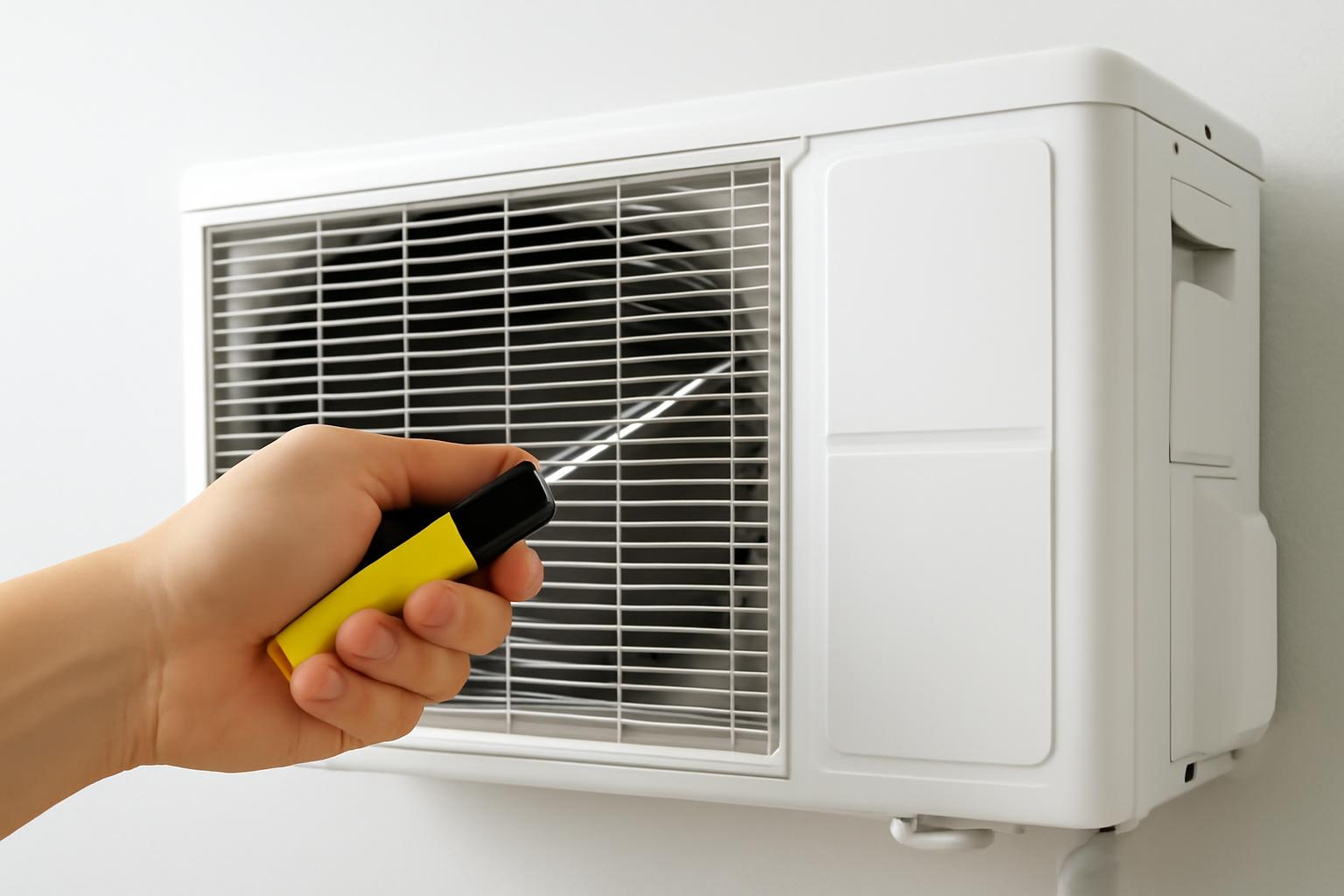
When an air conditioner appears broken, the first question is not “Which part failed?” It is “Can I safely make a few external checks, or should I stop the equipment and get help?”
A blank thermostat, dirty filter, tripped breaker, blocked outdoor unit, full drain pan, or poorly seated access panel can imitate a major failure. Symptoms alone, however, cannot establish the cause.
This guide uses three safety labels:
- Homeowner-safe observation: An external check requiring no tools, internal access, energized testing, or contact with refrigerant components.
- System-dependent maintenance: A task appropriate only when the equipment manual expressly describes it and the installation is accessible and safe.
- Technician-only work: Diagnosis or repair involving electricity, refrigerant, sealed compartments, motors, coils, compressors, internal wiring, or protective controls.
Start Here: Decide Whether to Troubleshoot or Shut the AC Off
Quick decision
- Protect people first. If heat is becoming unsafe or anyone is becoming unwell, move occupants and pets to a reliably cooler place.
- Check for warning signs. Smoke, a burning odor, repeated breaker trips, severe noise, substantial water leakage, visible ice, or rapid cycling means stop troubleshooting.
- Make basic external checks only when no immediate hazard is present. Do not open internal panels or test components.
During extreme heat, young children, older adults, medically vulnerable occupants, and pets take priority over the equipment. Fans, closed blinds, and reduced appliance use may make a room more tolerable, but they should not delay relocation when indoor conditions continue to worsen. A sponsored heatwave service article likewise recommends moving vulnerable occupants and pets to a cooler location before troubleshooting the failed system (heatwave AC failure guidance).
Stop operating the system and request qualified help if you encounter:
- Smoke or an electrical burning odor
- A breaker that trips again after one safe reset
- Severe buzzing, grinding, screeching, or squealing
- Substantial water entering the home
- Water close to electrical equipment
- Visible ice on a coil, cabinet, or refrigerant line
- Rapid, repeated starts and stops
- Exposed or damaged wiring
- A damaged equipment cabinet
Here, “turn the system off” means using the thermostat or an ordinary visible equipment switch only if it is safely accessible. Do not approach wet electrical equipment, a smoking cabinet, active fire, exposed wiring, or an unsafe electrical panel merely to perform a shutdown. Burning odors, leaks, ice, repeated breaker trips, abnormal noises, and short cycling are all conservative reasons to stop and seek professional service, but they do not identify the failed component (Southern Air’s commercial broken-AC guidance).
If an AC breaker has tripped and there is no smoke, burning odor, water near electrical equipment, severe noise, or visible damage, you may reset it once. If it trips again, leave it off. Trane’s manufacturer guidance also recommends professional attention when an AC breaker continues to trip (Trane air-conditioner troubleshooting).
Treat a gas odor differently from ordinary AC trouble. Leave the building rather than remaining inside to inspect the thermostat, furnace, air handler, or AC cabinet, and contact the gas utility or appropriate emergency service from a safe location. The available commercial HVAC guidance similarly treats gas odor as an evacuation issue, not a normal troubleshooting step (Extreme Comfort’s gas-odor warning).
Follow the alarm instructions and leave instead of troubleshooting.
Know Which System You Have Before Following a Checklist
The main checklist is designed for a typical central split air-conditioning system. That arrangement usually includes:
- A thermostat
- An indoor air handler or furnace containing the blower and indoor coil
- Ductwork with return grilles and supply registers
- An outdoor condenser
- A condensate drain or pump
- Household breakers and one or more visible equipment switches
Do not assume that every air conditioner has these components, controls, or access arrangements.
A heat pump also uses an outdoor unit, but it provides both heating and cooling. Thermostat modes and equipment responses vary by model and season. Confirm that the thermostat is in the intended mode, then consult the manufacturer’s manual before interpreting outdoor-unit pauses, sounds, or displayed messages.
For a ductless mini-split, limit your checks to the remote or wall controller, displayed error code, accessible filter, visible indoor-unit obstruction, and outdoor clearance. Do not remove the indoor head’s internal covers or transfer central-system panel and drain instructions to it.
For a packaged system, heating and cooling components may share one exterior cabinet. Treat that cabinet as technician-only. For a window unit or portable air conditioner, external checks may include the plug, receptacle, controls, accessible filter, visible inlet or outlet obstruction, condensate container, and required window or exhaust-hose arrangement. Follow the model manual before resetting built-in plug protection or handling drainage.
In short, do not apply central-system breaker, panel, drain, or outdoor-unit instructions unchanged to a heat pump, mini-split, packaged system, window unit, or portable AC.
Identify your equipment without opening anything:
- Note whether cooled air comes through ducts, wall-mounted heads, a window unit, or a portable hose.
- Photograph the thermostat or controller display.
- Look for an equipment label on an accessible cabinet exterior.
- Record the model and serial number without reaching around wiring, piping, or moving parts.
- Estimate the installation year from home records, invoices, or a plainly stated label date.
- Search the exact model number for the manufacturer’s manual.
- Record any displayed error code before changing settings or power.
HVAC Lens publishes homeowner-oriented information about filters, cycling, humidity, system fit, and contractor questions. Its About page explains that the goal is to make maintenance calls and estimates easier to understand—not to train readers as technicians. The publication provides general education rather than remote diagnosis, repair, installation, or emergency service, and its terms advise confirming major equipment changes with a licensed professional (HVAC Lens terms).
The 10-Minute Homeowner-Safe Check
This sequence is external observation, not repair. Stop immediately if you encounter exposed wiring, water near electrical equipment, smoke, a burning odor, severe noise, visible ice, cabinet damage, or anything that feels unsafe.
Complete the checks once, in order. If you correct a simple external issue, allow the thermostat and equipment controls several minutes to respond. Do not keep restarting the system.
Step 1: Check the thermostat
Label: Homeowner-safe observation
Confirm that:
- The display has power.
- The mode is set to Cool.
- The target temperature is below the displayed room temperature.
- The schedule has not raised the target.
- No obvious error or service message is displayed.
- Accessible batteries are replaced if the model uses them and the display is blank or weak.
For a basic test, leave the fan setting on Auto unless the equipment manual says otherwise. A fan set to On may circulate room-temperature air between cooling cycles, making the symptom harder to interpret.
Step 2: Check the breaker and visible equipment switches
Label: Homeowner-safe observation
At the household electrical panel, look for a clearly labeled AC, condenser, air-handler, or furnace breaker.
Reset it no more than once and only when conditions appear safe. If it trips again, leave it off and call a qualified HVAC technician or electrician. Do not remove the panel cover, replace internal fuses, or touch wiring.
You may also check ordinary visible equipment switches that resemble wall switches near the indoor equipment. Do not open disconnect boxes or use a breaker as a repeated on-off control.
Step 3: Inspect the air filter
Label: Homeowner-safe observation when the filter is designed for routine user access
Remove only a filter intended for normal homeowner access. If it is visibly loaded with dust or debris, replace it with the correct size and install it in the airflow direction marked on the filter or cabinet.
No single replacement interval suits every home. Filter depth, system runtime, pets, dust, smoke, renovation activity, occupancy, and existing airflow constraints all affect how quickly a filter loads. Inspect the actual filter instead of relying only on a calendar.
A dirty filter can restrict airflow, reduce cooling performance, and contribute to freezing or a protective shutdown. Do not compensate by removing the filter and operating the system unfiltered.
Step 4: Check return grilles and supply registers
Label: Homeowner-safe observation
Confirm that large return grilles are not blocked by furniture, boxes, curtains, or rugs. Make sure supply registers are open and unobstructed.
Do not close multiple registers to save energy or force more cooling into another room. Closing vents can alter system airflow and pressure without correcting the underlying comfort problem.
If only one or two rooms have weak airflow while the rest of the house appears normal, record the pattern. It may help a technician distinguish a local register or duct problem from a whole-system issue.
Step 5: Observe the outdoor unit from a safe distance
Label: Homeowner-safe observation
Look for leaves, grass clippings, vegetation, bags, fencing, stored objects, or other material visibly obstructing airflow around the outdoor cabinet. Move only loose objects that can be reached without opening the cabinet, touching tubing or wiring, or placing hands near the fan.
Do not pressure-wash the unit, reach through the grille, bend fins with tools, or remove panels. Commercial HVAC guidance warns that high-pressure water can damage condenser fins and reserves internal equipment work for trained service personnel.
From a safe position, record whether:
- You hear the outdoor unit
- The fan appears to turn
- The unit repeatedly attempts to start
- The cabinet remains silent
Silence does not prove the outdoor unit has failed.
Step 6: Look at the condensate area
Label: Homeowner-safe observation
Without touching electrical components, look for:
- A full or overflowing drain pan
- Water on the floor
- Dampness below the indoor equipment
- An obviously backed-up drain area
- A condensate-pump alarm or full reservoir
- Water stains suggesting an earlier overflow
Some systems use a float switch that stops operation when drainage backs up, helping limit an overflow. A no-start condition can therefore be intentional rather than evidence of compressor failure.
Do not apply vinegar, bleach, boiling water, compressed air, or a shop vacuum as a universal drain treatment. Drain layouts, pumps, traps, venting, connection points, and materials vary. Use only a method expressly described in the model or installation manual; otherwise, leave drain clearing to a technician.
Step 7: Confirm ordinary access panels appear seated
Label: Homeowner-safe observation
Look at the normal filter door or other exterior routine-access cover without removing an internal equipment panel. If a filter door is visibly loose and can be seated as intended without tools or exposure to wiring, moving parts, or internal components, correct its position.
Some air handlers and furnaces use door interlocks that prevent operation when a panel is not seated. Never tape down, hold, bypass, or defeat an interlock or float switch. If a protective control has stopped the equipment, the reason it operated needs to be identified.
After completing the checks, wait a few minutes and record whether:
- The thermostat status changed
- The indoor fan started
- The outdoor unit started
- Airflow improved
- Vent air remained warm
- The system stopped again
- The breaker tripped
- Water, ice, odor, or noise appeared
If normal cooling does not return, stop cycling controls and prepare for service.
Read the Symptom: No Start, Warm Air, Weak Airflow, Water, Ice, Noise, or Short Cycling
An AC symptom can narrow the next safe action, but it rarely identifies one failed part. Treat this as a symptom-to-next-step decision tree, not a remote diagnosis.
No start: thermostat and equipment appear inactive
Revisit the thermostat display, batteries, Cool mode, setpoint, breaker, and visible equipment switches. Inspect the filter, condensate area, and visibly seated routine-access panels.
If batteries do not restore a blank thermostat, the issue could involve thermostat power, a control circuit, a float switch, an interlock, or another fault. If the thermostat shows a cooling request but neither the indoor nor outdoor equipment responds, request service after completing the external checks.
Do not open a panel to search for a fuse, transformer, control board, or loose wire.
Indoor fan runs, but the home does not cool
Confirm Cool mode and a target below room temperature. Check the filter, returns, supply registers, and outdoor-unit clearance. From a safe position, note whether the outdoor unit appears to be operating.
Possible causes beyond those checks include an indoor or outdoor coil, fan, thermostat, electrical control, refrigerant circuit, compressor, duct system, or another component. Trane’s manufacturer troubleshooting guide similarly lists settings, filters, coils, drainage, power, and refrigerant-related problems as possibilities—not a diagnosis.
Air from the vents feels warm
First separate an obvious control or airflow issue from a problem requiring service:
- Is the thermostat in Cool mode?
- Is the target below the room temperature?
- Is the fan set to On and circulating air between cooling cycles?
- Is the filter visibly dirty?
- Are returns and registers open?
- Does the outdoor unit appear to operate?
- Did the symptom start suddenly or worsen gradually?
Warm air does not prove that the compressor has failed or the refrigerant is low. If settings and external airflow checks are correct, request a qualified diagnosis.
Airflow is weak
A dirty filter, blocked return, closed register, damaged or disconnected duct, indoor-coil restriction, blower fault, or control problem could contribute. Compare rooms and note whether the weakness affects the whole home or one area.
Do not remove an air-handler panel to inspect a blower wheel, motor, belt, or coil. Those are technician-only areas.
Water is near the indoor unit
A clogged drain, drain-pump problem, overflowing pan, thawing ice, or installation issue may be involved. If water is entering the home, stop cooling if the controls are safely accessible. Do not touch nearby electrical equipment or stand in water while operating a thermostat, switch, or panel. Enercare’s commercial troubleshooting guide also advises shutting off an AC that is leaking into the home (Enercare AC troubleshooting).
Protect flooring with towels or a container only when you can do so without approaching energized equipment or reaching under the cabinet. Arrange service promptly because continued leakage may damage floors, walls, ceilings, or belongings.
Ice is visible
Ice on an indoor coil, cabinet, or refrigerant line can occur with restricted airflow, a refrigerant-related fault, control trouble, or other problems. Stop cooling if the thermostat or ordinary switch is safely accessible and arrange diagnosis.
Do not chip, scrape, puncture, or directly heat the ice. Do not restart the system repeatedly to see whether it clears.
Adding refrigerant is not a homeowner remedy and may not correct the underlying cause.
The system starts and stops repeatedly
Normal operation can also involve shorter cycles under some conditions, so record approximate run and off times rather than assigning a cause.
Repeated restarting is not a solution. If cycling is rapid, accompanied by severe buzzing, or followed by a breaker trip, stop the system when safely possible and request service.
There is grinding, squealing, severe buzzing, or a burning odor
Turn the system off only through a safely accessible control. Do not approach smoking equipment, wet electrical areas, or an unsafe cabinet to do so. Do not remove a panel to inspect motors, bearings, belts, capacitors, contactors, or wiring. Bryant’s manufacturer repair guide specifically advises immediately shutting down equipment making grinding or squealing sounds (Bryant AC repair guide).
If smoke or active fire is present, leave the immediate area and seek appropriate emergency assistance. If the odor is gas rather than electrical, leave the building and contact the gas utility or emergency service from a safe location.
There is a musty odor
A musty smell is not the same as an electrical burning odor or fuel-gas odor. Moisture, drainage trouble, wet material, or contamination may need inspection, but smell alone does not prove mold or establish its location.
Check externally for visible water and drainage trouble. Do not spray cleaners into an air handler, duct system, or mini-split head.
Someone says the refrigerant is low
Residential AC refrigerant circulates in a closed system. A low charge generally points to leakage or an earlier charging problem, not routine fuel-like consumption.
A qualified technician should evaluate the system, identify the cause where practical, explain the proposed repair, and charge the equipment to its required specification. A recharge alone may temporarily change performance without correcting a leak. Bryant’s manufacturer guidance likewise treats low refrigerant as an indication of leakage requiring professional repair.
Keep People Cooler and Limit Property Damage While You Wait
Temporary comfort measures may make a room more tolerable, but they do not guarantee safety during extreme heat. If indoor conditions continue to worsen or someone appears unwell, prioritize a reliably cooled location and appropriate medical assistance over further household troubleshooting.
Reduce incoming heat
Close blinds or curtains on windows receiving direct sunlight. Concentrate activity in the coolest practical part of the home, which may be a shaded lower level. Close off unusually hot rooms only if doing so does not block an HVAC return or create another hazard.
Reduce or postpone use of:
- Ovens and cooktops
- Clothes dryers
- Dishwashers
- Powerful lighting
- Other heat-producing appliances
Use fans for people, not empty rooms
Portable and ceiling fans move air across occupants and can improve perceived comfort. They do not materially reduce the room’s air temperature, so turn them off in unoccupied rooms and do not treat them as a substitute for relocation when heat is becoming unsafe. Aire Serv’s commercial temporary-cooling guidance makes the same distinction between cooling occupants and cooling a room (Aire Serv temporary cooling advice).
Avoid wet bedding, open ice containers near electrical devices, or improvised arrangements that create spill, condensation, or slip risks.
Drink fluids regularly unless a clinician has instructed you otherwise. This is general comfort guidance, not treatment for heat illness. If someone appears ill, seek appropriate medical help rather than continuing to troubleshoot the AC.
Ventilate selectively
Open windows only when outside air is cooler and ventilation is reasonable considering:
- Outdoor humidity
- Wildfire smoke or other air pollution
- Pollen
- Rain and wind
- Outdoor noise
- Insects
- Window-fall risks
- Home security
If outdoor air is hotter, more humid, smoky, polluted, or otherwise unsuitable, keep it out.
Limit water damage
If condensate is leaking into the home:
- Stop cooling through a safely accessible control.
- Keep people away from wet electrical areas.
- Protect flooring or belongings only from a safe position.
- Do not crawl under or reach into energized equipment.
- Arrange service and watch nearby ceilings or walls for spreading water.
If ice was present, leakage may increase as the equipment thaws.
For renters
Document the condition and notify the landlord or property manager promptly through the process established in the lease or building rules. Record:
- Thermostat reading and display
- Date and time the problem began
- Error codes
- Visible water or ice
- Unusual sounds or odors
- Rooms affected
- Basic external checks completed
- Property damage
Take photographs from a safe position and retain copies of written notices. Avoid internal repairs or major work unless you are authorized to arrange them.
What Not to Repair Yourself
The boundary is straightforward: observe accessible external conditions, perform only model-approved routine maintenance, and leave internal diagnosis to a qualified professional.
Homeowner-safe observation
Usually appropriate when conditions are safe:
- Reading the thermostat or controller
- Replacing accessible thermostat batteries
- Looking at the breaker position
- Checking visible equipment switches
- Inspecting a routine-access filter
- Confirming that registers and returns are unobstructed
- Observing the outdoor cabinet from a distance
- Looking for water, ice, error codes, sounds, or odors
- Photographing an exterior equipment label
System-dependent maintenance
Appropriate only when the manual describes the task for the exact model and installation:
- Removing and washing a reusable filter
- Emptying a portable AC condensate container
- Cleaning an accessible window-unit filter
- Resetting built-in plug protection
- Handling a model-specific condensate feature
- Opening a manufacturer-designated filter or maintenance cover that requires no tools and exposes no energized or moving parts
If the manual is unclear, leave the cover closed and ask the manufacturer or technician.
Technician-only work
Leave the following to a qualified professional:
- Refrigerant charging, recovery, leak testing, or leak repair
- Capacitor or contactor inspection and replacement
- Motor, compressor, or winding tests
- Indoor or outdoor coil repairs
- Energized voltage, current, or resistance testing
- Internal wiring and control-board work
- Sealed-component or internal-cabinet access
- Blower or fan disassembly
- Refrigerant-side adjustments
- Internal drain or pump repairs requiring equipment access
Capacitors and high-voltage equipment are not appropriate for homeowner inspection or testing. Commercial AC safety guidance places electrical and refrigerant work with trained professionals, and the available evidence does not support DIY capacitor testing or handling.
Never bypass a float switch, access-panel interlock, breaker, pressure control, or another protective device. If a control has stopped the equipment, the appropriate response is to determine why it operated—not defeat it.
There is no universal condensate-line clearing recipe. Do not assume boiling water, chemicals, compressed air, or a shop vacuum is suitable for a particular installation. Follow the exact model and installation documentation or let a technician identify the drain arrangement.
Do not pressure-wash condenser fins, open sealed cabinets, alter refrigerant-side settings, or attempt to thaw equipment with a knife, heat gun, hair dryer, flame, or other direct heat.
DIY intervention can also make later diagnosis harder. Moving wiring or controls can create a new fault. A clear description of an untouched symptom is more useful than a guessed repair.
Prepare for the Service Call and Evaluate the Diagnosis
Use this checklist before contacting a technician. Copy it into a phone note or print it.
- [ ] System type: central split AC, heat pump, mini-split, packaged, window, or portable
- [ ] Manufacturer and model
- [ ] Approximate installation age
- [ ] Thermostat mode
- [ ] Thermostat room reading and setpoint
- [ ] Thermostat or controller error code
- [ ] Whether the display has power
- [ ] Breaker position and whether it tripped again after one reset
- [ ] Visible equipment-switch positions
- [ ] Filter size and condition
- [ ] Return and register condition
- [ ] Visible ice
- [ ] Visible water, full pan, or drain-pump alarm
- [ ] Whether the indoor fan runs
- [ ] Whether the outdoor unit appears to run
- [ ] Unusual sounds
- [ ] Burning, musty, gas, or other odor
- [ ] Rooms with weak airflow or poor cooling
- [ ] Date and time the problem began
- [ ] Whether the failure was sudden or gradual
- [ ] External checks performed
- [ ] What, if anything, briefly restored operation
Take clear photographs of error codes, water, ice, and equipment labels from a safe position. If a sound is intermittent, make a short recording only when you can do so without approaching moving parts, wet equipment, or a damaged cabinet.
Tell the technician exactly what happened and what you did. For example:
- “The breaker was reset once, the system ran for three minutes, and it tripped again.”
- “The indoor fan runs, the outdoor unit is silent, and the filter was replaced.”
- “Ice appeared on the line, so I stopped cooling and did not restart it.”
These observations are more useful than saying “the electrical system is bad” or guessing that the compressor failed.
Before authorizing work, ask:
- What failure did you diagnose?
- What observation or test supports that diagnosis?
- Does the proposed work correct the cause or only the symptom?
- What could happen if the repair is delayed?
- Are other major components showing deterioration?
- Is the work expected to restore normal capacity and operation?
For refrigerant work, ask directly: Does the quote include leak detection and repair, or only refrigerant recharge? Also ask how operation will be verified after the work.
Request a written scope identifying:
- Diagnostic charges
- Parts
- Labor
- Refrigerant
- Leak detection
- Permits, where applicable
- Disposal or recovery charges
- Follow-up testing
- Exclusions
- Parts and labor warranties
- Payment terms
If replacement is proposed, ask whether the assessment covered equipment sizing, airflow, duct condition, drainage, electrical requirements, and compatibility between the indoor and outdoor components. The quote should clearly identify what equipment remains and what changes.
Seek another assessment when the diagnosis is uncertain, a major component is involved, or complete replacement is proposed without a clear explanation. Trane’s manufacturer repair-or-replacement guide also recommends assessments from several HVAC companies before making a major decision (Trane repair-versus-replacement guide).
When comparing contractors, prioritize applicable licensing or certification, a written scope, transparent estimates, warranty terms, and a willingness to explain alternatives. A useful diagnosis connects symptoms, test results, proposed work, and the expected outcome.
Repair or Replace? Use the Diagnosis, Not One Formula
Begin with the diagnosed failure. An isolated thermostat, drain, capacitor, contactor, electrical control, or some motor problems present a different decision from a failed compressor, damaged major coil, or several deteriorating components.
Repair may deserve preference when:
- The system is relatively new.
- The fault is isolated.
- Major components are otherwise sound.
- Breakdowns have been infrequent.
- Cooling and humidity control were acceptable before the failure.
- Parts are available.
- Warranty coverage meaningfully reduces the total cost.
- No major sizing, duct, drainage, or installation problem is undermining performance.
Replacement deserves closer consideration when:
- Major failures recur.
- Several components are deteriorating.
- A compressor or major coil repair is proposed.
- Essential parts are unavailable or face long lead times.
- The system performed poorly even when operating.
- Cooling remains uneven or humidity control is unsatisfactory.
- The equipment is incorrectly sized or mismatched.
- A major repair is proposed for an older system with limited warranty.
- The repair would leave substantial unresolved risk.
Age is context, not a deadline. Published estimates vary. One consumer-finance discussion reports a central-AC life expectancy of roughly 10–15 years, while some manufacturer and contractor guidance gives longer ranges. Actual condition depends on climate, runtime, installation quality, maintenance, corrosion, power conditions, and repair history (CBS News’ repair-versus-replacement discussion).
The useful question is not merely “How old is it?” Ask: “What condition are its major components in, and what risks will remain after this repair?”
Review the actual warranty. A covered part does not necessarily mean a no-cost repair. Labor, diagnostics, refrigerant, shipping, permits, or related components may be excluded.
Refrigerant type and parts availability belong in the comparison, but an older refrigerant does not automatically require replacement. Ask:
- Can the required refrigerant and parts be obtained?
- Does the proposed work correct a leak or only add refrigerant?
- How do availability and serviceability affect immediate and future costs?
- Are any local requirements relevant to this particular project?
Two commercial rules of thumb are frequently mentioned:
- The “$5,000 rule”: Multiply system age by repair cost. A result above $5,000 is treated as a reason to consider replacement. Trane presents this as a rule of thumb rather than a definitive standard.
- The “50-percent rule”: Consider replacement when repair cost approaches half the quoted replacement cost. Commercial replacement guidance reports this as a commonly used heuristic, not a requirement (commercial discussion of the 50-percent rule).
Neither formula determines the correct decision. They do not adequately account for warranty coverage, installation quality, financing cost, local labor, expected time in the home, duct changes, component condition, or differences in replacement scope.
Use a side-by-side worksheet instead:
| Decision factor | Repair proposal | Replacement proposal |
|---|---|---|
| Diagnosed failure | ||
| Evidence supporting diagnosis | ||
| Total price | ||
| Parts and labor included | ||
| Refrigerant work included | ||
| Permit or electrical work | ||
| Warranty coverage | ||
| Condition of major components | ||
| Sizing assessment completed | ||
| Duct changes included | ||
| Drainage changes included | ||
| Matched indoor/outdoor equipment | ||
| Expected time in the home | ||
| Prior repair history | ||
| Comfort and humidity performance | ||
| Risk of additional repairs | ||
| Work not included |
Do not assume new equipment will pay for itself, guarantee lower bills, or solve every comfort problem. Efficiency, comfort, and operating cost depend on equipment sizing, duct leakage and restriction, installation quality, climate, humidity, utility prices, thermostat settings, and household use.
For an expensive decision, obtain multiple assessments—especially when a major component, matched indoor and outdoor equipment, electrical upgrade, or ductwork change is involved.
Why is my air conditioner running but not blowing cold air?
Possible causes include an incorrect thermostat setting, a fan circulating air between cooling cycles, a dirty filter, blocked return, closed registers, outdoor-unit obstruction, coil trouble, an electrical fault, thermostat trouble, a refrigerant problem, or compressor failure.
Confirm Cool mode, set the target below room temperature, inspect the filter and vents, and observe the outdoor unit from a safe distance. If those external checks do not restore cooling, request service rather than assigning a failed component.
Can I reset the AC circuit breaker when the air conditioner stops working?
Yes—once, provided there is no smoke, burning odor, water near electrical equipment, severe buzzing, visible damage, or another unsafe condition.
If the breaker trips again, leave it off and call a qualified HVAC technician or electrician. Do not repeatedly reset it.
Should I turn off an air conditioner that has ice or is leaking water?
Yes. Stop cooling through a safely accessible control if visible ice is present or water is entering the home.
Do not approach wet electrical equipment to perform a shutdown. Do not chip or directly heat ice. Protect belongings only when it is safe, and arrange professional diagnosis. Melting ice may increase leakage after shutdown.
Does low AC refrigerant mean it only needs to be recharged?
No. Low refrigerant in a closed air-conditioning system generally indicates leakage or another charging problem.
Ask whether the proposed service includes leak evaluation and repair or only refrigerant recharge. Repeatedly adding refrigerant may change performance temporarily without correcting the cause.
How do I decide whether to repair or replace a broken air conditioner?
Begin with a documented professional diagnosis. Then compare system age, warranty, repair history, major-component condition, parts and refrigerant availability, prior performance, complete repair cost, and the full replacement scope.
Also consider how long you expect to remain in the home and whether the contractor assessed sizing, ducts, drainage, electrical work, and compatibility between indoor and outdoor components.
Do not let an age threshold, the $5,000 rule, or the 50-percent rule make the decision by itself. For a major repair or replacement, obtain another assessment when the diagnosis or scope is unclear.
The immediate priority is simpler: protect people first, stop the equipment when warning signs appear, and otherwise check the thermostat, power, filter, vents, outdoor clearance, drainage, and visible panel seating once. If normal cooling does not return, record exactly what the system does and request a qualified diagnosis. A clear symptom history and written scope are more useful than repeatedly restarting the AC, guessing which part failed, or approving a major expense based on one formula.