
Heating
What Your Backup Electric Heat Is Doing—and When to Question It
Heat strips generate heat directly; heat pumps transfer it. AUX or EM HEAT does not prove which heater stages are actually energized.
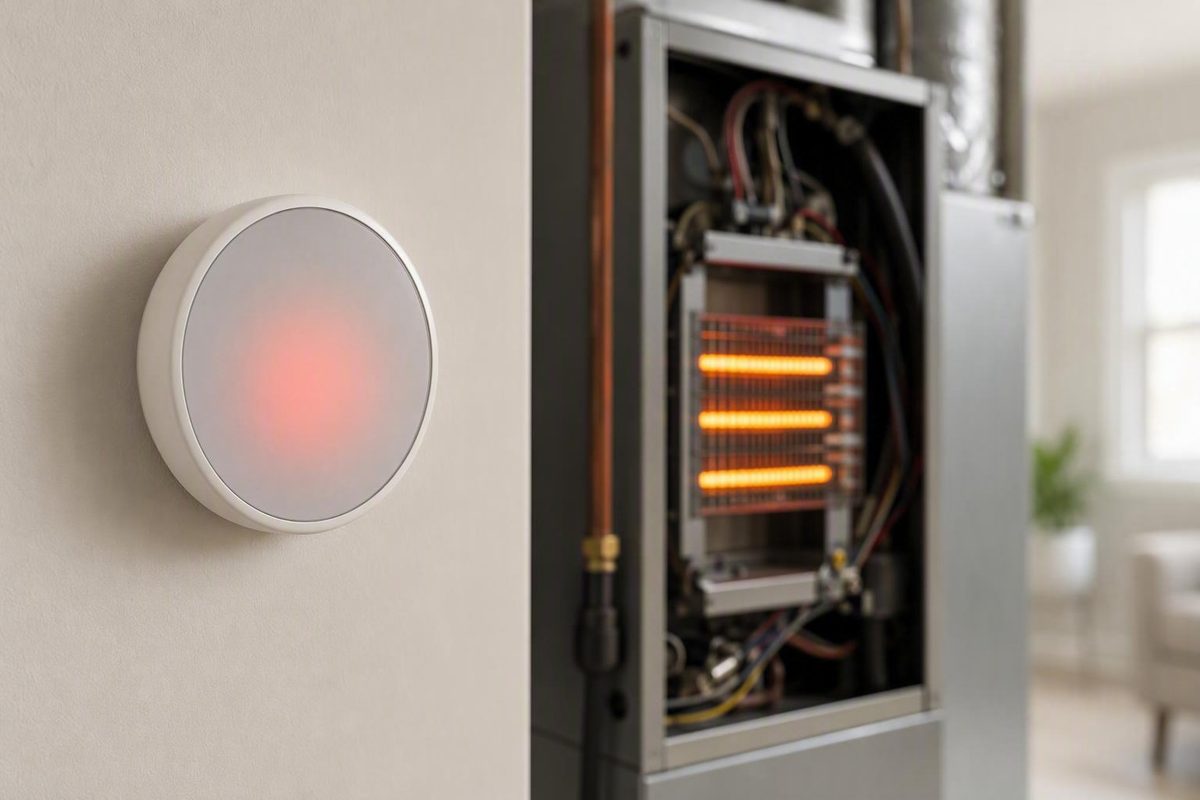
Seeing AUX HEAT or EM HEAT on a thermostat can be unsettling, especially when it coincides with a higher electric bill. The message does not automatically mean something is broken. It indicates that the system is requesting—or has been placed in—a backup-heating mode whose operation depends on the thermostat, heat pump, indoor equipment, controls, and installed backup source.
In many systems, that source is an electric heat-strip kit. These high-power resistance elements can provide necessary supplemental heat, but they are usually not the preferred everyday source when a working heat pump can carry the heating load. Understanding the operating mode, installed capacity, probable runtime, and equipment compatibility is more useful than guessing from a thermostat label or retail listing.
What an HVAC heat strip is and how it warms the house
An HVAC heat strip is an electric-resistance heating element used in compatible heating equipment to warm air moved by the system blower.
The basic sequence is straightforward:
- The thermostat and equipment controls request resistance heat.
- Electric current passes through a high-resistance element.
- The element becomes hot.
- The blower moves air across the heated element.
- The equipment or duct system distributes the warmed air into the occupied space.
In a central heat-pump system, heat strips are commonly installed in the indoor air handler. They may be sold as heater kits designed for a particular cabinet or equipment family rather than as universal components. Heat strips can also appear in electric furnaces and other configurations. Retail catalogs distinguish among air-handler kits, packaged-unit kits, and in-duct heaters, so those product classes should not be treated as automatically interchangeable. One retail catalog, for example, separates products by equipment application and lists multiple capacities from 5 to 20 kW, plus intermediate options (Ingrams Water & Air heat-strip catalog).
A heat strip and a heat pump warm the house in fundamentally different ways. A strip generates heat directly from electrical input. A heat pump uses a refrigeration cycle to collect and transfer heat into the home. Because a heat pump transfers heat rather than producing all of it through electrical resistance, it can deliver more heating for a given amount of electricity under suitable operating conditions.
Do not assume that every heat pump contains electric strips. Some systems use a furnace or another backup source, while other configurations may have no installed resistance backup. The indoor-unit model number, accessory labels, and manufacturer documentation—not the presence of a generic “heat” setting on the thermostat—are the best ways to identify what is installed.
The central homeowner takeaway is simple: a heat strip is generally support equipment, not automatically the system’s preferred everyday heat source. Its operation can be normal during a demanding heating period, but prolonged or unexplained operation is worth documenting.
Normal heat-pump mode, Auxiliary Heat, and Emergency Heat
In normal heat-pump mode, the outdoor unit and refrigeration circuit transfer heat into the home. The indoor blower distributes that heat. The system may satisfy the thermostat without using electric resistance heat.
Auxiliary Heat, commonly displayed as AUX, generally engages automatically when the system controls determine that the heat pump needs assistance. Depending on the equipment and configuration, the heat pump and backup source may operate together. Not every installation follows the same sequence.
Auxiliary operation can be normal. It may occur during high heating demand, after a substantial setpoint increase, or when the system determines that primary heating alone is not satisfying the call. The useful question is not merely whether AUX appeared, but how often it appeared, under what conditions, and whether the house reached the setpoint normally.
Emergency Heat, commonly displayed as EM HEAT, is different. It is generally a manually selected mode that bypasses or replaces normal heat-pump heating and relies on the installed backup source. It is ordinarily intended for a heat pump that is unavailable or intentionally taken out of normal operation—not as a routine shortcut for warming the house faster. Alabama Power’s homeowner guidance similarly distinguishes automatically engaged Auxiliary Heat from manually selected Emergency Heat intended for use when the heat pump is not functioning properly (Alabama Power’s strip-heating explanation).
| Question | Normal heat-pump mode | Auxiliary Heat | Emergency Heat |
|---|---|---|---|
| Who activates it? | Thermostat and normal system controls | Usually the system controls automatically | Usually selected manually by the homeowner or technician |
| Does the heat pump normally operate? | Yes | It may operate alongside the backup source, depending on the system | Normal heat-pump heating is generally bypassed or replaced |
| Why is it operating? | Routine heating demand | The controls have determined that primary heat needs assistance | The heat pump is unavailable or intentionally taken out of service |
| What should the homeowner do? | Observe normal comfort and runtime | Note the weather, setpoint change, duration, and frequency | Confirm that the setting is intentional and ask whether continued use is necessary |
Seeing AUX or EM HEAT indicates a control command or selected mode, but it does not prove which heater stages are actually energized.
Labels also vary. One thermostat may display “Aux Heat,” another may use “Stage 2,” and another may show only an icon. Some compatible equipment can control different amounts of backup heat, but the specific sequence must be confirmed from the thermostat and equipment documentation.
If EM HEAT appears unexpectedly, first confirm that it was not selected accidentally. If it was selected because the heat pump appears unavailable or is awaiting repair, ask the servicing professional whether Emergency Heat should remain in use.
Why heat strips can increase electricity use—and how to estimate the cost
Electric-resistance elements convert electrical input directly into heat at the element. Calling them simply “inefficient” can obscure the important comparison: a heat pump can deliver more useful heating for a given amount of electrical input because it transfers heat rather than creating all of it through resistance.
Prolonged strip-heat operation therefore generally uses more electricity to meet a heating demand than normal heat-pump operation. It can noticeably increase a winter bill, particularly when substantial resistance capacity remains energized for many hours. A manufacturer-affiliated comparison likewise identifies direct strip heating as having higher operating costs than heat-pump heating while noting that actual economics depend on utility rates and equipment capacity (GE Appliances Air & Water comparison).
There is no responsible universal multiplier for the bill increase. Actual use depends on:
- how many kilowatts are energized;
- whether the system controls capacity in stages;
- how long the resistance heat runs;
- outdoor conditions;
- thermostat settings and control configuration;
- the home’s insulation, air leakage, and overall heat loss;
- heat-pump condition and performance;
- airflow through the equipment; and
- the local electricity price.
Use this basic estimate:
Operating cost = energized kilowatts × runtime hours × electricity price per kilowatt-hour
For a clearly labeled arithmetic example, assume an electricity price of $0.15 per kWh. The 5-, 10-, 15-, and 20-kW capacities below are among the sizes shown in heat-kit retail listings (Lowe’s heat-strip listings).
| Energized capacity | Runtime at that capacity | Assumed rate | Derived cost |
|---|---|---|---|
| 5 kW | 1 full-load hour | $0.15/kWh | $0.75 |
| 10 kW | 1 full-load hour | $0.15/kWh | $1.50 |
| 15 kW | 1 full-load hour | $0.15/kWh | $2.25 |
| 20 kW | 1 full-load hour | $0.15/kWh | $3.00 |
These are calculations, not predictions of a household bill. Each assumes that the stated capacity remains energized continuously for the entire hour. A system may cycle the strips, energize only part of the installed capacity, or change the commanded capacity during a heating call. A 15-kW kit label therefore does not prove that the equipment consumes 15 kWh during every clock hour in which AUX appears.
A kilowatt is a measure of power. When a 10-kW resistance load remains energized for one full hour, the resulting energy use is 10 kWh. That relationship is useful for estimating cost, but only when the energized capacity and runtime assumptions are realistic.
Runtime-cost worksheet
- Installed kit capacity: ______ kW
- Estimated capacity energized during the event: ______ kW
- Estimated resistance-heat runtime per day: ______ hours
- Local electricity rate: $______ per kWh
- Number of days being evaluated: ______
- Calculation: __ kW × _ hours/day × $ per kWh × ___ days
- Estimated resistance-heat cost: $______
If you know only the installed capacity, you can calculate a high-side scenario based on full-capacity runtime, but label it clearly as an assumption. Do not present it as measured consumption.
Better runtime evidence may come from thermostat history, utility interval data, equipment service records, or professional testing. Compare days with similar weather when possible. A total monthly bill cannot isolate heat-strip use because it includes normal heat-pump operation and every other electrical load in the home.
A practical sequence is:
- Identify the installed heater-kit capacity.
- Ask whether the system can command different capacities.
- Review when AUX or EM HEAT appeared.
- Estimate how long resistance heat was actually requested.
- Apply the local utility rate.
- Ask for measured operation if the estimate still does not explain the bill.
Why heat strips turn on—and why there is no universal outdoor cutoff
Auxiliary or strip heat may be requested for several supported reasons:
- The heat pump cannot satisfy the current heating demand by itself.
- The thermostat setpoint was raised quickly.
- Emergency Heat was selected.
- A heat-pump or control problem has shifted more of the heating demand to the backup source.
- The installed control configuration requests assistance under the observed conditions.
Some homeowner guidance uses a difference of roughly 1.5°F to 2°F between room temperature and setpoint as an example of a condition that may trigger strip heat. That is not a universal rule; thermostat and equipment behavior can differ by system and configuration (Alabama Power’s thermostat discussion).
The same caution applies to outdoor temperature. Heat strips do not universally activate at 32°F, 35°F, or any other single temperature. A threshold described for one heat pump, thermostat, or packaged terminal unit cannot be applied automatically to a different central system.
Actual operation depends on the interaction among:
- heat-pump heating capacity;
- outdoor conditions;
- the home’s heating load;
- thermostat configuration;
- equipment controls;
- installed backup capacity; and
- the details of the installation.
Two neighboring houses can behave differently at the same outdoor temperature because they have different heat loss, equipment, control settings, or available low-temperature heating capacity.
Gradual thermostat adjustments may reduce avoidable auxiliary calls on some systems. For example, raising the setting in a small step and allowing the system time to respond may avoid creating an immediate large demand. It is not a guarantee. If the heat pump cannot meet the home’s heating load, slower thermostat changes cannot eliminate the need for backup heat.
An occasional AUX indication during demanding weather can be normal. Persistent AUX operation during relatively mild conditions is different: it is a reason to collect observations and request diagnosis. It is not proof that the strips, thermostat, or outdoor unit have failed. Possible areas for professional evaluation include control configuration, airflow, building heat loss, and heat-pump performance.
Auxiliary-heat observation log
| Observation | What to record |
|---|---|
| Date and time | When AUX or EM HEAT appeared |
| Outdoor conditions | Approximate temperature and notable weather |
| Indoor temperature | Room temperature shown by the thermostat |
| Setpoint | Requested temperature |
| Recent adjustment | Whether the setpoint was raised and by how much |
| Thermostat indicator | AUX, EM HEAT, Stage 2, or another label |
| Duration | How long the indicator and heating call continued |
| Comfort | Whether rooms felt normally warm, weakly heated, or uneven |
| Filter | Clean, dirty, damaged, or overdue for replacement |
| Outdoor unit | Whether it appeared to operate or remain off |
| Other symptoms | Odor, breaker trip, noise, or unexpected cycling |
Do not remove access panels to complete the log. The goal is to give a technician a repeatable operating pattern, not to perform an internal diagnosis.
Heat-strip sizes: what the kW number means and why bigger is not automatically better
A heat strip’s kilowatt rating describes its electrical heating capacity. The rating is also central to estimating full-load energy use: a resistance load drawing 10 kW continuously for one hour uses 10 kWh.
Retail catalogs commonly show 5-, 8-, 10-, 15-, and 20-kW kits. One HVAC educational article reports a broader approximate range of 3 to 25 kW, but the approved options for a particular system depend on its equipment documentation (NW HVAC heat-strip overview).
The presence of a larger option does not make it a better choice. Neither home square footage nor heat-pump tonnage alone establishes the correct heat-strip capacity.
Selection may need to account for:
- the home’s heating load;
- local design conditions and climate;
- the heat pump’s available heating output;
- the amount of backup load the strips are intended to cover;
- blower airflow and duct conditions;
- the equipment controls;
- manufacturer limits for the exact indoor or packaged unit;
- the required electrical configuration; and
- the electrical capacity available at the property.
General articles sometimes pair rough heat-pump tonnages with heater capacities. Those examples may illustrate the scale of the equipment, but they are not sizing standards and should not be converted into purchase recommendations.
Insufficient backup capacity may be unable to meet the intended heating load. Excessive or unapproved capacity may fall outside the airflow, control, or electrical requirements of the equipment. The relevant question is not, “What is the largest kit that fits physically?” It is, “Which kit and capacity does the manufacturer approve for this exact equipment, and does it suit the home’s backup-heating requirement?”
Before discussing size with a contractor, locate:
- the complete air-handler, electric-furnace, or packaged-unit model number;
- the serial number;
- the existing heater-kit label, if visible without removing a panel;
- the existing heater-kit part number;
- the heat-pump outdoor-unit model number;
- the thermostat make and model; and
- the manufacturer’s accessory documentation.
Photograph labels that are visible from outside the equipment. Do not reach into a cabinet, remove barriers, or disturb wiring to find them.
Final sizing should be completed or approved by a qualified HVAC professional using the exact equipment documentation and an appropriate assessment of the home’s heating load. If a recommendation rests only on square footage or nominal tonnage, ask what manufacturer information and load assumptions support it.
A compatibility-first checklist for buying a heat kit
Equal-kW heat kits are not necessarily interchangeable.
Retail listings commonly divide products by:
- brand;
- air-handler or packaged-unit family;
- equipment generation;
- application type;
- accessory series; and
- capacity.
For example, one retailer separates heat kits for Universal, VersaPro, Hyper Heat, Signature, packaged-unit, and different-generation applications. Those distinctions show why a brand name and kW rating are not enough to establish fit (MRCOOL DIY Direct heat-kit collection).
Pre-purchase compatibility worksheet
- Complete indoor or packaged-unit model: ________
- Serial number: ________
- Approved heater-kit part number: ________
- Source of approval: manufacturer manual / accessory table / written professional confirmation
- Equipment generation or series: ________
- Application: air handler / packaged unit / electric furnace / in-duct product / other
- Required voltage: ________
- Control requirements: ________
- Adapter required: yes / no / unknown
- Approved adapter part number: ________
- Circuit breakers included with kit: yes / no / unknown
- Other required electrical components: ________
- Available electrical capacity professionally evaluated: yes / no
- Installation professional: ________
- Local approval or inspection questions checked: yes / no / not yet determined
Statements such as “fits this brand” or “works with a three-ton system” omit information that may be essential.
Adapters are sold for certain old-to-new equipment combinations. Their existence does not mean any old kit can be connected to any new air handler. Retail listings containing generation-specific adapters reinforce the need to verify equipment series and part numbers rather than guess (Budget Heating heat-strip and adapter listings).
“Breaker included” describes a product component, not complete system compatibility.
Verify the electrical and installation requirements through the manufacturer’s documentation and a qualified professional before purchase.
This article is not a wiring, breaker-sizing, panel-capacity, code-compliance, or installation guide. Those decisions require model-specific specifications and an evaluation of the existing installation.
What a heat-strip kit costs before labor and electrical work
Separate the equipment-only retail price from total installed cost. The price on a product card generally covers only the listed kit and the components the seller identifies.
In the undated retail snapshot supplied for this article, a model-specific 5-kW air-handler kit was listed at approximately $80. That was a point-in-time seller listing, not a stable market average or installation quote (Budget Heating listing collection).
At the upper end of the same evidence snapshot, a 15-kW in-duct heater was listed at approximately $453. Because an in-duct product is materially different from a typical air-handler accessory kit, the two endpoints should not be treated as directly comparable products (Ingrams Water & Air catalog).
Numerous 5- to 20-kW products appeared between those figures, but prices, promotions, inventory, and product details can change. These examples illustrate listing variation; they do not define a current market range.
A product’s price does not establish:
- that it fits the equipment;
- that it is the right capacity;
- that it includes every required component;
- that the electrical installation can support it;
- that it offers better performance or durability; or
- what the completed installation will cost.
Potential installed-cost categories may include:
- professional HVAC labor;
- electrical labor;
- locally required approvals or inspections;
- an approved adapter;
- control components;
- wiring and conduit;
- disconnecting or overcurrent-protection equipment;
- manufacturer-required modifications; and
- electrical-service or panel work if an evaluation finds the existing supply inadequate.
Do not assume that a more expensive kit includes more of the installation. Conversely, a kit advertised with circuit breakers may still require other approved components and site work.
Quote-comparison checklist
Ask each bidder to state:
- What is the exact heater-kit part number?
- Which manufacturer document confirms compatibility with my complete equipment model?
- What capacity and control arrangement will be installed?
- What components are included with the kit?
- What additional controls, adapters, disconnecting equipment, wiring, or protective devices are included in the quote?
- Does the work include checking blower airflow and thermostat configuration?
- Who will determine whether local approvals or inspections apply?
- Is panel or electrical-service work included, excluded, or subject to evaluation?
- What labor and parts warranties apply?
- What happens if the ordered kit proves incompatible?
A reliable total installed-cost range cannot be derived from these retail prices. Site conditions, equipment requirements, local labor, and the existing electrical installation can change the scope substantially. Compare complete written scopes rather than kit prices alone.
Safe checks, warning signs, and questions for the HVAC professional
Homeowners can gather useful information without opening equipment or touching electrical components.
Start with these low-risk checks:
- Confirm the thermostat mode. Make sure the system is in normal Heat mode unless Emergency Heat was intentionally selected.
- Confirm the setpoint. Note the room temperature, requested temperature, and whether someone recently made a large adjustment.
- Record the indicator. Photograph or write down AUX, EM HEAT, Stage 2, or any other displayed message.
- Check the filter. Inspect it using the equipment’s normal filter-access procedure and replace it if it is dirty or overdue.
- Document the pattern. Record outdoor conditions, duration, comfort, noises, and whether the outdoor unit appears to operate.
- Review available history. Thermostat logs and utility interval data may show when the pattern began.
Weak heat, prolonged backup operation, a higher bill, or an AUX indication does not by itself prove that a heat strip has failed. Possible areas for professional diagnosis include thermostat configuration, restricted airflow, reduced heat-pump performance, wiring or relay faults, and a malfunctioning resistance element. Contractor troubleshooting guidance similarly treats inadequate warmth, persistent operation, higher bills, odors, and loud noises as symptoms requiring diagnosis rather than proof of one specific failure (Climate Control Company’s warning-sign overview).
Arrange prompt professional evaluation if you observe:
-
persistent backup operation with poor heating;
-
apparent overheating;
- a persistent sharp electrical, plastic, or melting odor;
- smoke; or
- unusual loud buzzing, banging, or other new noises.
Odor should be treated cautiously. A brief dusty smell after a long period without heating may result from accumulated dust warming on the elements, but that observation alone cannot rule out an electrical or equipment problem. A persistent sharp smell, smoke, breaker trips, or other signs of overheating should not be dismissed as ordinary startup dust.
Do not:
- remove electrical-compartment covers;
- touch or disconnect strip elements;
- test live voltage or current;
- change breakers;
- bypass relays, limits, or other controls;
- install an unapproved switch;
- disable backup heat; or
- install a heat kit.
Heat-strip work involves high electrical power and equipment-specific requirements. Installation and internal testing should be left to qualified professionals who can verify airflow, controls, wiring, and the manufacturer’s approved configuration. HVAC service guidance likewise recommends professional installation to reduce electrical and overheating risks (Precision Heating & Air’s heat-strip overview).
Questions to ask the HVAC professional
- What exact heater-kit model and part number are installed?
- What is the kit’s total capacity?
- Can the system command different capacities, and what was requested during the event I observed?
- Why was Auxiliary Heat being requested?
- Was the heat pump operating at the same time?
- Does the heater kit appear in the manufacturer’s approved documentation for this exact indoor or packaged unit?
- Is the thermostat configured correctly for the equipment?
- Is airflow adequate across the heater assembly?
- Is the filter, blower, or duct system restricting airflow?
- Does the electrical installation match the manufacturer’s requirements?
- Is there evidence of a control, wiring, relay, resistance-element, or heat-pump fault?
- Is Emergency Heat necessary while repairs are pending?
- If a different kit is recommended, what heating-load and compatibility information supports the change?
Frequently asked questions about HVAC heat strips
Do all heat pumps have electric heat strips?
No. Electric heat strips are a common backup source, but they are not universal. Some heat pumps use another form of backup heating, such as a furnace, and some equipment configurations may have no installed resistance backup.
Check the indoor-unit model, visible accessory labels, thermostat configuration, and manufacturer documentation.
At what outdoor temperature should HVAC heat strips turn on?
There is no universal activation temperature. Figures such as 32°F or 35°F may describe a general example, a particular equipment category, or a specific control setup, but they do not establish a rule for every central heat pump.
Activation depends on heat-pump capacity, home heat loss, outdoor conditions, thermostat and equipment controls, and the installation. The useful benchmark is the documented behavior of the specific system—not a temperature taken from a general article.
Can I determine heat-strip size from my heat pump’s tonnage?
Not reliably.
Correct selection also considers the home’s heating load, climate, heat-pump output, airflow, controls, manufacturer limits, required electrical configuration, and available electrical capacity. Use the exact indoor-unit model and approved accessory documentation, then have a qualified professional confirm the selection.
Is a burning smell normal when heat strips first turn on?
A brief dusty odor after a long period without heating can occur when accumulated dust warms on the elements. That possibility should not be used to dismiss smoke, a persistent sharp electrical or melting smell, repeated breaker trips, or apparent overheating.
Odor alone cannot reliably identify the cause. If the smell persists or is accompanied by other warning signs, stop investigating the equipment and arrange prompt professional evaluation. Apparent fire conditions require an appropriate emergency response.
Can I install or disable HVAC heat strips myself?
No. Do not use general internet guidance to install, disconnect, disable, rewire, bypass, or electrically test heat strips. The work involves high-power electrical circuits and model-specific requirements for airflow, controls, safety devices, wiring, and equipment compatibility.
Have a qualified professional determine whether a proposed change is approved and appropriate for the home and equipment.
A heat strip is useful backup equipment, but an AUX indicator, kW label, or retail listing never tells the whole story. Identify the operating mode, document when backup heat appears, and estimate cost from plausible energized capacity and runtime. Limit homeowner checks to thermostat settings, filter condition, records, and external observations.
Persistent backup operation, weak heating, breaker trips, smoke, or sharp electrical odors call for qualified evaluation. Sizing, wiring, installation, testing, and disabling decisions belong with qualified professionals using manufacturer-specific requirements. Consistent with HVAC Lens’s editorial boundary, this is general homeowner information rather than contractor advice; confirm major equipment changes with a licensed professional.