
Airflow
Could Your Air Conditioner Be Contributing to Allergy or Asthma Symptoms?
Symptoms that consistently worsen while the AC runs and improve after you leave can support investigation, but the pattern is not diagnostic.
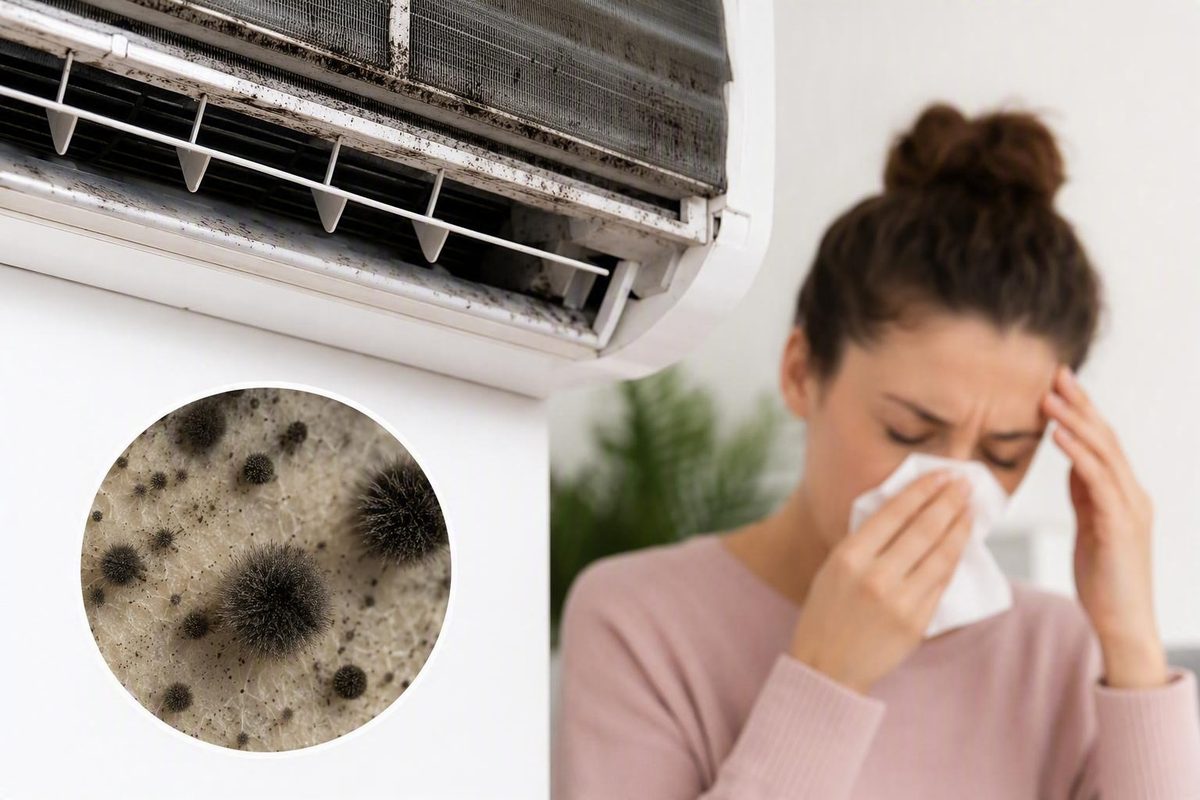
The short answer: symptoms can raise suspicion, not confirm black mold
Possible allergy-like or irritant symptoms associated with indoor mold exposure include:
- Sneezing
- Nasal congestion or a runny nose
- Coughing
- Red, itchy, or irritated eyes
- Throat irritation
- Itchy or irritated skin
- A rash
For someone with asthma, mold exposure may also trigger or worsen wheezing, shortness of breath, coughing, or chest tightness. These are allergic, asthmatic, or irritant responses—not symptoms unique to an air conditioner or to “black mold.” Cleveland Clinic describes black-mold reactions primarily in terms of allergy and asthma symptoms, not a distinctive illness that can be identified from symptoms alone.
That distinction matters because the same complaints can result from pollen, household dust, pets, smoke, respiratory infections, cleaning products, or other indoor-air problems. Even if symptoms begin while the air conditioner is running, they cannot by themselves confirm that:
- Mold is present.
- The AC is the source.
- The material is a particular species.
- Mold caused the occupant’s illness.
The phrase black mold is commonly used for dark-colored growth and, more specifically, for Stachybotrys chartarum. Many molds can appear black, however, and so-called black mold does not have a unique symptom profile. For most people, it is not considered inherently more dangerous than other indoor molds.
The practical question is therefore not simply, “Is this toxic black mold?” It is, “Is moisture or contamination present in the air-conditioning system, and does it need to be addressed safely?”
Keep health symptoms and equipment evidence separate. Symptoms can justify further investigation, while a musty odor, standing water, drainage trouble, or suspicious material inside the equipment can strengthen the case for an HVAC assessment. Neither category proves the other.
A practical symptom checklist—and what each clue means
When investigating possible black mold in an AC unit, organize what occupants are experiencing instead of treating every complaint as proof of mold.
Nose and sinuses
Relevant symptoms include:
- Sneezing
- Nasal congestion
- A runny nose
- Postnasal drip
- General nasal or sinus irritation
These can occur during an allergic response, but they overlap heavily with seasonal allergies, colds, pet allergens, and dust exposure. Congestion alone reveals little about the source.
Eyes
Watch for:
- Red eyes
- Itching
- Irritation
- Watering
Eye symptoms may become more noticeable in a room where air movement is disturbing dust, pollen, or another irritant. They do not distinguish mold from those alternatives.
Throat and lungs
Potential irritant symptoms include:
- Coughing
- Throat irritation
- A scratchy or uncomfortable throat
- Respiratory-tract irritation
Not every cough represents an asthma attack. A brief cough or irritated throat may reflect irritation, whereas asthma commonly involves a broader pattern that may include wheezing, chest tightness, and difficulty breathing.
Skin
Possible skin effects include:
- Itching
- Dry or irritated skin
- A rash
Skin symptoms are particularly difficult to trace to an HVAC source because they have many environmental and medical explanations.
Asthma-related symptoms
For someone with asthma, pay closer attention to:
- Wheezing
- Shortness of breath
- Chest tightness
- Increased or worsening cough
- A noticeable flare when entering the building or when the system starts
Mold can trigger or worsen asthma in susceptible people, but smoke, dust, pollen, fragrances, pets, and respiratory infections can cause similar reactions. Asthma symptoms should be treated as a health concern first, not merely as evidence in a home investigation.
Individual responses also vary. An allergic reaction may begin quickly, while another person may notice symptoms later—or have no noticeable symptoms at all. Symptoms that consistently worsen while the AC runs and improve after the person leaves can support a decision to investigate, but the pattern is not diagnostic. A medically reviewed overview of mold in air conditioners describes both variable symptom timing and the need for medical evaluation of unexplained symptoms.
A short log can make the pattern clearer. For several days, record:
- When the AC starts and stops
- Which rooms are occupied
- What symptoms occur
- Whether there is an odor
- Whether symptoms ease outdoors or in another building
- Other possible exposures, such as pollen, smoke, cleaning, or pets
- Any visible moisture or changes around vents
This log is not a home mold test. It is information that may help a healthcare professional evaluate symptoms or help an HVAC professional decide where to inspect.
Who may be more vulnerable—and when health comes first
Greater caution is appropriate for occupants with:
- Asthma
- A diagnosed mold allergy
- COPD or another chronic lung disease
- A weakened immune system
Children and older adults are also commonly described as potentially more susceptible, although age alone cannot predict an individual response.
Wheezing, shortness of breath, chest tightness, or worsening asthma should not be treated only as an HVAC troubleshooting problem. Stop inspecting the equipment and attend to the person’s medical needs. Follow any existing clinician-provided asthma or allergy plan. Severe breathing difficulty or a serious asthma attack warrants urgent medical help; persistent, unexplained, or worsening symptoms warrant clinical evaluation. People with asthma, COPD, allergies, or compromised immune systems may experience greater effects, according to Cleveland Clinic’s medically reviewed guidance.
A healthcare professional can assess breathing symptoms, consider other causes, and evaluate a possible mold allergy. Testing may help establish that a person is allergic to mold, but it cannot by itself show that a particular air conditioner caused the exposure.
Serious illness is not the typical outcome for otherwise healthy people exposed to household mold, but individual susceptibility changes the risk calculation. A person with significant respiratory disease or impaired immunity should ask a healthcare professional how to limit exposure during an indoor mold investigation.
Equipment changes are not medical treatment. Replacing a filter or shutting down a suspected source does not substitute for appropriate clinical evaluation when symptoms are significant.
Physical signs that make an AC moisture problem more plausible
Occupant symptoms are one part of the picture. Equipment and moisture clues are the other. Look for combinations of signs rather than expecting a single observation to provide a diagnosis.
A musty or earthy odor
A persistent musty smell is a reason to investigate, especially if it becomes stronger when the AC starts or is most noticeable near a supply vent, return grille, air handler, or window unit.
Odor is not conclusive. Damp building materials, a wet filter, a dirty drain pan, duct debris, or another moisture problem can also produce unpleasant smells. An odor that reliably appears during system operation can nevertheless help narrow the inspection.
Suspicious material
Possible growth may appear:
- Patchy or spotted
- Fuzzy
- Damp
- Slimy
- Irregular rather than evenly distributed
Appearance can support suspicion, but it cannot confirm that the material is mold or identify its species. Photographs can document changes; they cannot provide a definitive identification.
Moisture and drainage clues
Because mold needs moisture, water-related evidence is often more informative than color. Check safely accessible areas for:
- Leaks
- Standing water
- A persistently wet drip pan
- Heavy or unusual condensation
- Water staining or damaged material
- An obstructed condensate outlet
- Excessive indoor humidity
- Material that returns after being wiped away
Dust, pollen, and other organic particles can accumulate in HVAC equipment and provide material on which mold may grow when moisture remains available.
Potential locations include evaporator coils, drain pans, condensate lines, blower assemblies, air handlers, filters, vents, plenums, and ductwork. Manufacturer guidance on mold growth in air conditioners identifies these components and condensate drainage as relevant inspection areas.
Access varies greatly by equipment type.
Mold can also be hidden. The absence of a visible patch or obvious odor does not rule it out, particularly when moisture has entered an insulated or inaccessible part of the system.
By contrast, weak cooling, reduced airflow, unusual noise, or a higher energy bill does not confirm mold.
Black residue is not automatically black mold
Dark material on a vent, filter rack, cabinet, or internal surface does not prove that “toxic black mold” is present. Molds occur in many colors, and a black appearance cannot identify Stachybotrys chartarum, toxicity, or health risk.
The material might instead be:
- Ordinary household dust
- Soot
- Wet debris
- Dirt trapped by condensation
- Another biological or nonbiological contaminant
- Mold of an unidentified type
Some visual differences can help frame the possibilities:
- Dust is often dry, loose, and relatively easy to lift.
- Soot may be black, greasy, and prone to smearing.
- Suspected mold may be patchy, fuzzy, damp, or slimy and may recur if moisture remains.
A commercial comparison of dust, soot, and suspected HVAC mold describes these general differences, but they should not be treated as a definitive identification method.
Texture, odor, staining, photographs, wipe behavior, and home tape comparisons can all mislead. Wet dust can form dark patches, for example, while mold may be flat or hidden. Pressing household tape against a surface does not turn a visual comparison into a laboratory result.
Laboratory analysis can identify sampled material and may sometimes identify a mold type or species. Testing may be useful when the result would change a specific decision—for example, when the nature of damaged material remains uncertain or a qualified professional needs to define the work. It still cannot prove that the sampled material caused someone’s symptoms.
The EPA says visible mold generally does not require routine sampling and that no federal exposure limit exists for indoor mold or mold spores. Its home mold and moisture guidance emphasizes correcting the water source and addressing contamination rather than testing solely to obtain a species name.
The practical priority is not deciding whether a dark patch deserves the label “toxic black mold.” It is determining whether contamination and moisture are present, whether affected material lies in the air path, and how the contamination and its underlying cause can be handled safely.
What to do when you suspect mold inside the AC
The EPA advises against operating an HVAC system known or reasonably suspected to contain mold internally because airflow could distribute contamination through the building. Medically reviewed AC-specific guidance gives the same direction: do not continue running a suspected contaminated unit merely to see whether an odor or symptoms return.
If someone is struggling to breathe, experiencing chest tightness, wheezing significantly, or having a serious asthma flare, address the medical concern first. Equipment inspection can wait.
For a non-emergency situation, use a limited observation sequence:
- Note the timing. Record when odors or symptoms appear in relation to system operation.
- Look for accessible moisture. Without opening sealed parts, check for visible leaks, water staining, standing water, or unusual condensation.
- Check the filter. Note its installation date, condition, orientation, and whether it fits the rack correctly.
- Observe accessible drainage areas. If the drip pan or condensate outlet is designed to be visible to the user, look for an obvious backup or overflow.
- Document what you see. Take photographs and note whether material recurs, but do not rely on photos for identification.
- Arrange an assessment if internal contamination appears plausible.
Do not open sealed components or alter refrigerant-side settings. HVAC Lens advises homeowners to keep inspections to user-accessible areas and confirm significant work with a qualified professional.
Any homeowner cleaning should be limited to a small, accessible surface that the equipment manufacturer specifically permits the owner to clean. Follow the manufacturer’s shutdown and cleaning instructions. Where those instructions allow cleaning, medically reviewed guidance recommends gloves, eye protection, respiratory protection, and complete drying. If safe access, appropriate protection, or manufacturer permission is uncertain, do not proceed with DIY cleaning.
Do not assume one cleaner is suitable for every component. Equipment materials and manufacturer instructions vary, so a method allowed for a removable plastic grille may not be appropriate for a coil, insulation, wiring, drain component, or coated metal surface.
Cleaning a supply grille is not the same as cleaning an air-conditioning system. Spraying or wiping the visible vent will not resolve contamination on an evaporator coil, blower wheel, internal insulation, air-handler cabinet, plenum, or inside ductwork. If a grille quickly becomes dirty again, the source may be upstream or moisture may still be present.
Professional HVAC or mold-remediation assessment is appropriate when:
- Contamination is hidden, extensive, or recurring.
- Material is on a coil, blower, air handler, plenum, insulation, or inside ductwork.
- A leak or drainage problem remains unresolved.
- Porous internal material is wet or contaminated.
- Inspection would require disassembly.
- Odor persists after an accessible surface issue is corrected.
- A vulnerable occupant lives in the home.
- Suspicious material appears in multiple areas served by the system.
The assessment should identify both the affected components and the moisture source. A recommendation for duct cleaning, a UV device, a filter upgrade, a spray treatment, or equipment replacement does not by itself demonstrate that the underlying problem has been found.
Why mold returns after cleaning—and how to prevent it
Visible material often returns because wiping addresses the surface but not the conditions that supported growth. Recurrence may indicate persistent condensation, a leak, obstructed drainage, high humidity, or contaminated porous material that was not removed or adequately treated.
Make moisture control the center of the prevention plan.
Control indoor humidity
Keep indoor relative humidity below 60%, ideally around 30% to 50%. The EPA also recommends drying water-damaged areas and items within 24 to 48 hours to help prevent mold growth. These measurable targets appear in its residential mold and moisture guidance.
Actual indoor humidity depends on climate, equipment sizing, runtime, ventilation, and the building. A basic hygrometer can show whether humidity is persistently high, but the reading will not identify the cause.
Keep condensate moving
Drip pans should remain clean and drain as designed. Condensate lines should be unobstructed. Overflow, staining, slime, or recurring water in an area that should drain warrants investigation.
Repair plumbing, roof, building-envelope, and HVAC leaks rather than relying on repeated surface cleaning. The objective is to eliminate the recurring water source and dry affected material.
Replace filters appropriately
Replace the HVAC filter according to equipment guidance and household conditions. Runtime, filter depth, pets, dust, renovation work, smoke, and system design can all affect the appropriate interval.
Do not install a higher-efficiency filter merely because it captures smaller particles. Confirm compatibility in the equipment documentation or with a qualified HVAC professional.
Filters can reduce some airborne particles and help limit dust accumulation on equipment. Portable air purifiers may also reduce some particles in the room where they operate. Neither can remove mold actively growing on a coil, blower, insulation, wall, or other surface.
Track whether the correction worked
Keep a simple record of:
- Humidity readings
- Visible moisture
- Odor timing
- Where suspicious material appeared
- How quickly it returned
- Drainage or leak repairs
- Filter changes
- Professional cleaning or component work
- The date the system was restarted
This history can help a contractor distinguish a one-time surface issue from an ongoing water or drainage problem. It may also reveal whether an odor returns during particular weather or operating conditions.
Prevention does not depend on identifying a species. A dry, properly draining system is less supportive of mold growth regardless of the original material’s color.
A homeowner decision path: symptoms, system clues, and next calls
Use the following path to decide what deserves attention first.
1. Is someone having severe breathing difficulty or a serious asthma attack? Prioritize urgent medical care. Do not delay to inspect a vent, photograph a coil, or finish troubleshooting the AC.
2. Are symptoms persistent, unexplained, or worsening without being an emergency? Arrange healthcare evaluation. Document when and where symptoms occur, whether the AC was running, and whether the person improves elsewhere. Describe observations without telling the clinician that mold is a confirmed cause.
3. Is there a musty odor, visible moisture, drainage trouble, or suspicious material inside the air path? Do not run a system reasonably suspected of internal contamination. Arrange an appropriate HVAC or mold assessment, especially if coils, blowers, insulation, plenums, or ducts may be involved.
4. Is there dark residue but no moisture, musty odor, or recurrence? Evaluate it cautiously. It may be dust, soot, or another contaminant rather than mold. Document it, consider likely particle sources, and do not assign a species from color.
5. Does suspicious growth return after wiping? Recurrence suggests that moisture, inaccessible contamination, or another underlying source may remain unresolved. Check for leaks, condensate backup, wet porous material, and high humidity, then involve a professional if the cause is not safely accessible.
When speaking with a contractor, ask:
- Where is moisture entering or collecting?
- Is the drain pan functioning and draining correctly?
- Is the condensate line obstructed or improperly routed?
- Which components are affected?
- Is suspicious material in the air path?
- Are porous materials or internal insulation involved?
- What moisture-source correction is included?
- What will be cleaned, removed, repaired, or replaced—and why?
- How will the system be dried and checked before restart?
- How will recurrence be monitored?
- Would sampling change the proposed work?
Ask for observations and a defined scope, not just a product recommendation. A proposal should explain how it addresses both the contamination and the reason moisture accumulated.
HVAC Lens provides general homeowner information, not medical diagnosis, contractor direction, or mold-remediation advice. Equipment and buildings vary, so confirm significant work with qualified medical, HVAC, or remediation professionals as appropriate.
Frequently asked questions
Can black mold in an AC cause headaches or fatigue?
Headaches and fatigue have many possible causes, including respiratory illness, dehydration, sleep problems, stress, heat, medication effects, and other indoor-air conditions. They are not established as typical or diagnostic symptoms of black mold in an AC.
Do not use either symptom to conclude that mold is present. If headaches or fatigue are persistent, worsening, or unexplained, seek medical evaluation and describe when and where they occur without asserting an environmental cause.
Should I run my air conditioner if I suspect mold inside it?
Do not run a system reasonably suspected of containing mold internally until it has been appropriately assessed. Meaningful grounds for suspicion include internal growth, water damage, drainage trouble, recurring material, or a persistent musty odor associated with operation—not an isolated sneeze or a small amount of dry dust.
Can I tell whether dark material is mold, dust, or soot by looking at it?
Not definitively. Dry, loose material may be dust; black, greasy material that smears may be soot; and patchy, fuzzy, damp, or slimy material may raise suspicion of mold. Moisture can alter dust, however, and mold can have different colors and textures.
Treat appearance as a clue. Consider moisture, odor, location, and recurrence, then use qualified assessment or laboratory analysis only when identification would change the decision.
Do I need a mold test if growth is visible in or around the AC?
Usually not simply to establish that a visible moisture and contamination problem needs attention. Sampling may add cost without changing the need to correct water intrusion, address affected material, and dry the system.
Testing can be useful when the material is uncertain, the extent is disputed, or a qualified professional explains how the result would alter the work. It cannot prove that the material caused an occupant’s symptoms.
Will a new filter or air purifier remove mold from an AC system?
No. A suitable filter or portable air purifier may reduce some airborne particles, but it cannot remove mold growing on a coil, blower, drain pan, insulation, duct lining, or building material.
A new filter may support prevention after contamination and moisture have been addressed. Any efficiency upgrade should be compatible with the system’s airflow requirements.
The calm takeaway is threefold: allergy-like or asthma symptoms can justify investigation, but they cannot diagnose black mold; musty odor, moisture, drainage trouble, and recurring growth make an AC problem more plausible; and the durable response is to protect occupants, avoid operating a system reasonably suspected of internal contamination, correct the moisture source, and involve qualified medical and HVAC professionals where appropriate.