
Cooling
Find Out Whether Your AC Contactor Really Needs Replacement
A silent, chattering or nonstop outdoor AC unit may have a contactor fault. See safe checks, stop points and questions to ask before approving replacement.
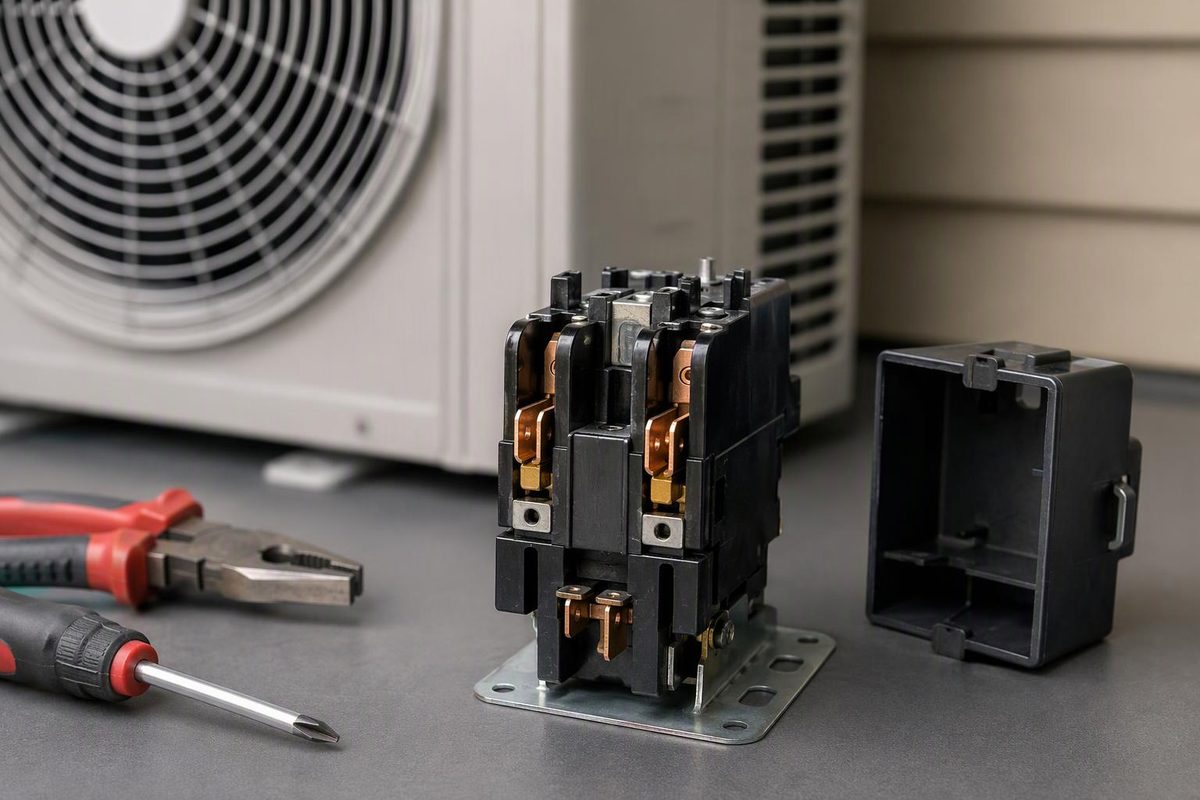
An AC unit contactor can cause the outdoor unit to stay silent or keep running after cooling is turned off, but neither symptom proves it needs replacement. Lost power, thermostat settings, wiring faults and safety controls can produce overlapping symptoms. Note what the indoor and outdoor equipment actually do; leave electrical testing and contactor replacement to a qualified HVAC professional.
Select the warning signs and outdoor-unit behavior to see your next step.
Choose the Next Safe Step
Check Settings, Then Arrange Service
A silent outdoor unit does not prove a bad contactor.
Confirm COOL mode and a setpoint below room temperature. Check the accessible filter with the system off and note breaker status. If basic checks do not restore operation, request professional diagnosis.
Keep covers installed. Do not press the contactor or measure live voltage.
Sources: Carrier AC startup guidance; Trane AC shutdown guidance; Schneider Electric contactor troubleshooting; Lennox XC13 manual, cited in the article. This tool chooses a safe next step, not a failed part.
The Contactor Switches Power, Not Just the Cooling Signal
In a conventional central air conditioner, the contactor is an electrically operated switch, usually inside the outdoor unit’s electrical compartment. A control signal energizes its electromagnetic coil, closing the power contacts so the outdoor equipment can run. Carrier’s contactor description explains the mechanism; the Lennox XC13 manual shows a residential example in the outdoor control panel.
The control circuit and equipment power circuit are different. A common residential arrangement uses a 24-volt AC control signal while the contactor switches higher-voltage equipment power, as illustrated in that Lennox manual. The exact design depends on the system. Some replacement controls also have electronic delays or protection features; Copeland’s replacement-control instructions describe one such design.
A contactor is not a capacitor. Both can be involved in a failure to start, but replacing one does not establish that the other is working.
Symptoms Narrow the Diagnosis but Do Not Confirm It
Indoor Airflow With No Outdoor Operation
Record whether the outdoor unit is completely silent, clicks once, or hums without starting. A failed contactor is possible, but so are a failed capacitor, missing outdoor power or a safety lockout. Carrier lists these alternatives specifically for an indoor fan running while the outdoor unit does not in its AC startup troubleshooting guide.
For a broader check sequence, use the guide to an outside AC unit that is not running. Indoor airflow alone does not tell you whether the outdoor unit has power or is receiving a cooling command.
Chattering or Humming Calls for Service
Repeated chatter does not automatically mean worn power contacts. In guidance for its contactors and starters, Schneider Electric identifies low voltage, poor control-circuit contacts and a chattering input device as possible causes. Its troubleshooting note illustrates why the control signal needs checking—not just the switch itself. It does not identify the cause of a noise in your AC.
Turn cooling off and arrange service rather than repeatedly trying to start a humming or chattering unit. Describe whether the sound is a single click, repeated clicking or a sustained hum; do not open the cabinet to locate it.
Outdoor Operation After Cooling Is Off Needs Attention
First distinguish the indoor blower from the outdoor equipment. A thermostat fan setting of ON can keep indoor airflow going without a cooling cycle. By contrast, welded contactor contacts can keep the outdoor unit powered when it should stop. Trane identifies both conditions in its guide to an AC that will not turn off.
If the outdoor equipment continues operating after cooling is switched off, shut off its clearly identified breaker if you can safely access the panel, and request service. Do not try to pry the contactor open.
Safe Checks End at the Electrical Cover
For buzzing, a burning odor or visible ice, shut the system off and call for service rather than continuing checks. These are stop points in Carrier’s troubleshooting guidance.
If there are no warning signs, use this check sequence:
- Check the thermostat. Confirm COOL mode and a setpoint below room temperature. Note whether the fan is set to AUTO or ON. Replace thermostat batteries if the model uses them and the display is weak or blank.
- Inspect the accessible filter. With the system off, replace a clogged disposable filter with the correct type and size. This checks airflow context; it does not test the contactor.
- Note breaker status. If the AC breaker has tripped again after a reset, leave it off. Do not keep resetting it.
- Observe with all covers installed. Record indoor airflow, outdoor fan movement, sounds and the thermostat’s cooling indication. A short recording from a safe distance can help describe an intermittent fault.
Carrier recommends professional inspection when basic checks fail. Follow the breaker-trip stop points if power repeatedly cuts out.
Do not remove the electrical cover, press the contactor manually, bridge terminals or attempt live voltage measurements. Thermostat OFF is not electrical isolation. Lennox explicitly warns that line voltage remains present when its single-pole-contactor units are not operating; see the electrical-shock warning in the XC13 equipment manual.
Replacement Should Follow a Confirmed Failure
A useful diagnosis explains both what the contactor did and whether it received the correct command. Before approving replacement, ask the technician these specific questions.
Was the correct control voltage reaching the coil when the fault occurred? If not, ask what interrupted the signal. Replacing the contactor does not explain a missing command.
Did the contactor fail to close, fail to conduct properly, or remain closed without a command? Ask what measurement or inspection established the failure, rather than accepting the symptom alone as proof.
Were supply voltage, connections and relevant safety controls checked? An open contactor may be responding correctly to another problem. For example, the Lennox XC13 manual describes protective temperature switches wired into its control signal on some units. That arrangement should not be assumed for every AC model.
Is the replacement approved for this equipment’s control voltage, switching arrangement and load ratings? Appearance alone is not a compatibility check. Copeland’s instructions specify electrical ratings and require following the equipment manufacturer’s installation and service instructions.
Request an itemized quote showing diagnosis, part, labor and warranty. The sources cited here do not provide a replacement price for your system. Before the technician leaves, ask them to verify both startup and shutdown from the thermostat and explain whether any underlying control or electrical fault also needed correction.