
Airflow
A Return Air Grille Pulls Air Back—Keep It Clear and Know When Airflow Needs Service
Identify a return air grille, check for a filter, clean it safely and recognize when noise or weak airflow calls for an HVAC assessment.
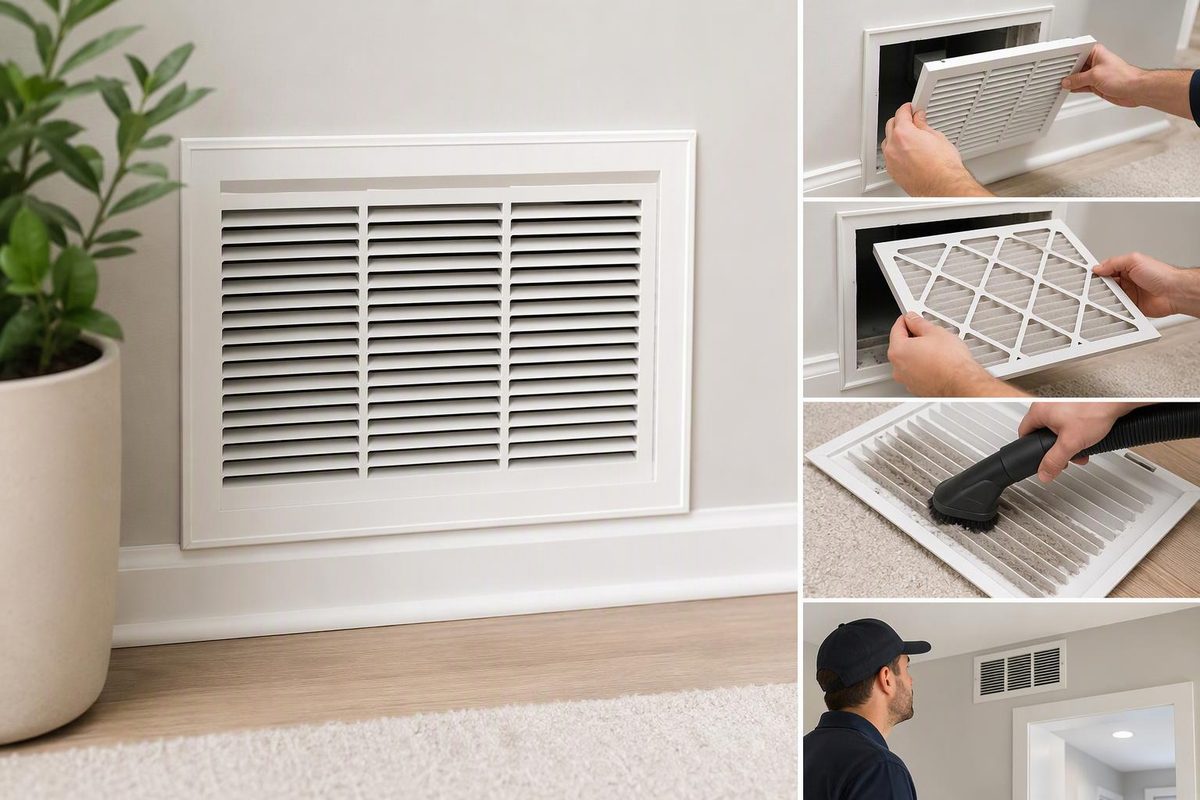
A return air grille covers the opening where room air is drawn back into a ducted HVAC system. The air travels toward the furnace or air handler to be filtered and heated or cooled again. The grille is only the visible cover; the return duct and filter arrangement behind it determine the path back to the equipment.
Keep the grille unobstructed. Do not cover it with a magnetic sheet or hide it behind furniture, curtains or a rug. Blocking a return can restrict airflow through the system rather than simply changing the temperature in one room.
How to identify a return air grille
Run the HVAC blower and check the direction of airflow:
- Supply register: Air blows into the room. The register is often smaller and may have a lever that adjusts a damper.
- Return grille: Air moves into the opening. The grille is often larger and normally has no closing damper.
Hold a single sheet of tissue loosely near the grille rather than pushing anything through it. A return should draw the tissue toward its face. Appearance alone is not conclusive because grille styles and locations vary. A home may have one large central return in a hallway or several returns in individual rooms. Trane’s return-air overview similarly distinguishes returns, which draw air inward, from supply vents, which deliver conditioned air.
Do not confuse an HVAC return with a bathroom or kitchen exhaust grille. An exhaust opening sends air outdoors and usually draws only when its separate fan is running.
Return location and size are design and code issues, not just decorating choices. Section 601.5 of the 2024 International Mechanical Code prohibits return air from being taken from locations including bathrooms, garages and furnace rooms. It allows specified kitchen exceptions and requires return openings to be sized according to the equipment instructions, ACCA Manual D or a registered design professional’s design. Because jurisdictions may adopt or amend different code editions, have a qualified contractor assess any plan to add or relocate a return (2024 IMC Section 601.5).
Check whether the grille holds a filter
A large return grille may have a hinged face and a filter immediately behind it. Other systems use a fixed grille and put the filter in a rack beside the furnace or air handler. The Department of Energy notes that filters may be installed at the return plenum or in return grilles, particularly when the air handler is difficult to access (DOE Building Science Education).
Do not add a filter behind every return merely because one fits. First identify the intended filter location from the equipment instructions, an existing label or a contractor. An extra filter adds airflow resistance, while removing the system’s only filter leaves equipment unprotected.
If this is the designated filter grille:
- Turn the system off at the thermostat before opening the grille.
- Note the filter dimensions and arrow direction before removal.
- Install the specified size and a filter efficiency the system can accommodate.
- Point the arrow into the return opening—toward the blower, not toward the room. See how to follow the filter airflow arrow.
- Make sure the filter sits properly in its holder, then close and latch the grille.
A dirty or clogged filter can dramatically reduce airflow and increase furnace runtime, motor wear and energy use, according to the same DOE filter guidance.
Clean the grille without reaching into the duct
A light coating of dust on a return grille is normal because room air is moving through it. EPA says dusty return registers do not, by themselves, show that the ducts contain heavy contamination; the registers can usually be vacuumed or removed for cleaning (EPA duct-cleaning guidance).
For routine cleaning:
- Switch the HVAC system off.
- Vacuum the grille face with a soft brush attachment.
- If deeper cleaning is needed, support the grille while removing its screws—especially on a ceiling.
- Wash a removable metal grille with mild soap and water, then dry it completely before reinstalling it.
- Vacuum only loose dust at the accessible edge of the opening. Do not push tools into flexible duct, disturb duct liner or spray cleaner inside.
Wet or deteriorated insulation, animal contamination, heavy debris or a persistent musty odor calls for investigation of the source rather than another wipe of the grille. EPA recommends duct cleaning on an as-needed basis and emphasizes correcting moisture or contamination causes.
Read the airflow symptoms
A blocked grille is simple to correct, but the grille itself is not always the fault. Note these patterns while the system runs:
- Whistling at the return: Check for a dirty filter, an obstruction or a grille that no longer sits flat. If the sound persists, the return opening, filter or duct system may be creating excessive resistance.
- Weak airflow at many supply vents: Check the designated filter and all return grilles. If they are clear, the blower, coil or duct system needs assessment.
- One room changes temperature when its door closes: The room may not have an adequate path back to a central return. DOE lists dedicated returns, transfer grilles, jump ducts and door undercuts as return-path strategies; the appropriate option still needs to be selected and sized for the house (DOE ducted-return guidance).
- Dust quickly reappears: Confirm that the filter fits its intended holder and that a filter grille closes properly. Dust on the grille face alone does not justify whole-duct cleaning.
- The filter pulls out of shape: Turn the system off and look for an obvious obstruction or heavily loaded filter. If a correctly sized clean filter still deforms, ask for airflow and static-pressure testing rather than installing a more restrictive filter.
When to arrange service
Arrange an HVAC assessment when clearing the grille and checking the intended filter do not restore normal airflow, or when you notice persistent whistling, weak airflow at many supplies, large comfort changes when doors close, or loose or damaged return ductwork.
Useful contractor questions include:
- Where is this system intended to be filtered?
- Does the installed filter fit and suit the equipment?
- What are the measured total external static pressure and system airflow?
- Is there leakage or damage on the return side?
- Does the return size meet the equipment instructions or the duct design?
Those checks are more informative than replacing a noisy grille based on appearance alone.
Turn the system off promptly for a burning or electrical odor, smoke, repeated breaker trips, visible ice or severe mechanical noise. Those symptoms should not be treated as a grille-cleaning project.