
Cooling
Why Your New AC Locks Out After a Leak Alarm
A new R-454B or R-32 AC may lock out from VOC interference or a hidden leak. Learn what fan-only operation means and what to ask the installer.
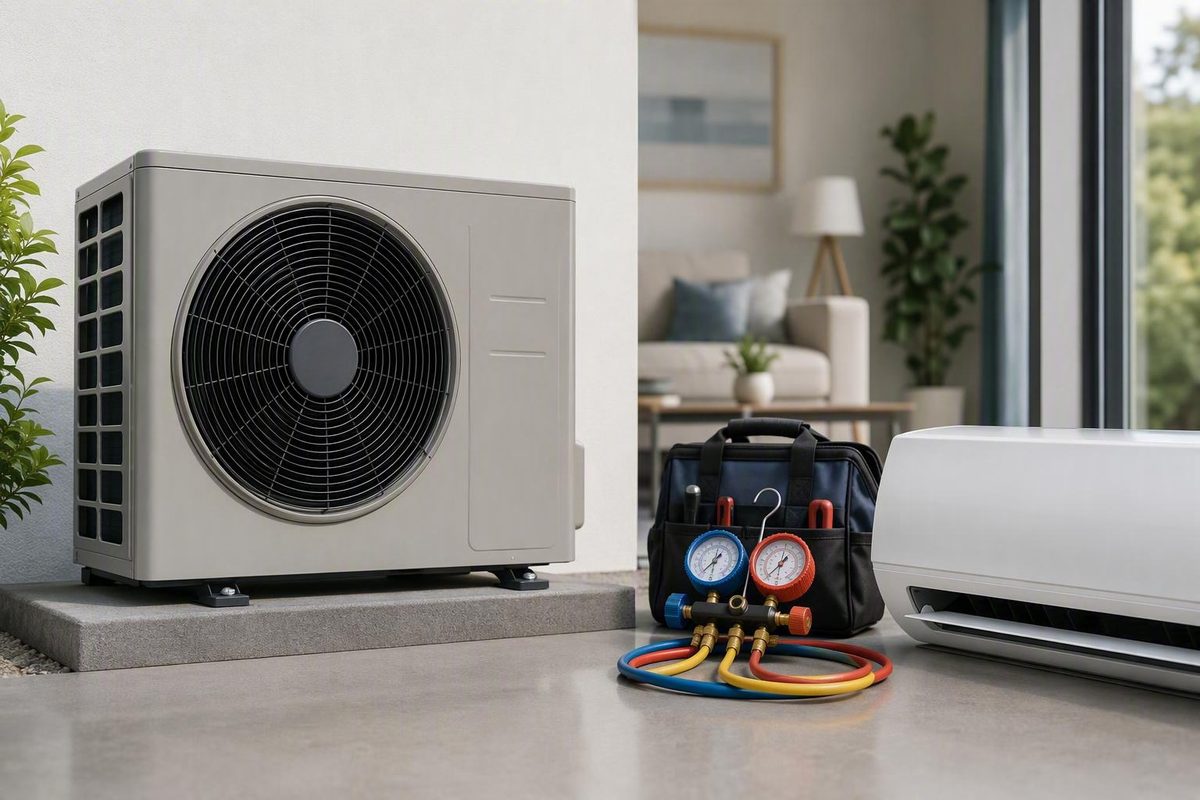
Yes, a new R-454B or R-32 air conditioner can trigger a refrigerant alarm even when the first service visit finds no leak. Some A2L sensors also respond to volatile organic compounds (VOCs) from paint, cleaners, flooring adhesives, aerosols, sealants, and fragrances. However, one negative leak check does not prove the alarm was false, so record the code, stop nearby chemical use, and have the installer follow the manufacturer’s diagnostic procedure.
Check the symptoms and recent VOC sources; the result separates a plausible nuisance trip from signs that require leak testing.
Select what happened, what was used nearby, and what the first technician found. This checker does not override the equipment warning or diagnose a sealed refrigerant circuit.
System age is included in your service summary but does not prove whether the trip was false.
With no selections, neither environmental interference nor a refrigerant leak can be supported. Do not bypass the sensor or repeatedly reset the equipment.
- Photograph the full fault message and equipment indicators.
- Record whether the blower continued after the outdoor unit stopped.
- Ask the installer to identify the component that generated the fault.
- Is this an A2L gas-sensor code, a pressure fault, or another condition?
- What sensor technology and manufacturer procedure apply?
- Which refrigerant-circuit locations were tested?
| Evidence Pattern | What It Supports | Appropriate Action | What It Does Not Prove |
|---|---|---|---|
| Confirmed sensor code, recent VOC source, matching timing, no physical leak signs, and a negative first check | Environmental interference is plausible | Stop the suspected product, ventilate as the manual permits, document the pattern, and use only a manufacturer-approved reset while arranging installer verification | That the refrigerant circuit is leak-free |
| Hissing, oily residue, ice, weaker cooling, or higher humidity | A refrigerant or other mechanical problem needs professional testing | Follow the equipment warning, keep it off when directed, and request documented leak testing | That any single symptom identifies the leak location |
| Repeated alarms without a known VOC source | An unresolved sensor, control, installation, or refrigerant-circuit condition | Request fault history, manufacturer-directed sensor evaluation, and expanded leak checks | That the sensor is defective |
| Generic message or pressure-related fault rather than a confirmed gas-sensor code | The shutdown may have another cause | Have the installer define the code before pursuing a VOC explanation | That an A2L sensor caused the event |
| Technician confirms a leak location | A real leak requiring a specified repair | Keep the system off as directed and obtain the repair and post-repair verification plan | That adding refrigerant without repairing the leak resolves it |
Safety: Never bypass, cover, unplug, relocate, or repeatedly reset a refrigerant safety sensor. Sources: HVAC Know It All A2L sensor guidance, HVAC School A2L safety guidance, EPA Technology Transitions resources, and Trane refrigerant-leak guidance.
Do not bypass, unplug, cover, relocate, or repeatedly reset the refrigerant sensor. Even when environmental interference is suspected, the sensor must remain able to respond to an actual refrigerant release (HVAC School’s guidance on A2L sensor alarms). Use a reset only if the instructions for the exact model permit it.
Fan-Only Operation Can Be the Intended Safety Response
When an A2L leak-detection sensor trips, the controls may stop the compressor while keeping the indoor blower running. That can feel as though the AC has shut off while the thermostat and fan remain active.
This response is intended to prevent additional refrigerant circulation and disperse refrigerant that might have entered the occupied space or duct system. The exact sequence varies by model: one system may run the blower, another may lock out more equipment, and another may display a delay or fault message.
Fan-only operation therefore supports the possibility of a sensor-triggered mitigation sequence, but it does not identify what reached the sensor. The trigger could be refrigerant, another vapor to which the sensor responds, or an equipment-specific sensor or control condition.
Keep these three facts separate:
- The built-in system reported an alarm or fault.
- The controls stopped the compressor or other equipment.
- The first leak check did not confirm escaping refrigerant.
All three can be true. A zero reading on one portable instrument does not automatically invalidate the installed alarm.
Confirm That the Code Actually Came From the Leak Sensor
“Refrigerant leak alarm” may be a homeowner’s description rather than the manufacturer’s fault definition. A built-in gas-sensor event is not the same as a low-pressure fault, compressor fault, airflow problem, or communication error.
Before the display changes, photograph or record:
- The complete message and fault code
- The thermostat screen and equipment indicator lights
- The indoor and outdoor unit brands
- Full model and serial numbers
- The refrigerant shown on the equipment label
- The time of the event and approximate runtime before shutdown
- Whether the outdoor unit stopped while indoor airflow continued
- Whether the system restarted by itself
If the outdoor unit stopped, compare the behavior with common causes of an outdoor unit not running, but do not assume the alarm and shutdown are unrelated.
The installer should retrieve the current code and fault history, then consult the service literature for that exact model. Ask whether the event came from the refrigerant sensor, a pressure control, or another monitored condition.
New A2L Equipment Uses Different Detection And Control Features
The HVAC industry is moving toward lower-global-warming-potential refrigerants. The EPA’s Technology Transitions Program restricts certain higher-global-warming-potential HFC uses and requires labels on certain new air-conditioning and heat-pump equipment using or intended to use HFCs or HFC blends (EPA Technology Transitions Program).
R-32 and R-454B are A2L refrigerants characterized by the supplied trade sources as mildly flammable. New equipment designed for them may include refrigerant detection and mitigation controls that were absent from the system it replaced. AHRI’s transition resources address A2L safety, model codes, installation, service practices, and equipment and piping durability (AHRI Safe Refrigerant Transition resources).
Not every A2L system uses the same sensor, alarm threshold, terminology, or shutdown sequence. The refrigerant label, exact model, displayed code, and manufacturer documentation control the diagnosis.
Paint, Flooring, Cleaners, And Aerosols Can Fool Some Sensors
Some refrigerant sensors use metal-oxide-semiconductor, or MOS, technology. A MOS sensor monitors changes in electrical resistance across a heated metal-oxide surface as gases interact with it.
Its limitation is selectivity. Trade educators report that some sensors used in newer A2L systems can respond to VOCs as well as refrigerant (HVAC Know It All’s explanation of A2L sensor cross-sensitivity). Reported possible triggers include:
- Fresh paint, stain, and solvents
- New flooring and flooring adhesive
- Construction adhesive, caulk, and sealant
- Household cleaning products
- Hairspray and personal-care aerosols
- Air fresheners and plug-in fragrances
- Scented candles
- Vapors released while construction products cure
A return grille can draw these vapors toward the indoor equipment even when a product was not used directly beside the sensor. Recent renovation work is especially relevant when paint, flooring, adhesive, caulk, or sealant is still curing.
A repeatable pattern strengthens the nuisance-trip theory. Examples include an alarm shortly after the same cleaner is used or alarms that occur while new flooring adhesive is curing but stop as the odor dissipates. It still does not prove the refrigerant circuit is leak-free; VOC exposure and a leak can exist at the same time.
Do not assume every unit has a MOS sensor. Other sensing technologies exist, and cross-sensitivity varies by sensor, refrigerant, equipment model, and installation. Ask the installer to identify the sensor technology and check whether the manufacturer recognizes environmental interferences for that model.
Stop using suspected products near the indoor equipment. Ventilate only as allowed by the equipment instructions and installer guidance. If the manufacturer permits a reset, clearing the vapors and observing what happens after one approved reset may help establish a pattern. Do not keep resetting a recurring alarm to obtain cooling.
Use a simple event log:
| Alarm Time | Runtime Before Alarm | Product Or Work Nearby | What Stopped | Recovery |
|---|---|---|---|---|
| Tuesday, 3:15 p.m. | 18 minutes | Floor adhesive curing | Outdoor unit | Remained locked out |
| Thursday, 8:40 p.m. | 22 minutes | No known chemical use | Entire system | Restarted later |
The log gives the installer a chronology; it is not a substitute for leak testing.
One Negative Leak Check Does Not Exclude A Hidden Leak
A handheld detector’s zero reading means only that the instrument did not detect refrigerant in the locations tested at that time. The portable detector and built-in sensor may use different technologies, sample different locations, or respond differently to surrounding gases.
Small, intermittent, or inaccessible leaks can evade electronic detection. Soap solution can reveal some accessible leaks by forming bubbles, but an absence of bubbles does not exclude a smaller leak.
Report any of these observations:
- Oily staining near fittings, valves, service ports, lines, or equipment
- Hissing near refrigerant lines or components
- Ice or frost on a coil or refrigerant line
- Cooling that has noticeably weakened
- Higher indoor humidity during cooling
- Uneven room comfort
- Repeated short operating cycles
Poor cooling, higher humidity, uneven cooling, oily residue, and hissing can accompany a refrigerant leak, although several also have other HVAC causes (Trane’s refrigerant-leak guidance). Ice, weak cooling, and short cycling can also result from airflow, control, or installation problems.
A pressure reading needs context. Ask the technician to document how long the test ran, its starting and ending conditions, which sections were tested, whether any sections were isolated, and which model-approved procedure and test pressure were used. No single test duration is a universal pass-or-fail standard.
The Installer Should Test The Alarm And Refrigerant Circuit Separately
A staged investigation avoids both premature conclusions: declaring every event a false alarm or replacing the sensor before checking for a leak.
Verify The Fault Source And Chronology
The installer should retrieve the fault history and identify the component that generated the event. Provide alarm times, runtime, shutdown behavior, nearby chemical use, and earlier test findings.
A pattern tied to paint, cleaning, aerosols, or curing adhesive is relevant. Repeated alarms with no identifiable VOC source, especially alongside hissing, oily residue, ice, or declining cooling, make refrigerant-circuit testing more pressing.
Compare Installed And Portable Detection
The technician can test appropriate locations with a suitable portable detector. A disagreement between the installed sensor and handheld detector needs investigation rather than an assumption that either device is necessarily wrong.
The technician may inspect service ports, valve cores, caps, fittings, brazed joints, the line set, and indoor and outdoor coils, depending on the system’s construction. Soap solution may be appropriate at accessible suspected points.
Follow The Manufacturer’s Sensor Procedure
Ask what the service documentation requires for sensor placement, wiring, configuration, fault clearing, and replacement. Do not assume the sensor or control board is defective unless the model-specific procedure supports that finding.
Recent VOC exposure should not be used to dismiss repeated alarms without evaluating both the detection system and refrigerant circuit. Conversely, a sensor should not automatically be replaced merely because the first handheld check was negative.
Isolate System Sections When Basic Tests Remain Inconclusive
A technician may use dry-nitrogen pressure testing or isolate the indoor coil, line set, and outdoor section to narrow the search. Sectional isolation can require refrigerant removal, line-set disconnection, extended monitoring, and several days without cooling (PV Heating, Cooling & Plumbing’s leak-isolation overview).
Isolation is more involved and does not guarantee that every possible leak will be found. Results depend on correct setup and test conditions.
Refrigerant recovery, charging, evacuation, nitrogen testing, sealed-system disconnection, and internal electrical diagnostics belong to qualified service personnel.
Preserve The Evidence For A Warranty Callback
Contact the original installer promptly for a recurring alarm or lockout on recently installed equipment. Treat it as a commissioning and warranty conversation, while recognizing that coverage for diagnostics, labor, sensors, refrigerant, and repairs varies.
Keep the fault photos, alarm log, model and serial numbers, commissioning sheets, invoices, service reports, written test results, and warranty documents. Ask the installer:
- What is the manufacturer’s exact definition of the code?
- Which component generated it?
- Is it a gas-sensor event, pressure shutdown, or another fault?
- What sensor technology does this model use?
- Was measurable refrigerant loss documented?
- Which locations were checked, and by what method?
- Were service ports, fittings, joints, coils, and the line set examined?
- How long did pressure testing run, and were sections isolated?
- Were paint, flooring, cleaners, aerosols, and sealants considered?
- Does the manufacturer provide a relevant service bulletin or diagnostic sequence?
- What criteria must be met before replacing the sensor?
- What is the post-repair or post-reset verification plan?
Request available commissioning records for refrigerant-charge verification, line-set setup, airflow, sensor configuration, and previous fault history. Missing paperwork does not establish faulty commissioning, but it identifies work that may need verification.
A satisfactory resolution should document one of three outcomes: a confirmed leak and specified repair; environmental interference supported by the event pattern and manufacturer-guided evaluation; or an equipment-specific correction supported by the applicable diagnostic procedure.
Keep The Safety System Intact While Waiting
Leave the equipment off whenever its warning, operating manual, installer, or a confirmed-leak diagnosis requires it. If a leak is confirmed, keep the system off until it has been professionally repaired and recharged, consistent with manufacturer consumer guidance.
Do not open sealed sections, connect gauges, add refrigerant, pressure-test the system, clean or move the installed sensor, probe internal wiring, or disconnect a safety device. Keep access to the indoor and outdoor equipment clear for the technician.
If the alarm disappears after a cleaner, aerosol, or construction product is removed, document that result without declaring the problem solved. The installer still needs to confirm that the fault history and refrigerant-circuit findings support a nuisance trip rather than a hidden leak.