
System Decisions
New R-410A Installs Are Federally Allowed Again, but Only With Pre-2025 Parts
EPA's May 2026 rule lets pre-2025 R-410A inventory be installed from July 27. How to read the data plate, spot servicing-only parts and check state rules.
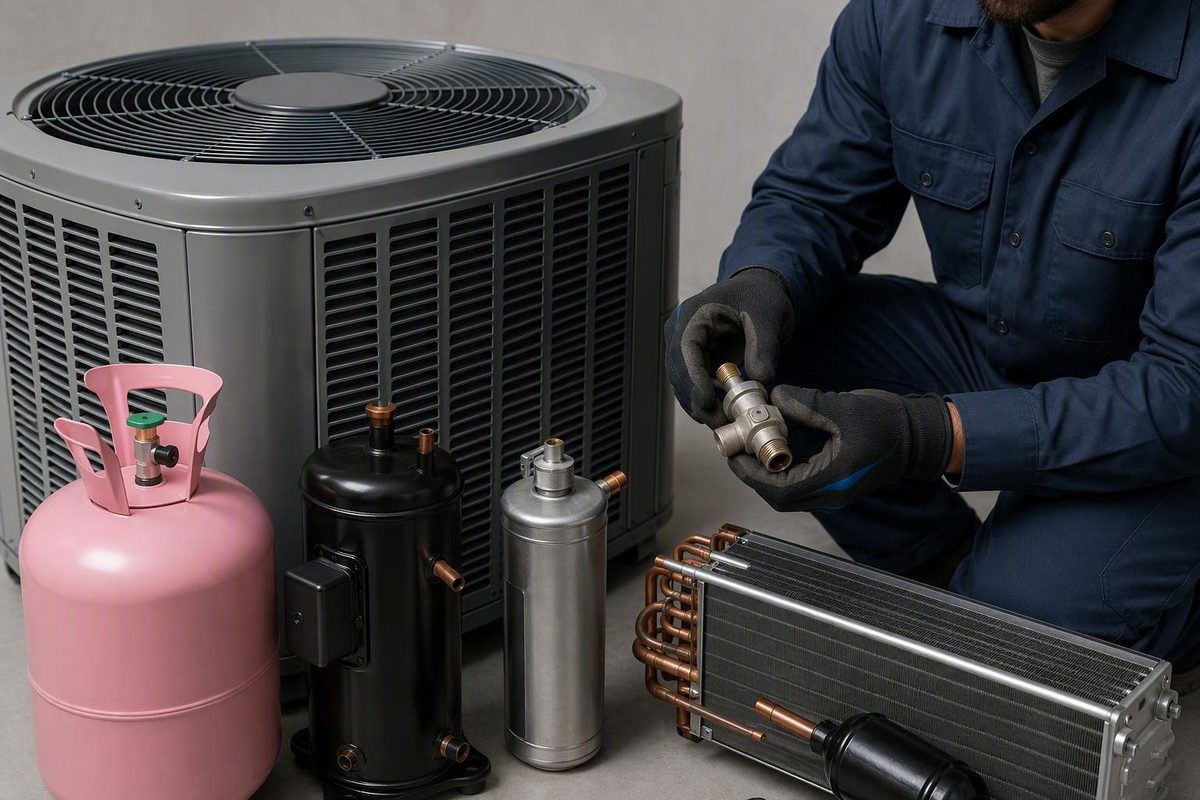
Yes, with conditions. Since July 27, 2026, federal rules again allow a contractor to install a new field-assembled R-410A air conditioner or heat pump (the ordinary split system with an outdoor unit and an indoor coil or air handler), provided every specified component was made in the United States, or imported into the United States, before January 1, 2025. EPA’s final rule in the Federal Register (Vol. 91, No. 100, published May 26, 2026) removed the January 1, 2026 installation deadline for that leftover inventory. It did not reopen manufacture or import of R-410A equipment, it does not override stricter state rules, and it does not let a contractor build a new system around a condenser marked “For servicing existing equipment only.”
Choose the job type, the date on the outdoor unit and whether the servicing-only label is present; the verdict and the question to put to your contractor update beside the controls.
R-410A quote legality check
Federal rule in effect from July 27, 2026. Take the date from the outdoor unit's data plate, not from the quote.
GREEN: federally allowed
Pre-2025, US-built stock with no servicing-only label can go into a new system from July 27, 2026, as long as every specified component (outdoor unit, indoor coil or air handler) meets the same test, not only the outdoor unit.
Ask the contractor
Will you put the manufacture or import date of each component, with model and serial numbers, in writing on the quote?
Based on: US-built equipment; a state without its own HFC rules. Change these under More details.
More details: where it was built, and your state
All outcomes in one table
| Job | What you see | Verdict |
|---|---|---|
| New system | Pre-2025, US-built or imported before Jan 1, 2025, no servicing-only label | Green |
| New system | Pre-2025 build date, but imported on or after Jan 1, 2025 | Red |
| New system | Dated on or after Jan 1, 2025 | Red |
| New system | Servicing-only label on any component | Red |
| New system | Plate date, import date or label not yet known | Amber |
| Condenser-only swap | Servicing-only label present, or pre-2025 unit | Green |
| Condenser-only swap | Post-2025 unit with no servicing-only label, or date unknown | Amber |
| Packaged unit | Any date: separate product category | Amber |
| Any job | New York, or another state with its own HFC rules | Amber at best |
Source: EPA Technology Transitions reconsideration final rule, Federal Register Vol. 91, No. 100 (May 26, 2026), effective July 27, 2026; EPA May 2026 fact sheet; NAHB rule summary. Federal screen only, not legal advice; permits and local codes are separate.
What EPA Changed on July 27, 2026
The rule removes the former January 1, 2026 installation compliance date for qualifying field-assembled residential and light-commercial air-conditioning and heat-pump systems that use refrigerants above the applicable 700-GWP limit, which is the group R-410A falls in.
To use the exception, the system’s specified components must have been domestically manufactured or imported into the United States before January 1, 2025. Qualifying inventory may be installed until that finite supply is exhausted, according to the EPA’s May 2026 Technology Transitions fact sheet.
This is an inventory exception. A component built in the US after the cutoff, or built abroad and imported after it, does not qualify because a distributor happens to have it on a shelf.
The effective date cuts two ways. The rule sets the federal position from July 27, 2026 onward; it does not by itself settle how an installation completed earlier in 2026, under the previous framework, should be judged. And a contractor who told you in the spring that new R-410A systems could no longer go in was describing the rule as it then stood. The install deadline was January 1, 2026 until this rule lifted it.
The Job Type Decides Which Federal Rule Applies
“Installing R-410A” can mean a complete split system, a packaged product, one replaced component, routine service, or simply running the equipment already in the house. EPA treats these differently, and the wording on an estimate does not decide the category.
| Proposed Work | Federal Treatment | Verify |
|---|---|---|
| Whole new split system | Every specified component must meet the pre-2025 test; one old part does not carry the rest, per EPA sector guidance | Model, serial and date for each component |
| Packaged or self-contained unit | A separate product category; the field-assembled exception does not automatically apply | Category, and which rule and date govern it |
| Condensing-unit swap on an existing system | Not treated as installing a new system | Written repair scope, compatibility, label |
| Repair parts | Treated differently from components of a new system | Scope and compatibility |
| Equipment already running | No federal requirement to retire it because of the HFC phasedown, per EPA’s HFC phasedown FAQ | Whether repair still makes sense |
This is a high-level guide, not a classification of every multi-component project. A condenser replacement is the example EPA itself gives of work that is not a new installation. Jobs that touch several indoor and outdoor components need closer review.
If the category is unclear, have the contractor name the controlling federal category in writing. “Changeout” and “repair” are trade shorthand, not legal categories.
What the Outdoor Unit’s Data Plate and Labels Show
Before approving a quote, ask for a photograph of the complete data plate on the outdoor unit. Also ask for a written equipment schedule with the brand, full model number and serial number of every proposed component: the condenser or heat pump, the indoor coil, the air handler and anything else in the configuration.
EPA says a technician can confirm the age of a condensing unit from its label. For a whole new system, though, the exception depends on all the specified components, so one old outdoor unit does not clear the quote.
The date on the plate does not mean the same thing for every unit:
- Built in the United States: the test is whether it was manufactured before January 1, 2025.
- Built abroad: the test is whether it was imported into the United States before January 1, 2025.
A pre-2025 build date on foreign-made equipment shows its age, not when it entered the country. A condenser made in Canada or Mexico in December 2024 and imported in February 2025 does not qualify as part of a new system, even though its plate predates the cutoff.
For foreign-built old stock, ask which document establishes the US import date. If the contractor cannot produce one, the old plate date proves nothing about federal eligibility.
The second thing to look for is a sticker or line of text reading “For servicing existing equipment only.” EPA requires specified components made or imported after the cutoff, and designed for refrigerants above the limit, to carry that wording. On a quote for a whole new system, that label on any component is disqualifying, because it marks the part as post-cutoff repair stock.
One consequence of the cutoff is easy to miss. Any qualifying unit has been sitting in a warehouse since 2024 or earlier. A quote that presents old-stock R-410A equipment as a current model is describing it wrongly, and its age is a fair subject for the warranty and price questions below.
A Condenser-Only Swap Counts as Repair, Not a New Installation
EPA says replacing the condensing unit in an existing system is not treated as installing a new system under this rule. Components used to repair an existing system are handled differently from components installed as part of a new one, and repair is the use the servicing-only label exists for. A post-2025 R-410A condenser carrying that wording, connected to indoor equipment you already own, is the label being used as intended.
Scope still matters. If the “swap” on the estimate also replaces the indoor coil and the air handler, the work starts to look like a whole system, and the pre-2025 test comes back into play. Have the contractor put the repair scope in writing, along with compatibility with the indoor equipment that stays, any manufacturer requirements and the permit.
None of this is a reason to replace an operating R-410A air conditioner or heat pump. Homeowners are not federally required to retire equipment already in use solely because of the HFC phasedown, according to EPA’s HFC phasedown FAQ. Continued operation, repair of existing equipment and installation of unused inventory are three separate questions.
Federal Permission Leaves State and Local Approval Open
The EPA rule addresses federal restrictions on higher-GWP refrigerants and nothing else. A system that qualifies under the inventory exception may still have to satisfy state refrigerant requirements, contractor licensing rules, local building, mechanical or fire codes, permit and inspection requirements, equipment listing and labeling conditions, the manufacturer’s installation instructions, and compatibility requirements for the exact indoor and outdoor components.
States may be stricter than EPA. The National Association of Home Builders cautions in its summary of the 2026 rule that the federal allowance does not stop states from keeping tighter restrictions, and it flags New York as a stricter state. If you live there, ask which state rule allows the exact models quoted before you discuss price.
Ask the contractor to identify the required permit and to confirm that the permitting authority will accept the exact models, system category and refrigerant being proposed.
If a contractor says no permit is required, check that with the city, county or other authority responsible for mechanical permits. Requirements vary by jurisdiction and by project scope, so use the authority’s current permit information instead of assuming the last HVAC job at your address set the pattern.
An AHRI Certificate Confirms the Match, Not the Legality
Ask for the AHRI Certificate of Product Ratings covering the exact outdoor unit, indoor unit or coil, and any other components listed in the proposal. Compare every model number on the certificate with the quote and with the equipment labels. A similar model number is not the certified configuration.
The certificate reports independently verified published performance ratings, which may include capacity and efficiency metrics depending on the equipment. Those ratings apply only to the model numbers and combinations listed.
It does not establish any of the following:
- Federal eligibility under the R-410A inventory exception
- State or local code approval, or permit approval
- Correct sizing for the home, or installation quality
- Manufacturer warranty coverage
- Eligibility for a particular rebate, tax credit or utility incentive
- Whether old-stock equipment is a sensible long-term purchase
AHRI certification is voluntary, and records may be removed from public view after equipment is discontinued. A missing search result is therefore not proof that a system is unlawful or mismatched. If a record cannot be found, AHRI advises submitting the brand and model number of every component when requesting help through the AHRI Directory’s technical support page.
For older inventory, ask the contractor or the manufacturer for the certificate even when a public search turns up nothing. Then confirm separately that the manufacturer authorizes the exact component combination.
What to Get in Writing Before Signing an Old-Stock Quote
Federal eligibility answers one question: whether the equipment may be installed under the federal HFC rule. Sizing, match, warranty and value are separate, and each has its own piece of paper.
| Ask For | What It Settles |
|---|---|
| Job category | New field-assembled system, packaged product, condensing-unit replacement or other repair |
| Model, serial and date for every component | Whether each part meets the domestic-manufacture or US-import cutoff |
| Import document for foreign-built units | The date that controls, which the plate does not show |
| Manufacturer approval of the combination | That the parts are an approved match, not merely connectable |
| AHRI certificate | Ratings for the exact combination quoted |
| Heating and cooling load basis | That the size was chosen for the house, not for what was left in stock |
| Permit and inspection | Local acceptance of the exact models and refrigerant |
| Warranty terms | Parts and labor, start date, registration, and written confirmation that the inventory’s age does not reduce coverage |
| Incentive eligibility | Whether a claimed rebate, tax credit or utility incentive covers this equipment under the program’s current rules |
Ask why R-410A inventory is being recommended at all. The contractor should be able to compare it with currently manufactured equipment on sizing, certified efficiency, warranty, installation requirements and expected repair support.
Check the refrigerant named on every component as well. R-32 and R-454B are not drop-in replacements for R-410A. Equipment has to be designed, listed, labeled and installed for its specified refrigerant, so a quote that mixes components across refrigerants is wrong regardless of dates.
Finally, ask a licensed local contractor to state in writing why the exact scope and models are allowed. Keep that explanation with the data-plate photographs, model and serial numbers, purchase invoices, manufacture or import documentation, the matched-system certificate, permit and inspection records and the written warranty. Those records answer the question for an inspector, a warranty claim or the next owner of the house.