
System Decisions
How to Recognize a Blocked HVAC Vent
See what blocked supply and return vents look like, how to test airflow safely, and when weak airflow points to a hidden duct or equipment problem.
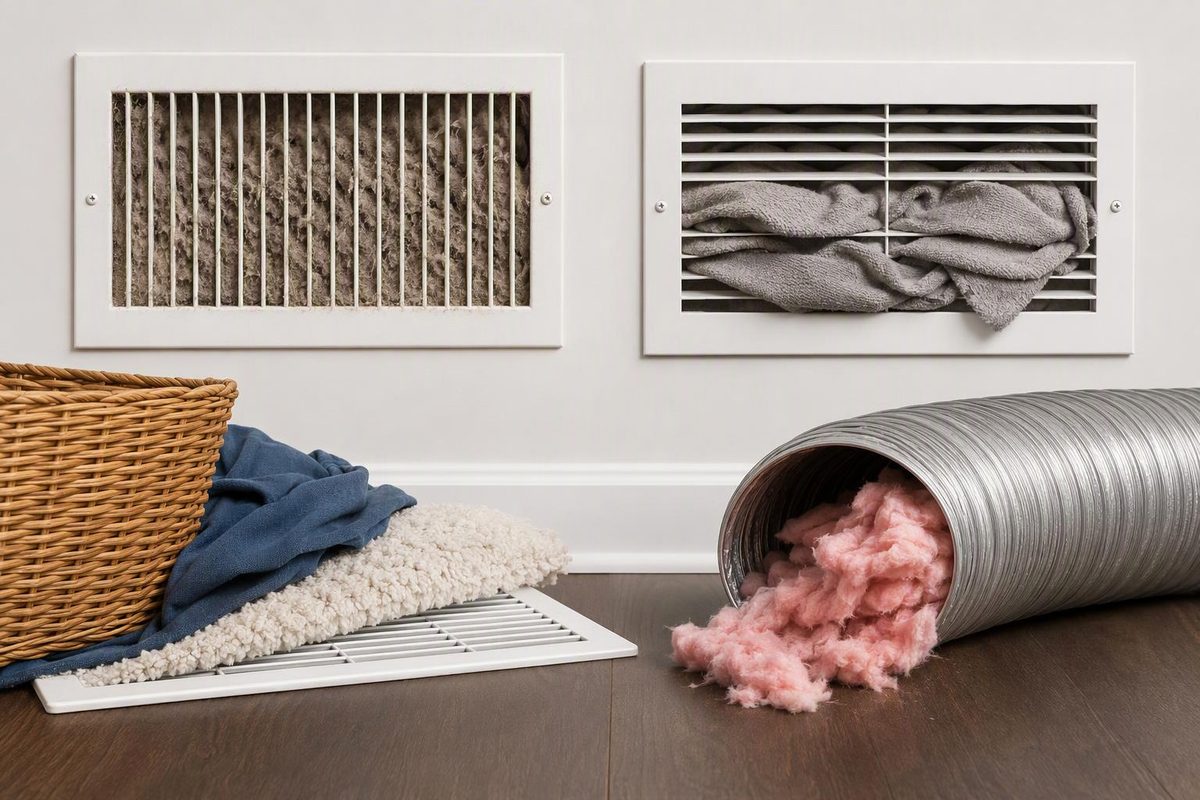
A blocked HVAC vent may have a rug, sofa, curtain or closed damper covering it, but it can also look completely clear. If the grille is exposed and open but airflow is weak, the obstruction may be inside the branch duct—or the real cause may be a dirty filter, duct leak or equipment problem.
Select what you see and how many vents are affected; the checker identifies the most likely next step.
Blocked-Vent Check
Not enough evidence yet
Identify the outlet, the number affected and what is visible at the grille. A clear-looking grille does not rule out a hidden duct or system problem.
Source basis: DOE terminal guidance and EPA duct-cleaning guidance. This check identifies patterns; it does not measure airflow.
First Identify a Supply or Return Vent
A supply vent blows heated or cooled air into the room. It commonly has adjustable louvers or a small damper lever.
A return vent pulls room air back toward the air handler. It is often larger and usually has fixed slats rather than a closing damper. The Department of Energy describes supply terminals as generally adjustable and return grilles as fixed; grille design and sizing also affect airflow and noise (DOE Building Science Education).
That distinction matters because a closed lever can explain weak airflow at a supply register, while a return grille normally should not be closed.
What a Blocked Vent Can Look Like
| What You See | What It May Mean |
|---|---|
| Furniture, curtains, boxes or bedding against a wall grille | The face of a supply or return is obstructed |
| A rug, mat or furniture over a floor register | Supply air cannot enter the room freely |
| Supply louvers tightly closed | The register damper is shut, not necessarily clogged |
| Dense lint or pet hair across a large grille | A return is restricted at its face |
| Paper, a toy or renovation debris inside the opening | A local obstruction is blocking the duct boot |
| A clear grille with little or no airflow | The problem may be deeper in the duct or system |
A light coating of dust is not proof that a vent or duct is blocked. The EPA says dusty return grilles are normal because they pull dust-laden air through the grate. The grille can usually be vacuumed or removed for cleaning, and the agency does not recommend routine duct cleaning solely because a little dust is visible (EPA duct-cleaning guidance).
Check Airflow Without Opening the Duct System
Run the Blower
Set the thermostat to heat or cool and wait for the blower to start. If the equipment is between cycles, temporarily set the fan to On.
Hold your hand near the grille without removing it. A supply should blow outward. A return should have a mild inward pull. Return ducts provide the path room air uses to reach the central air handler, so blocking them can disturb circulation through the home (DOE Building Science Education).
Expose the Entire Grille
Move furniture, rugs, drapes and stored items far enough away to expose the opening and leave a clear air path. Carrier specifically advises against covering returns, even partially, with furniture, drapes, rugs or solid covers (Carrier).
For a supply register, move its lever gently to the open position. Do not force a stuck damper. A return grille usually has no closing damper, so do not try to close it.
Clean Only What You Can Reach Safely
Turn the system off before cleaning the grille. Vacuum loose lint and dust with a brush attachment. Remove an object only if it is loose and easily reached from the opening.
Do not push rods, chemicals or a household vacuum hose deep into the duct. That can damage flexible duct or move debris farther into the branch.
Check the Filter and Compare Vents
A clogged HVAC filter can reduce airflow at many vents and imitate a duct blockage. Confirm the correct filter size and replacement timing in the equipment instructions.
Run the system again and compare the suspect supply with another similar register on the same floor. Airflow is not designed to be identical at every register, but one nearly dead vent among several strong ones is useful evidence of a local problem.
Do not deliberately close other vents to make the weak one blow harder. Closed or blocked vents increase airflow resistance and can contribute to uneven temperatures, noise and equipment strain (Lennox).
A Clear Grille Can Still Have a Hidden Airflow Problem
A vent-level obstruction becomes less likely when the grille is clear, its damper is open and nearby supplies blow normally. Possible hidden causes include:
- A crushed, kinked or disconnected flexible duct
- An internal balancing damper that is closed or misadjusted
- Debris farther inside the branch duct
- A duct leak releasing air before it reaches the register
- A dirty coil, blower problem or other system-wide restriction
DOE guidance notes that flexible duct should not be compressed or kinked and that contractors can assess airflow at each register and test duct leakage (DOE homeowner HVAC guide).
If most or all vents are weak, check the thermostat and filter first. Widespread weakness points away from a single blocked grille and toward a restriction or equipment issue affecting the system.
If only one or two vents are weak, record the affected rooms and whether the change followed remodeling, flooring work, furniture changes, or activity in an attic or crawl space. That pattern can help a technician identify the relevant duct branch.
Ask the contractor to measure airflow and static pressure, inspect the affected branch and show you any claimed obstruction. Weak airflow alone does not establish that the ducts need cleaning; EPA notes that evidence for routine duct cleaning is limited. Before accepting a cleaning offer, review what a low-price duct-cleaning scope may actually include.
Ice, Smoke and Electrical Odors Require a Different Response
Turn cooling off if reduced airflow comes with visible ice, water leakage or a coil that freezes again after thawing. Restricted airflow, including blocked vents, can contribute to evaporator icing, although refrigerant and mechanical faults can cause the same symptom (Carrier).
Shut the system down and arrange service for a burning or electrical odor, smoke, sparks, repeated breaker trips or severe new noise. Leave the home and call emergency services for visible fire.
If a carbon-monoxide alarm sounds, go outside immediately, call emergency services and do not re-enter until responders permit it (U.S. Consumer Product Safety Commission). For other symptoms, use this heating and air-conditioning symptom check.