
Furnace Air Flow Direction: Orienting and Verifying the Filter Arrow
Air in a forced-air system moves from your return vents, through the filter, into the furnace or air handler, and back out through the supply vents. The arrow…
By Mara Keene · · 8 min read
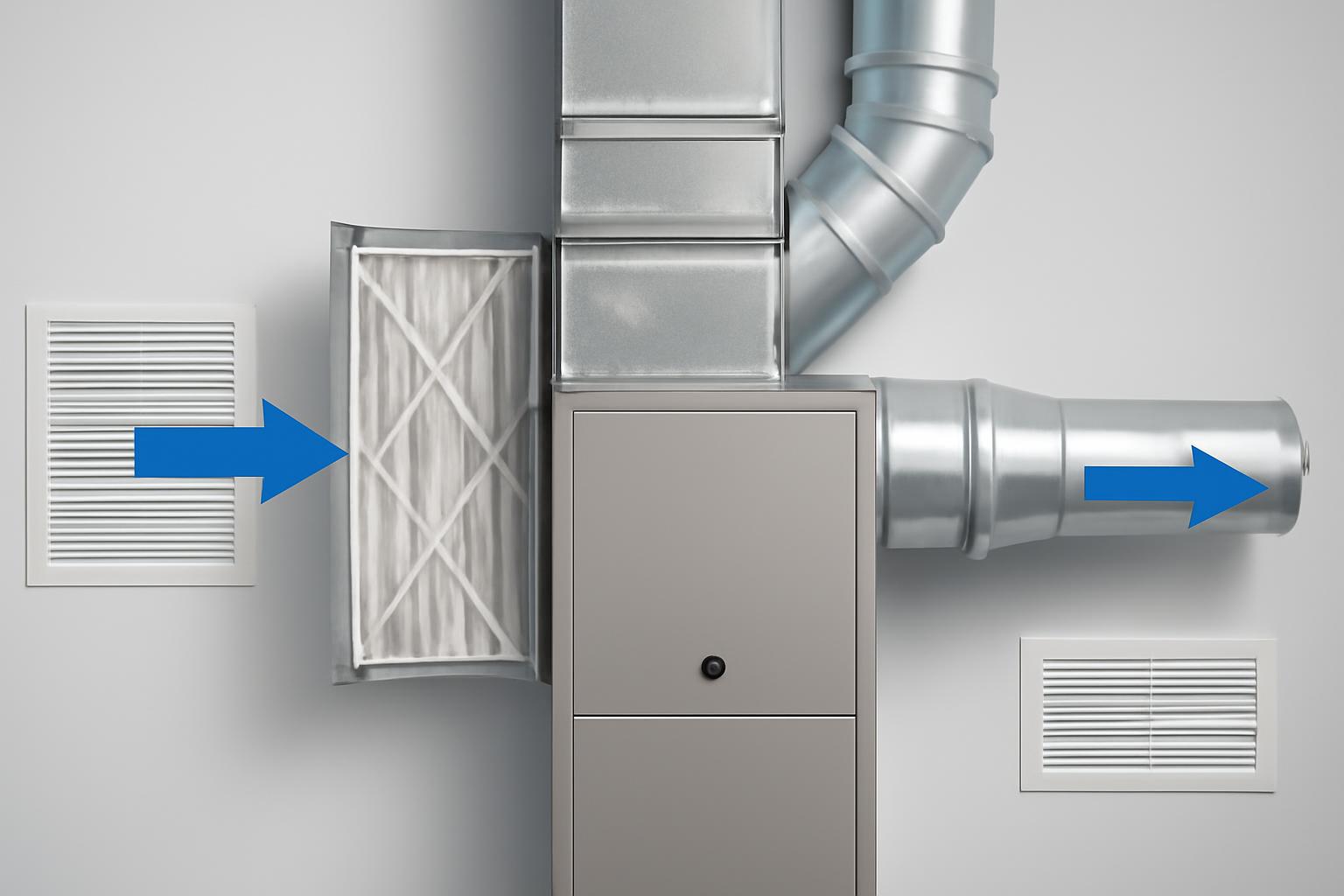
Overview
Air in a forced-air system moves from your return vents, through the filter, into the furnace or air handler, and back out through the supply vents. The arrow printed on the filter frame follows that airflow, so it should point toward the furnace, blower, or air handler, not back toward the room the air came from.
Two clarifications prevent most mistakes here. First, the arrow indicates the direction air travels through the filter, not which edge of the filter you slide into the slot first. The Building America Solution Center, a resource from the Pacific Northwest National Laboratory, notes that most commercial filters carry an arrow on the edge indicating the direction of airflow when properly installed, and that in an upflow air handler that arrow should face upward even if the printed text ends up upside down. The writing on the frame does not matter; the arrow does.
Second, “furnace air flow direction” can mean two different things: the furnace’s overall configuration (upflow, downflow, or horizontal) and the orientation of the filter itself. Topline Air’s guide points out that a furnace will typically have downward, upward, or horizontal airflow, but Summers PHC adds that the type of furnace changes the airflow direction without changing the installation rule. The arrow always follows the air toward the equipment. The rest of this guide shows you how to apply that one rule to your specific setup.
Filter Direction by Furnace Configuration and Location
Once you know where your filter sits, the arrow direction follows directly from the airflow rule. Filterbuy’s direction guide summarizes it plainly: the arrow on the filter frame must always point toward the furnace or air handler, the same direction the air flows. The table below translates that rule into a physical direction for the setups the supplied sources describe.
| Your setup | Where return air comes from | Arrow should point |
|---|---|---|
| Upflow furnace (return duct below the furnace) | Below the furnace, moving upward | Up, toward the furnace |
| Upflow furnace (side return air inlet, left or right) | Beside the furnace, moving sideways into the blower compartment | Horizontally, toward the furnace or blower, per the equipment’s own markings |
| Downflow furnace (return duct enters from above) | Above the furnace, moving downward | Down, toward the furnace |
| Horizontal furnace or air handler | One end of the horizontal run | Sideways, toward the blower motor |
| Wall return grille | The room, pulled into the wall | Into the wall, away from the room |
| Ceiling return grille | The room, pulled upward | Up, into the ceiling ductwork |
| Floor return grille | The room, pulled downward | Down, into the duct below |
Summers PHC explains the furnace-mounted cases: if the return duct is below the furnace, air moves upward and the arrow points up toward the furnace; if the return enters from above, air flows downward and the arrow points down. Aer Terra’s filter guide covers the horizontal case, where the arrow points horizontally toward the blower motor, and the grille cases, where the arrow points into the ductwork behind the grille. Filterbuy describes the same grille logic in room terms: at a ceiling, wall, or floor return, air is pulled out of the room into the duct, so the arrow points away from the room.
One caution before you rely on the table: your equipment’s own markings control. Topline Air notes that most furnaces have an airflow direction arrow on the metal panel around the filter housing, and that the user manual or the sticker documentation on the body of the system gives a definitive answer. If your furnace’s own arrow or documentation disagrees with a general table, trust the equipment.
How to Confirm Airflow When the Direction Is Unclear
When the old filter is gone, was installed by someone you do not trust, or shows no readable arrow, you can still confirm the direction without running the system or guessing. Work from the most authoritative clue down to the weakest, and stop the moment two reliable clues conflict.
Before anything else, turn the system off. The Building America Solution Center’s filter replacement guidance starts its sequence by turning off the HVAC equipment or setting the thermostat so it will not operate while you work. Then find the filter if you have not already. Aer Terra lists the three most common locations: behind a large return air vent on your wall, ceiling, or floor; inside the blower compartment of your furnace, behind a metal door or panel; or in a filter rack between the return duct and the air handler. C.W. Suter’s guide adds that the filter is usually behind a small access panel near the return duct or blower compartment, and some systems keep it inside the return grille itself. Some homes have more than one filter, so check every return grille you can find.
With the system off and the filter located, work through the clues in this order:
- Read the equipment itself. Topline Air notes that most furnaces print an airflow arrow on the metal panel around the filter housing, and that the user manual or the sticker documentation on the system body gives a definitive answer.
- Trace the return duct. Filterbuy’s rule of thumb: the big duct feeding the filter slot is the return, so point the arrow at the furnace on the other side. The Building America Solution Center confirms the underlying layout, noting that HVAC filters are typically located upstream of other components, usually in the return duct adjacent to the air handler or on the back of the return register grille.
- Use the filter’s construction as a secondary clue. For standard pleated filters, Filterbuy states that the wire-mesh or reinforced backing faces the furnace while the open pleated face receives the dirty return air. Aer Terra agrees that the side with wire mesh or reinforcement should face the furnace. Treat this as a tiebreaker only, and only for pleated filters that actually have a reinforced side.
Be skeptical of shortcuts. The location of the equipment (attic versus basement), the position of the cabinet, and the intuition that hot air rises are all clues, not proof. A community discussion on DIY Stack Exchange shows how these assumptions lead people to opposite conclusions about the same system. Blower position, equipment labels, and documentation outrank any general rule about where air “should” go.
Finally, know when to stop. If the equipment marking says one thing and the visible duct path clearly says another, if there is no filter at all where you expected one, if airflow through the house stays weak after you have installed a correctly oriented filter, or if reaching the filter requires opening anything beyond an ordinary access panel or grille, pause and get the model documentation or an HVAC professional involved. A confirmed answer next week is better than a guessed answer today, and a technician can verify the direction in minutes during any routine visit.
Correct a Backward Filter and Check the Fit
If you discover the filter arrow pointing away from the furnace, correct it at your next opportunity, but do not treat it as an emergency. Filterbuy states directly that a few months reversed is not an emergency, and Summers PHC notes that a furnace can usually still run with the filter installed backward, it just will not operate as efficiently. The concerns the sources raise are qualitative: C.W. Suter explains that a backwards or clogged filter restricts airflow and forces the system to work harder, which increases wear, and Aer Terra adds that a reversed filter cannot capture particles effectively and makes the system use more energy. None of the supplied sources quantifies these effects with direct reversal testing, so treat them as reasons for a prompt fix rather than a countdown to failure.
The correction itself follows the same sequence the Building America Solution Center outlines for any filter replacement: turn off the equipment or set the thermostat so it will not run, remove the filter, align the airflow arrow so it points toward the HVAC equipment in the return duct or return register grille, insert the filter into its slot, restore any levers, gaskets, seals, or grilles to their proper condition, and then turn the equipment back on. If the reversed filter is visibly loaded with dust on the wrong face, this is a sensible moment to install a fresh one rather than flipping the dirty filter around.
Getting the arrow right is necessary but not sufficient. Check the fit while you are there. Summers PHC warns that a wrong-size filter can leave gaps around the frame, letting dust and other airborne particles bypass the filter and enter the HVAC system. C.W. Suter makes the same point about loose filters: air slips around the edges instead of passing through the filter media, which reduces effectiveness. Match the dimensions printed on the old filter’s frame, and confirm the new filter sits snugly with no daylight around the edges.
Once you have verified the correct direction, make the next replacement trivial. Take a photo of the properly installed filter, or write the airflow direction on the cabinet or grille frame with a marker. Do this only after you have confirmed the direction against the equipment markings or documentation, so you are recording a verified answer rather than preserving a guess.
Questions About Nonstandard Systems and Specialty Filters
Are there systems where “arrow toward the furnace” could be misleading? The shorthand covers typical residential layouts, but it describes the usual case, not a universal law. The Building America Solution Center says filters are typically located upstream of other components, usually in the return duct adjacent to the air handler or on the back of the return register grille, which is why the arrow normally points at the equipment. “Typically” leaves room for exceptions, and the supplied evidence does not catalog every nonstandard residential arrangement. The more durable phrasing is that the arrow follows the airflow. If your system’s layout makes the airflow path ambiguous, Topline Air’s advice applies: the user manual or the sticker documentation on the system body is the definitive reference, and a technician can confirm the path if the documentation is missing.
Do washable, electrostatic, fiberglass, and specialty media filters use the same orientation clues? The airflow-arrow rule applies to any filter that prints one, but the secondary clues do not transfer. The reinforced or wire-mesh side facing the furnace is a pleated-filter detail described by Filterbuy and Aer Terra, and the supplied evidence does not compare orientation markings across washable, electrostatic, fiberglass, or other specialty constructions. For those filters, let the model’s own instructions and printed markings control, and do not assume a general clue from one filter type carries over to another.