
System Decisions
Leave the Furnace Off After a Flame Rollout Fault
A furnace rollout fault needs more than a reset. Find the emergency signs, what to record safely, and which checks to discuss before approving a repair.
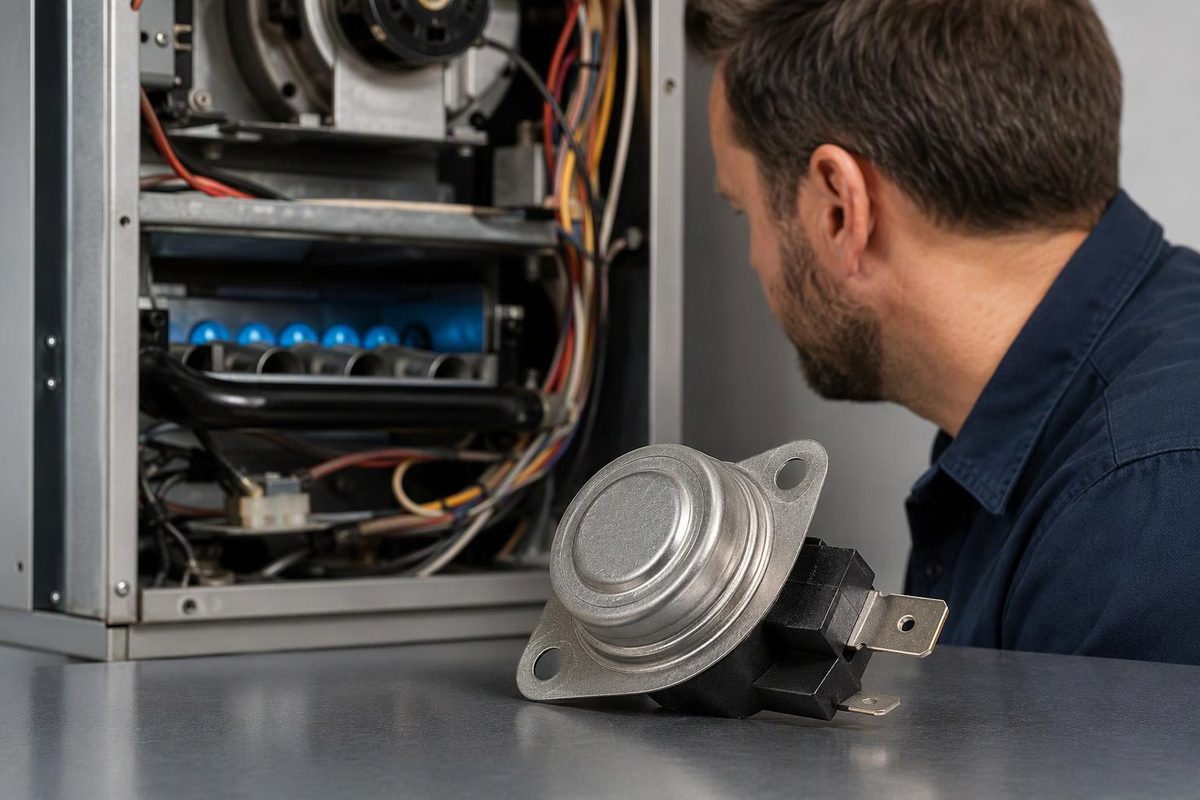
If your gas furnace displays a flame rollout switch open fault, leave it off and arrange professional service. The switch detects excessive heat near the burners; a trip can signal a combustion or venting problem, not simply a bad switch. Do not reset it to restore heat. Lennox advises inspection before running the furnace again after a rollout trip.
Select the warning sign you’re seeing to distinguish an emergency from a furnace service call.
Choose Your Next Step
Set the thermostat to Off. If safely accessible, turn off the furnace’s electrical service switch. Arrange professional inspection; do not reset or restart it.
No listed emergency signs does not mean the furnace is safe to run.
Emergency Instructions
| Warning Sign | Action |
|---|---|
| CO alarm or symptoms | Get everyone outside and call emergency services. Seek prompt medical attention for suspected poisoning. Do not reenter until responders permit it. A silent alarm does not rule out exposure. |
| Gas odor or suspected leak | Leave without operating electrical devices, including the thermostat or furnace switch. Call emergency services and your gas utility from a safe location. |
| Active fire or smoke | Leave and call emergency services. Do not approach the furnace. |
Sources: Lennox rollout guidance, CPSC carbon monoxide guidance and PG&E gas-safety guidance cited in the article. This tool does not diagnose the fault.
Emergency Signs Mean Leave, Not Inspect
A sounding CO alarm or suspected carbon monoxide symptoms: Get everyone outside immediately and call emergency services. Headache, dizziness, nausea and confusion can be symptoms; a silent alarm does not rule out exposure. Seek prompt medical attention for suspected CO poisoning. Do not stay inside to inspect the furnace or reenter until responders give permission. CPSC carbon monoxide guidance
Gas odor or a suspected gas leak: Leave immediately. Do not operate the thermostat, furnace switch, lights or other electrical devices. Call emergency services and your gas utility from a safe location. PG&E gas-safety guidance
Active fire or smoke: Leave and call emergency services rather than approaching the equipment.
A rollout fault without those emergency signs: Set the thermostat to Off and, if safely accessible, turn off the furnace’s electrical service switch. Leave it off pending inspection. Do not restart it to reproduce the fault. The absence of those warning signs does not establish that the furnace is safe to run.
The Switch Stops Burner Operation When Its Temperature Threshold Is Exceeded
Normally, combustion gases travel through the heat exchanger and out the furnace’s exhaust system. Rollout means flame or excessive heat is moving into an area near the burners where it should not be.
The rollout switch is a temperature-operated safety device, typically mounted on or near the burner box. When its threshold is exceeded, it opens the safety circuit and stops gas delivery to the burners. Many furnaces use manual-reset rollout switches: cooling down alone does not restore operation.
The exact location, number of switches and trip temperature depend on the model. For example, the Lennox G43UF has a manual-reset switch on each side of its burner box. That arrangement does not establish where the switches are on another furnace. G43UF service manual, “Flame Rollout Switches”
An “open” fault is a clue, not a complete diagnosis. Table 4 in the same G43UF manual lists an improperly attached connector as another possible explanation for that model’s rollout fault indication. A technician must determine whether the switch tripped, the component failed, or the circuit has another fault. Do not reconnect wiring yourself.
Rollout, High-Limit and Flame-Sensing Faults Need Different Checks
| Device | What It Monitors | Diagnostic Distinction |
|---|---|---|
| Flame rollout switch | Excessive heat near the burners | Combustion and venting need investigation |
| High-limit control | Excessive furnace air temperature | Restricted airflow or a blower problem may be involved |
| Flame sensor | Whether burner flame is established | Flame sensing is not rollout detection |
Manufacturer manuals treat these as separate controls with different fault paths. A dirty filter can cause high-limit shutdown, but replacing it does not establish that a rollout fault is resolved. See the Unitary Products Group safety-control descriptions and the G43UF ignition-control descriptions cited above.
A thermostat setting or dirty filter may explain other no-heat problems. Neither is a reason to dismiss a rollout fault or restart the furnace. Likewise, do not treat rollout as a reason to clean the furnace flame sensor.
Record the Fault Without Opening the Burner Compartment
With no emergency signs present, collect information without opening the burner compartment or touching components. Do not delay shutdown to gather details.
Photograph the fault display or record the light pattern through an existing viewing window only if it is readily accessible before shutdown. Get the model number from an accessible label or existing paperwork; the technician needs the model to interpret its controls and fault codes.
Write down what happened before shutdown: no ignition, a brief burn, unusual noise, or an odor already noticed. Report any known filter neglect, recent maintenance or vent work. If you have already noticed snow around an outdoor vent from a safe ground-level position, include that observation; do not restart the furnace to see whether the vent is working.
Tell the technician if anyone has already reset the switch or cycled power. A furnace that ran after a reset still needs investigation.
Do not run the furnace with panels removed, press the rollout reset button, bypass the switch, or use a jumper as a test. Those actions are not homeowner diagnostic steps for this fault.
Ask for the Cause Before Approving a Switch Replacement
The Unitary Products Group manual cited above identifies combustion-air blower trouble, heat-exchanger problems and a blocked vent connection as reasons its rollout controls may operate. These are possible causes for the equipment covered by that manual, not a diagnosis of your furnace.
Burner condition and gas pressure also warrant professional checking. ENERGY STAR includes gas connections, gas pressure, burner combustion and the heat exchanger in its heating-maintenance checklist. That checklist identifies maintenance checks; it does not establish what caused your rollout fault.
Before approving a repair, ask the technician to distinguish an actual temperature trip from a switch or wiring fault. If the recommendation is to replace the switch, ask what evidence shows that it is defective and what was found in the venting, burners, inducer—the combustion-air blower—and heat exchanger.
Also ask what checks will confirm safe operation after the repair. Restoring continuity through the switch is not, by itself, evidence that a combustion or venting problem has been corrected.
A rollout code alone does not prove a cracked heat exchanger or justify replacing the whole furnace. Equally, a furnace that runs after a reset is not proof that the underlying problem has been corrected. The repair decision should follow the technician’s findings, not the code alone.