
Cooling
Your AC Smells Burned—Here’s How to Respond Safely
Visible fire signs mean leave and call emergency services. A strong or concerning burning odor means shut the AC down and do not restart it before inspection.
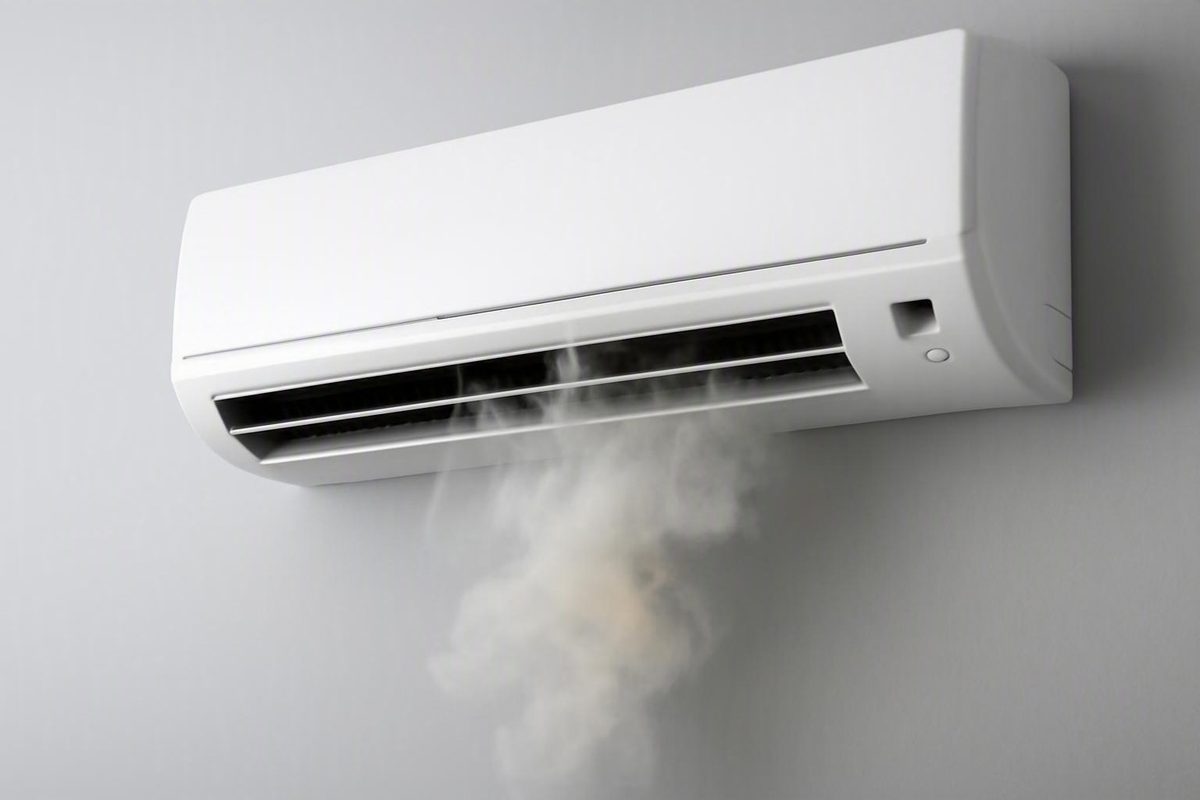
An air conditioner burning smell is a warning symptom, not a diagnosis. Restricted airflow, an overheating motor, friction, deteriorating insulation, an electrical or control fault, or material near a hot or moving component could all be involved. Whether the odor resembles plastic, rubber, hot metal, ozone, smoke, or gunpowder does not reliably identify the failed part.
The immediate decision is simpler: protect people first, stop equipment that may be overheating, and leave internal HVAC and electrical work to qualified professionals.
First response: decide whether to shut down, isolate power, or leave
Use this three-level triage before checking the filter or trying to locate the odor.
| What you observe | Immediate response |
|---|---|
| Visible smoke, flame, sparks, glowing or melting material, or visible charring | Leave the affected area and contact emergency services. Do not approach the equipment to investigate (emergency guidance for smoke or scorching). |
| A strong, worsening, persistent, smoky, electrical, plastic-like, metallic, rubber-like, or gunpowder-like odor | Turn the system off at the thermostat. Do not restart it before qualified inspection (Bryant’s air-conditioner odor guidance). |
| A faint, dry, dusty odor after prolonged disuse, with no other warning signs | A limited startup-dust exception may apply, especially if heating or auxiliary-heat components just operated. Shut the system down if the odor persists, strengthens, or returns (guidance on dust burn-off and auxiliary heat). |
If you see smoke, flame, sparks, glowing material, melting, or charring, leave. Do not walk toward the indoor cabinet, outdoor condenser, electrical panel, or disconnect to determine which part is involved. Contact emergency services from a safe location.
If there are no visible fire signs but the odor is strong, worsening, persistent, smoky, electrical, plastic-like, metallic, rubber-like, or gunpowder-like, set the thermostat to Off. Do not switch to fan-only mode, change temperatures, or run another cycle to see whether the smell returns. The absence of smoke does not establish that continued operation is safe.
For suspected electrical trouble, some HVAC guidance recommends shutting off the known HVAC breaker after turning off the thermostat. Treat that as an optional step only when you already know the correct control and can use its normal external handle without approaching the apparent hazard or opening anything. Do not experiment with breakers to identify the circuit. If the breaker, disconnect, equipment, or surrounding area appears unsafe, leave it alone and obtain qualified help (shutdown guidance for suspected electrical trouble).
Once the system is off, keep it off. The odor may disappear because the suspected component is no longer energized, heating, or moving. That does not establish that the underlying condition has cleared or that another startup is safe.
These are deliberately conservative response rules, not a remote diagnosis of a capacitor, motor, control board, belt, compressor, wire, or other part. Their purpose is to stop questionable equipment from continuing to operate while you arrange an appropriate inspection.
When a dusty startup odor may be different—and why the exception is narrow
A faint dusty or “toasty” odor can occur under limited circumstances. The clearest explanation involves heating equipment that has been unused for an extended period: dust settles on a heat exchanger, electric heating element, or heat-pump auxiliary heat strip and produces a temporary odor when that component first becomes hot.
A potentially temporary startup-dust odor would ordinarily have all of these features:
- It is faint rather than sharp or overpowering.
- It smells dry and dusty, not like melting plastic, hot wiring, rubber, smoke, or gunpowder.
- The equipment has been unused for a prolonged period.
- Heat, emergency heat, or auxiliary heat has just operated.
- There is no visible smoke, sparking, melting, or charring.
- There is no buzzing, grinding, scraping, squealing, or abnormal fan noise.
- Airflow and heating or cooling performance appear normal.
- The system is not tripping a breaker, shutting itself down, or cycling abnormally.
- The odor is fading rather than becoming stronger.
Electric heat strips in some heat-pump systems are a particularly relevant context. By contrast, seasonal heat-dust burn-off is a weaker explanation if the thermostat is definitely set to cooling and no heating or auxiliary-heat component should be operating.
There is no universal time limit that makes a burning smell safe. Published HVAC guidance describes temporary dust odors as lasting anywhere from a few minutes to several cycles or longer. Those varying estimates are practical descriptions, not a recognized safety threshold. Do not dismiss an odor merely because it has been present for less than a particular number of minutes.
Instead, evaluate the complete pattern. Shut the system down if the odor:
- Persists instead of fading
- Becomes stronger
- Returns during later operation
- Appears while the system is strictly cooling
- Smells electrical, smoky, plastic-like, rubber-like, metallic, or gunpowder-like
- Occurs with abnormal sound, weak airflow, poor performance, breaker activity, or unexpected shutdown
Without running another cycle, look at the thermostat and record the displayed mode: Cool, Heat, Fan, Emergency Heat, Auxiliary Heat, or unknown. Thermostat displays vary, so record exactly what you see rather than interpreting it.
That information can help a technician, but do not cycle through modes to reproduce a potentially dangerous odor. If the system is already off, leave it off.
What can cause a burning odor: four fault categories, not a smell-based diagnosis
Possible causes fall into four useful categories: restricted airflow, mechanical overheating, electrical or control failure, and debris or other material near a hot or moving component. These categories can overlap, and the available evidence does not justify ranking them by prevalence.
1. Restricted airflow
A heavily loaded filter or obstructed airflow path may create abnormal operating conditions. Depending on the equipment, reduced airflow may contribute to longer operation, poor performance, blower stress, overheating, or a protective shutdown.
In this situation, the filter is not necessarily the material producing the smell. It may contribute indirectly while a motor, wire, connector, control, or nearby material produces the odor. Contractor guidance identifies dirty filters and blocked vents as possible contributors to restricted airflow and blower problems, but those observations do not identify the overheating component (airflow restriction and blower-strain explanation).
Possible airflow clues include:
- A visibly loaded accessible filter
- Weak flow at multiple supply registers
- Furniture or household items blocking a return grille
- Several closed or obstructed supply registers
- Unusually long cooling cycles
- Intermittent airflow or repeated shutdowns
These remain clues, not confirmation. Weak airflow can have causes that are not visible from the living space, and motor behavior varies by system design.
2. Mechanical overheating
Moving components can generate excess heat when a motor is failing, a bearing is worn, a fan is obstructed, or parts are rubbing. Relevant components include the indoor blower motor and outdoor condenser-fan motor.
Older belt-driven equipment introduces another possibility. A cracked, frayed, slipping, deteriorated, or misaligned belt may generate friction and a rubber-like odor. Many newer systems use direct-drive motors, so a belt explanation does not apply universally.
Mechanical warning signs can include:
- Grinding, scraping, or squealing
- A fan that starts slowly or stops
- Intermittent airflow
- Abnormal vibration
- An outdoor fan that sounds strained
- An odor that becomes stronger while the system runs
A rubber-like odor does not prove that a belt failed, just as a metallic odor does not prove bearing failure. Motors, insulation, wiring, dust, and nearby materials can produce overlapping subjective descriptions.
3. Electrical or control failure
Possible electrical sources include damaged wiring insulation, loose or overheated connections, short circuits, and failed or overheating controls. Components a technician may need to test include:
- Capacitors
- Contactors
- Relays
- Circuit boards
- Motor windings
- Connectors and terminals
- Wiring and insulation
- Protective controls
These components cannot be evaluated safely by smell or an external visual check. Opening equipment or testing electrical parts is not a homeowner-level odor check. HVAC guidance lists overheated wiring, capacitors, relays, motors, and melted insulation among the possible sources of burning-plastic odors and recommends professional handling of electrical components (possible electrical and mechanical sources).
Buzzing, repeated breaker trips, flickering lights, discoloration, visible melting, or a hot-wiring odor increases concern. None of those symptoms identifies the exact failed device.
4. Debris or material near a hot or moving component
Leaves, vegetation, packaging, insulation, a loose object, or other material may be near airflow, a fan, a vent, or a warm component. An object resting on or immediately beside an accessible supply register might also warm and make the HVAC system appear to be the source.
A homeowner can look for obvious exterior obstructions from a safe position. That does not justify reaching through a grille, probing into ducts, entering a fan area, or removing equipment panels. Debris is one possibility, not a presumptive or leading diagnosis.
The practical takeaway is that smell character cannot separate these categories with confidence. “Plastic,” “rubber,” “metallic,” “ozone-like,” and “gunpowder-like” are useful descriptions for a service call, but they are not component tests.
Use timing, operating mode, and location as clues—not proof
Before the details fade, record three things: when the odor begins, which mode is operating, and where the odor seems strongest.
For timing, note whether the smell:
- Appears immediately at startup
- Begins after several minutes
- Strengthens the longer the system runs
- Appears shortly before the system shuts down
- Remains after the thermostat is turned off
- Has returned at a similar point in previous cycles
Do not run additional cycles to complete this list. Document only what has already occurred.
Next, record the operating mode shown on the thermostat. A smell in cooling, fan-only, heating, or auxiliary-heat operation gives a technician different testing priorities because different combinations of equipment may operate in each mode.
For example, an odor that occurred in cooling but not during an earlier fan-only period is useful information. It does not prove that a particular motor winding, heating component, circuit board, capacitor, or control has failed. Avoid switching between modes to recreate the pattern.
Location matters too. Distinguish among these areas without opening equipment:
- One or more supply vents
- The main return grille
- The indoor air-handler or furnace cabinet
- The outdoor condenser
- A nearby outlet, light, appliance, power strip, or wall area
An odor at multiple supply vents may mean that airflow is distributing a smell from somewhere in or near the system. It does not reveal which component generated it. A smell strongest near the return could originate elsewhere in the room and be drawn toward the duct system.
If the odor is strongest near the outdoor unit and accompanies abnormal fan noise, a stationary fan, poor cooling, or repeated shutdown, keep the system off and arrange professional inspection. Do not reach through the condenser grille or attempt to move the fan.
If the odor persists after the HVAC system has been shut down, reconsider the source. A nearby outlet, light fixture, appliance, charger, extension lead, warmed vent material, or household circuit may be responsible. Do not assume that a continuing odor is simply the air conditioner “cooling down.”
Descriptions such as plastic, rubber, metallic, ozone-like, smoky, or gunpowder-like remain worth recording. People describe odors differently, however, and several heated materials can smell similar. Use the words to communicate the event, not to declare that a particular part has failed.
Warning signs that make professional inspection more urgent
Use companion symptoms to determine urgency, not to make a definitive diagnosis.
| Observation | Urgency | What it may tell the professional |
|---|---|---|
| Flame, visible smoke, sparks, glowing or melting material, or visible charring | Emergency | Possible fire or energized fault; leave and contact emergency services |
| Strong smoke or burning-plastic odor that is worsening | Urgent shutdown | Possible electrical or mechanical overheating |
| Buzzing, flickering lights, melted insulation, discoloration, or hot-wiring odor | High electrical concern | A circuit, connection, motor, or control may need electrical testing |
| Repeated breaker trips | High electrical concern | A fault or abnormal electrical condition may be present |
| Weak or intermittent airflow | Prompt HVAC inspection | Restricted airflow or blower trouble may be involved |
| Poor cooling or unusually long operation | Prompt HVAC inspection | The system may be operating abnormally |
| Repeated system shutdowns | Prompt HVAC inspection | A protective control or another fault may be stopping operation |
| Grinding, squealing, or scraping | Prompt shutdown and inspection | A motor, bearing, belt, fan, or moving assembly may be in distress |
| New or persistent clicking or buzzing | Prompt shutdown and inspection | A control, motor, or electrical component may require testing |
| Abnormal outdoor-fan noise or a fan that is not moving | Prompt shutdown and inspection | Outdoor mechanical or electrical operation needs assessment |
Visible smoke, flame, sparks, glowing material, melting, or charring calls for leaving the affected area and contacting emergency services rather than approaching the equipment. Trane similarly recommends immediate shutdown and fire-department involvement for a burning or gunpowder-like AC odor that may involve an electrical fire (Trane’s burning-odor response guidance).
Repeated breaker trips deserve particular caution. Do not repeatedly reset a breaker to see whether the air conditioner will continue running. Record what happened and give that information to the professional.
Weak airflow, poor cooling, long cycles, and intermittent operation can accompany restricted airflow or an overheating blower, but none proves that diagnosis. Likewise, a system that stops itself may be responding to a protective control or another abnormal condition. The shutdown behavior does not reveal which part failed.
A filter change does not clear the system for restart when higher-concern signs are present. If the event included an electrical, smoky, plastic-like, or gunpowder-like odor, buzzing, visible discoloration, abnormal operation, or breaker activity, leave the equipment off even if you subsequently find a dirty filter.
Checks a homeowner can make without opening equipment
Make external checks only after the system is off and only when there is no smoke, fire, sparking, unsafe electrical condition, or other immediate hazard. If approaching the equipment feels questionable, skip the checks and call for help.
Check the accessible filter. If the filter can be reached through its normal homeowner access point without opening an equipment service panel, look for heavy dust loading, deformation, collapse, moisture, or incorrect placement. Replace it only with a compatible filter and according to the equipment and filter instructions.
Do not assume that “new” means “correct.” Filter dimensions, airflow direction, fit, and equipment requirements matter. Keep the old filter or photograph it if its condition may help the technician.
Check supply registers and return grilles. Move furniture, rugs, curtains, boxes, and household objects that visibly block them. Do not probe through a grille, unscrew ductwork, or use major vent adjustments as a substitute for diagnosis.
Observe the outdoor unit from a safe position. Note obvious vegetation, leaves, bags, or other material obstructing the exterior. Do not remove panels, put tools or fingers through the grille, reach into the fan area, or touch wiring. Leave anything that cannot be addressed from outside the equipment for the technician.
Look around accessible vents. An object resting on or immediately beside a vent may be warming or producing the odor. Observe without probing into the duct. Also note whether the smell is stronger near an outlet, appliance, light fixture, charger, or power strip.
Do not:
- Remove an air-handler, furnace, mini-split, packaged-unit, or condenser access panel
- Inspect, move, or tighten internal wiring
- Test a capacitor
- Touch a motor, relay, contactor, circuit board, or internal control
- Reach into a blower or condenser fan
- Bypass a switch or protective device
- Open an electrical panel for diagnosis or repair
- Reset a breaker repeatedly
- Restart the system merely to collect more evidence
A clean filter and clear vents do not rule out electrical or mechanical failure. They establish only that those visible airflow conditions are not obvious at the time of observation.
This boundary reflects HVAC Lens’s homeowner-education scope: helping readers understand observations and contractor conversations rather than training them as technicians. Its safe-check guide for a broken air conditioner similarly distinguishes external observations from technician-only work involving motors, compressors, internal wiring, protective controls, and energized testing.
Who to call and what information to provide
The appropriate contact depends on what is happening now and where the apparent source is located.
Contact emergency services for visible smoke, flame, sparks, glowing or melting material, visible charring, or other apparent signs of fire. Leave the affected area first rather than approaching the equipment to investigate or photograph it.
Call a qualified HVAC professional when the apparent problem involves the indoor blower, outdoor condenser fan, motor, capacitor, contactor, relay, HVAC circuit board, control, airflow, or another part of the heating and cooling system. Keep the equipment off while awaiting inspection.
An electrician may need to participate if the apparent source is an outlet, household wiring, electrical panel, disconnect, or a circuit outside the HVAC equipment. An HVAC professional may also recommend electrical involvement after inspection. Do not try to assign responsibility to a particular trade based on odor alone.
If you rent, report that you shut the system down and describe what you observed through the landlord or property manager’s designated maintenance or emergency channel. Do not restart the equipment while service access is being coordinated.
Use this handoff template when calling:
Thermostat mode: Cool, Heat, Fan, Emergency Heat, Auxiliary Heat, or unknown Timing: Immediate at startup, after several minutes, near shutdown, or after the system stopped Odor description: Dusty, smoky, electrical, plastic-like, rubber-like, metallic, ozone-like, gunpowder-like, or another description Strongest location: Supply vent, return grille, indoor cabinet, outdoor unit, outlet, appliance, or unknown After shutdown: Odor faded, persisted, or became stronger Filter: Clean, lightly loaded, heavily loaded, damaged, wet, recently replaced, or not safely accessible Airflow: Normal, weak, intermittent, or absent Sounds: Buzzing, clicking, grinding, squealing, scraping, abnormal fan sound, or none noticed Performance: Cooling normally, cooling poorly, running unusually long, or shutting down Electrical behavior: Breaker tripped, lights flickered, visible discoloration, or none noticed Safety signs: Smoke, flame, sparks, melting, charring, or none observed
Also mention recent HVAC service, construction or renovation dust, electrical work, storms, power disturbances, outages, and any previous occurrence. These details provide context; they do not prove causation.
Do not turn the air conditioner back on to demonstrate the smell when the technician arrives. Describe the event and let the professional decide how to inspect and energize the equipment safely.
Reducing recurrence without promising that maintenance prevents every failure
Routine care can reduce some airflow- and wear-related problems, but no maintenance plan can prevent every wiring fault, failed control, motor problem, or burning odor.
Check the filter on a schedule that accounts for:
- The filter manufacturer’s instructions
- The HVAC equipment documentation
- Filter type and depth
- System runtime
- Pets
- Construction or renovation dust
- Local dust conditions
- Household occupancy and activities
Avoid treating one monthly or multi-month interval as universal. A lightly used system with a deeper filter may differ from heavily operated equipment using a thin filter. Inspecting the accessible filter and following model-specific documentation is more useful than relying on one calendar rule.
Keep return grilles and supply registers free of furniture and household obstructions. Maintain the outdoor condenser’s clearance according to its manufacturer and installation instructions rather than assuming one spacing applies to every model. Avoid stacking items beside the unit or allowing vegetation to grow into its airflow path.
Arrange periodic professional maintenance appropriate to the equipment. Inspection may reveal wear, deteriorating connections, airflow problems, abnormal motor operation, damaged components, or debris that is not externally visible. Carrier recommends professional attention for persistent electrical or burning odors and presents filter and equipment care as preventive measures rather than guarantees (Carrier’s AC odor and maintenance guidance).
Keep the equipment model number, installation records, service history, and manufacturer documentation available. Model-specific information can help distinguish a direct-drive blower from older belt-driven equipment or a conventional air conditioner from a heat pump with auxiliary heat.
Address early warning signs before they are accompanied by an air conditioner burning smell. Recurring breaker trips, weak airflow, unusual sounds, intermittent shutdowns, or declining cooling performance justify professional attention even if the equipment later restarts.
The maintenance boundary remains important: replacing an accessible filter and keeping external airflow paths clear are ordinary homeowner tasks. Electrical testing, internal mechanical inspection, panel removal, fan access, motor work, capacitor testing, and control diagnosis belong to qualified professionals.
Should I turn off only the thermostat, or also the circuit breaker?
Start by turning the system off at the thermostat when it is safe to do so. For suspected electrical trouble, some guidance also recommends shutting off the known HVAC breaker, but only if you can identify and operate it without experimenting or approaching the apparent hazard (Bryant’s shutdown and professional-service guidance).
If there is smoke, flame, sparking, melting, or visible charring, leave and contact emergency services instead of trying to reach a shutoff.
Is it safe to restart the AC if the burning smell disappears?
Not when the odor was strong, persistent, smoky, electrical, plastic-like, metallic, rubber-like, or gunpowder-like, or when it occurred with abnormal sound, weak airflow, shutdowns, poor cooling, flickering lights, or breaker activity.
The smell may disappear because the suspected component is no longer operating. That does not establish that the fault has cleared. Keep the system off until it has been inspected.
The limited exception is a faint, fading dusty odor after prolonged disuse, particularly when heating or auxiliary-heat components have just operated and there are no other warning signs. Even then, no universal duration proves safety.
Can a dirty air filter cause an air conditioner burning smell?
A heavily loaded filter can contribute indirectly. Restricted airflow may create abnormal operating conditions, contribute to longer operation or poor performance, and be associated with overheating. The filter itself may not be the material producing the odor.
If the accessible filter is dirty, replace it according to the equipment instructions—but do not treat that as proof that the problem is fixed. A filter change does not make restarting appropriate after an electrical, smoky, plastic-like, or otherwise concerning odor.
Why does the smell happen in cooling mode but not fan-only mode?
Cooling and fan-only operation can involve different combinations of equipment and controls. The distinction can help a technician prioritize inspection.
It does not prove that a motor winding, heating component, circuit board, capacitor, or other specific part has failed. Record the mode-specific pattern, keep the system off if the odor was concerning, and do not cycle through modes to reproduce it.
When does a burning AC smell require emergency services instead of an HVAC appointment?
Leave the affected area and contact emergency services for visible smoke, flame, sparks, glowing or melting material, visible charring, or other apparent signs of fire. Do not approach the equipment or an unsafe electrical area to investigate (manufacturer guidance for burning or gunpowder-like AC odors).
Without visible fire signs, a strong, persistent, worsening, electrical, smoky, plastic-like, metallic, rubber-like, or gunpowder-like odor generally calls for immediate shutdown and qualified inspection—not continued operation.
The concise rule is: visible fire signs mean leave and call emergency services; a strong or concerning burning odor means shut the AC down and do not restart it before inspection. A faint startup-dust odor is only a narrow possibility, especially when heating components have just operated after prolonged disuse. Document the mode, timing, location, airflow, sounds, performance, shutdown behavior, and breaker activity, but leave panels, wiring, capacitors, motors, fans, and internal diagnosis to qualified professionals.