
HEPA Filter Cassette Types: Specifications, Compatibility, and Maintenance
A HEPA filter cassette is a form-factor or system label, not a single standardized product. The term is applied to deep-pleat HVAC and cleanroom filters, self-…
By Mara Keene · · 16 min read
Overview
A HEPA filter cassette is a form-factor or system label, not a single standardized product. The term is applied to deep-pleat HVAC and cleanroom filters, self-cleaning process-air units, appliance cartridges, and equipment-specific vacuum replacements. Before comparing efficiency, price, or dimensions, identify which equipment category you are actually filling, because the categories are not interchangeable.
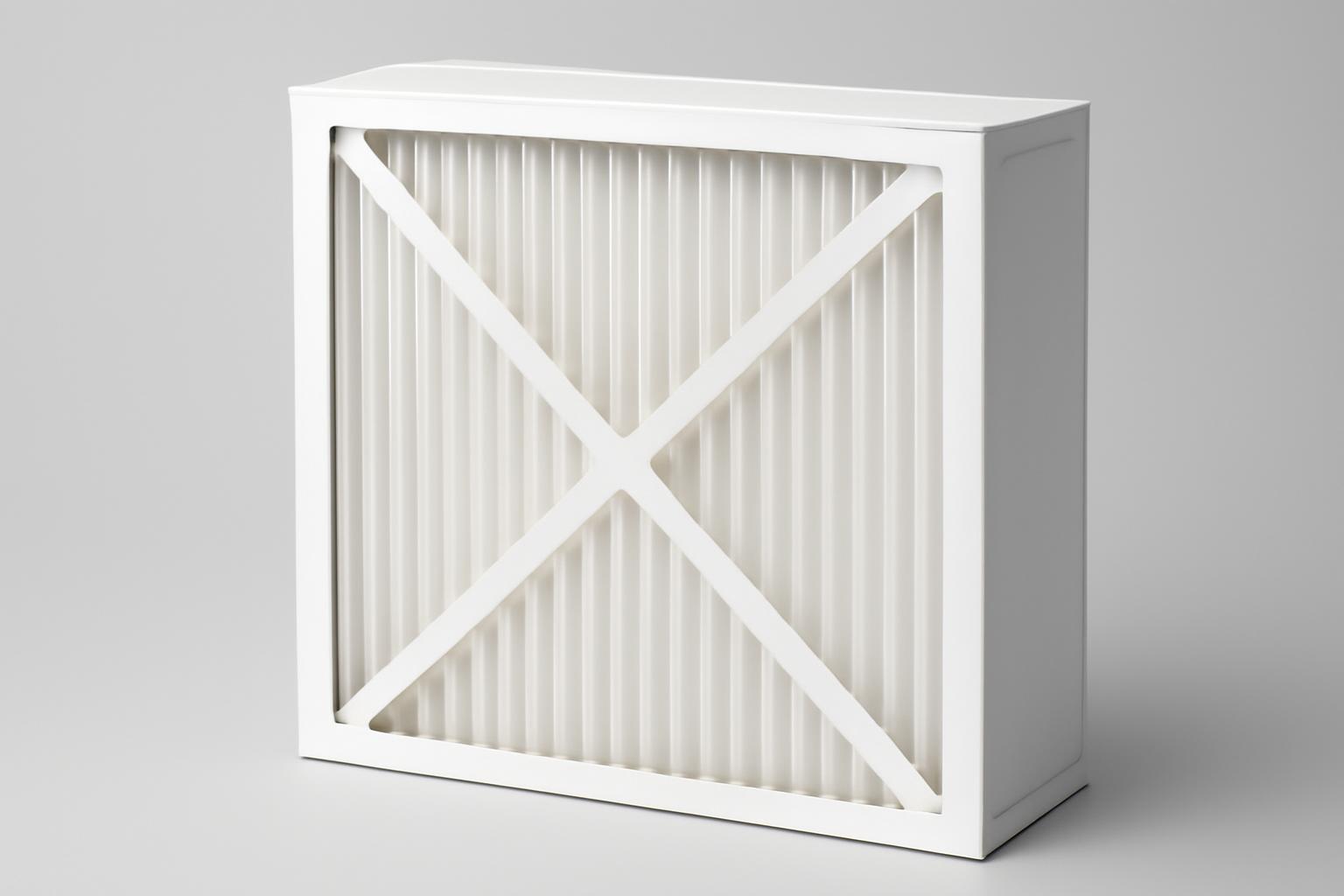
That ambiguity is the first thing to resolve. The same phrase describes materially different objects across the supplier landscape. One vendor uses “HEPA filter cassette” to mean a deep-pleat element with a media pack at least 6 inches (150 mm) thick, and sometimes 10 inches (220 mm) or 12 inches (292 mm), designed to drop into cleanroom air-handling units and HVAC systems (cleanroom-ffu.com). Another applies it to sealed cassettes for filtering dust-laden process air inside self-cleaning HEPA filter units (containment-technology.com). A third uses it for an air-purifier accessory that combines HEPA media with activated carbon pellets (lloydsofindiana.com). A fourth sells it as a genuine replacement pack for a specific Metabo vacuum (worlddiamondsource.com).
Two boundaries are worth drawing right away. A filter cassette is the replaceable element, not the housing, ceiling grid, or complete purification appliance that surrounds it, and a cassette that is part of an integrated purifier or vacuum is defined by that machine rather than by a generic size. So treat “cassette” as a starting label. It tells you the rough form factor, but it does not by itself guarantee dimensions, efficiency grade, or application. The rest of this guide walks through the fields you need to compare (efficiency evidence, physical fit, airflow and resistance, construction, application controls, gas versus particle handling, and maintenance) so you can turn the term into a compatible, documentable specification.
HEPA efficiency classes, percentages, and standards
A useful efficiency specification names four things together: the standard, the class, the stated efficiency value, and the test basis. A class letter or a percentage on its own is not enough, because different testing conventions measure efficiency differently and are not automatically interchangeable.
Start with what the class letters mean. Deep-pleat HEPA cassettes are commonly offered in grades such as H13, H14, and U15 (cleanroom-ffu.com). Under EN 1822, these grades are defined by efficiency at the most penetrating particle size, or MPPS: the particle diameter that is hardest for the medium to capture. That is the key point that trips up buyers. When a supplier states H14 at 99.995% efficiency, that value is measured at MPPS, not at a fixed 0.3-micron reference point (airtecnics.com).
Contrast that with the familiar “99.97% at 0.3 microns” convention you often see on consumer and appliance products. That figure describes capture at one specified particle size, which is not the same test basis as an MPPS-referenced class. The two numbers can look similar but are not proven equivalent without checking the cited method and grade. A vacuum replacement that “stops 99.995% of fine dusts over 0.3 μm” and “corresponds to dust class H (HEPA 14)” is stating capture above a size threshold, which again is a different statement from an MPPS class efficiency (worlddiamondsource.com). Before treating any two efficiency claims as interchangeable, confirm the standard, the test method, and the filter grade behind each one.
The picture gets more complicated when ISO 29463 enters. ISO 29463 keeps the EPA, HEPA, and ULPA naming from EN 1822 and also evaluates efficiency under MPPS, but it re-labels the classes and adds intermediate grades (filtermedias.com). One published comparison maps EN 1822 H13 to ISO 35 H (≥99.95%) and H14 to ISO 45 H (≥99.995%). However, the secondary sources disagree on the letter used for the ISO 50 grade: one lists it as ISO 50U within the ULPA range (filtermedias.com), while a class-comparison sheet labels the same ≥99.999% overall grade as ISO 50 H (tripleairtechnology.co.uk).
Because those secondary sources conflict on notation, do not treat any crosswalk here as a complete or authoritative equivalence. The same class-comparison sheet also distinguishes an “overall value” from a “local value,” meaning the efficiency measured across the whole filter is stated separately from the minimum efficiency allowed at any single scanned point (tripleairtechnology.co.uk). For a critical application, that local value is often where leak verification matters most.
The practical takeaway is to specify efficiency defensibly rather than by a single percentage. Request the named standard (EN 1822 or ISO 29463), the class, the overall efficiency, and where relevant the local value, plus confirmation of whether individual leak or scan testing applies. This guide cannot select a class for your application, because the evidence here does not include an authoritative requirement for any particular use; that requirement comes from your own equipment specification or governing procedure.
How to specify and match a replacement cassette
Work in a fixed order: identify the equipment, confirm the physical fit, capture the operating airflow and pressure data, choose construction and seal details, and request the applicable documentation. If you skip a step, you risk an element that either does not fit the housing or does not perform at your operating point. Quotes only become comparable when every buyer answers the same fields, so hold these constant when you send them out.
The checklist below is built from the specification fields the supplier evidence actually supports. Items that depend on your specific housing (gel-seat position, flange style, clamping arrangement) are flagged as things to confirm against equipment drawings or with the supplier, because the sources do not establish a universal measuring method.
- Equipment identity: Record the exact machine, unit, or housing model the cassette serves, since integrated purifier and vacuum cassettes are defined by the host machine (airtecnics.com; worlddiamondsource.com).
- Face dimensions and depth: Capture width, height, and media-pack depth. Common deep-pleat sizes include 24x24x12 and 24x24x6 inches, with custom sizes available, and depths run from 6 inches (150 mm) up to 12 inches (292 mm) (komtfil.com; cleanroom-ffu.com).
- Efficiency class and standard: State the class (for example H13, H14, U15) and the governing standard behind it (cleanroom-ffu.com).
- Rated airflow and pressure drop: Give the design airflow (in CMH/CFM or m³/h) and require the pressure-drop figure at that stated airflow for the chosen size and grade (cleanroom-ffu.com; containment-technology.com).
- Frame, gasket, and sealant: Specify frame material (metal or MDF/wooden) and gasket type (for example EPDM or neoprene), plus sealant where relevant (komtfil.com; cleanroom-ffu.com).
- Separator construction: Note whether the media uses aluminum or paper separators, since that affects moisture and hygiene suitability (cleanroom-ffu.com).
- Test documentation: For critical service, require individual testing and full performance documentation shipped with the unit (cleanroom-ffu.com).
- Confirm-with-supplier items: Seal position, flange profile, airflow direction, and clamping method, verified against equipment drawings.
On price: there is no defensible universal range to publish, because the products carrying this name span consumer cartridges, vacuum packs, purifier accessories, and large industrial cassettes that are not comparable. Instead of chasing a headline number, compare quotes only when size, grade, operating point, construction, documentation, and changeout scope are identical across bids. When those variables match, a price difference is meaningful; when they do not, it is noise.
Physical fit and housing compatibility
Before ordering, document the existing filter and its housing so the replacement drops in and seals correctly. Physical mismatch is the most common and most avoidable error, because the label class tells you nothing about whether the element fits the opening.
Record the equipment model first, then the face width and height, the media-pack depth, the frame material, and the gasket type and its seat location. The supplier evidence supports depth as a distinct variable (6, 10, or 12 inches on deep-pleat designs) and treats frame and gasket as selectable attributes rather than fixed defaults (cleanroom-ffu.com; komtfil.com). One point deserves care: nominal catalog sizes such as 24x24x12 are naming conventions, not guaranteed housing-opening measurements (komtfil.com). The actual opening, the gasket seat, and the required compression can differ, so measure the real aperture rather than trusting the printed size.
Several fit details are not resolved by any supplied source and must be confirmed rather than assumed:
- Airflow direction through the element, so it installs the correct way round.
- Gasket seat position (face-seal versus edge-seal) and the seal profile.
- Flange style and any mounting or clamping hardware.
- Clamping or hold-down force needed to compress the gasket without distorting the frame.
For each of these, treat the equipment drawings or the filter supplier as the authority. The sources here confirm that dimensions, depth, frame, and gasket vary by product, and that custom sizes exist, but they do not provide a universal procedure for measuring a housing (komtfil.com; cleanroom-ffu.com; containment-technology.com). When a dimension is ambiguous, confirm it in writing with the supplier before you order.
Airflow, face velocity, and pressure drop
Pressure-drop data is only meaningful when it is tied to a specific airflow, so never accept a single resistance number without its airflow condition. Resistance rises with airflow through the same element, which means an initial pressure loss quoted at one flow rate does not apply at another.
The supplier data shows why airflow and depth belong together with resistance. Deep-pleat catalogs pair each size and airflow rate (in CMH and CFM) with a corresponding pressure drop that differs between H13 and H14 grades, so a higher grade in the same envelope generally carries a different resistance (cleanroom-ffu.com). Process-air cassette tables likewise list air volume alongside a specific filter-area load (m³/m²h), initial pressure loss, and final pressure loss for each type (containment-technology.com). Face velocity, which is airflow divided by the filter’s face area, is what that specific filter-area load expresses; a larger media area at the same airflow lowers the velocity and the resistance.
There is also a difference between a laboratory test endpoint and a field replacement limit, and the two should not be confused. The ASHRAE 52.2 test method measures resistance to airflow at multiple rates (50%, 75%, 100%, and 125% of the test airflow) and defines minimum final resistance values used to end a laboratory test, with manufacturers specifying the final resistance for testing (ashrae.org). That is a test construct. It does not by itself set the resistance at which you should change a filter in service.
The practical action is to require the airflow-versus-pressure curve, or at minimum the initial and final pressure loss at your stated operating airflow, for the exact size and depth you intend to buy. Match that operating point to your fan and duct capacity before committing, so the new element does not starve airflow or overload the fan.
Frames, seals, and separator construction
Frame, gasket, sealant, and separator are compatibility and environment decisions, not cosmetic ones. The right combination depends on your housing, your operating temperature and humidity, and any hygiene requirement, so choose each attribute against the actual application rather than defaulting to the cheapest option.
On the visible hardware, supplier catalogs offer metal or wooden (MDF) frames, gaskets in materials such as neoprene, PU, or EPDM, and polyurethane sealant to bond the media pack into the frame (cleanroom-ffu.com; komtfil.com). The gasket has to match the housing’s seal seat, and a wooden frame may be unsuitable where moisture or wash-down is expected, so confirm the frame choice against your environment.
The separator choice inside the pleat pack is where one supplier gives a concrete environmental tradeoff, and it is worth attributing precisely because it is a single-supplier comparison rather than a universal engineering rule. According to that supplier, aluminum separators are more durable and more resistant to corrosion and moisture, but they cost relatively more (cleanroom-ffu.com). Paper separators are relatively cheap, but the same source cautions that they cannot be used in humid environments and can become a breeding ground for microorganisms, so it advises paying special attention to the use scenario when cost is the driver (cleanroom-ffu.com). Read that as a humidity and hygiene decision, not just a purchase-price one: in a damp or hygiene-sensitive setting, the cheaper separator can be the wrong choice. Confirm the separator material against your operating humidity and any cleanliness requirement before selecting on price.
Applications and critical-service controls
The application sets how deep your specification has to go. For ordinary HVAC or general cleanroom service, the decision is largely a matter of correct fit, grade, and pressure drop. For toxic dust, active pharmaceutical ingredients, or other hazardous or validated processes, the filter becomes part of a system where containment, installed validation, and changeout controls also matter.
You can see the split in the sources. General cleanroom and HVAC cassettes are described mainly by dimensions, class, frame, and seal, designed to fit air-handling units and HVAC systems (komtfil.com). Process-air cassettes, by contrast, are specified for filtering dust-laden process air in self-cleaning units, with staged filtration and higher dust loading (containment-technology.com), and cassette filter systems are offered specifically for dust removal in demanding processes such as toxic dusts or powders, including active pharmaceutical ingredients (infastaub.com). Do not assume every cleanroom, healthcare, or industrial job needs the same controls; let the hazard and any validation requirement decide how far to extend the specification beyond fit and efficiency.
Leak testing, containment, and hazardous-process requirements
For hazardous or validated service, extend the requirement from filter efficiency alone to installed testing and contained handling. The supplier evidence supports two specific controls here, and treats several others as process-dependent rather than universal.
Installed leak and seal verification is directly supported. On self-cleaning process-air units, the second-stage security filter can be tested during validation, during operation, and after each filter change using installed measuring lances and a laser particle counter, to prove the H14/EN 1822 efficiency has been reached, with the cassette seal checked at the same time (containment-technology.com). That is a meaningful distinction from a catalog efficiency claim: it verifies performance in place, including the seal, rather than only in a factory test.
Contained changeout is the second supported control. The same process-air cassette can be sealed inside its plastic bag so the filter unit stays sealed, letting the operator transport the cassette to incineration inside the sealed bag without contamination (containment-technology.com). Where that matters, staged systems are relevant too: one dust-collector design pairs a cleanable first stage with a non-cleanable downstream safety filter, using H13 for the cleanable stage and H13 to U15 for the safety stage (infastaub.com).
Beyond leak testing and contained changeout, other controls that often accompany hazardous-dust service (electrical grounding of conductive components, fire-safety certification, and disposal or incineration handling) are not established as universal requirements by these sources. Treat them as items to define with the system owner and the applicable process procedures. The safe default is to ask the equipment owner which of these apply, rather than assume a generic rule covers your process.
Test documentation and acceptance checks
At acceptance, verify that the documents you receive actually correspond to the unit you ordered and the conditions it will run in. A claimed class on a datasheet is not the same as evidence that this specific filter meets it, so ask for the paperwork and then match it, item by item, to the delivered cassette.
For a critical-service filter, request:
- The named standard and class the filter was tested to (cleanroom-ffu.com).
- The filter identifier or serial reference tying the paperwork to the physical unit, where individually tested filters ship with full performance documentation (cleanroom-ffu.com).
- The efficiency or scan report where individual testing applies.
- The pressure-drop figure at a stated airflow for the ordered size and grade (cleanroom-ffu.com).
- Relevant material or construction documentation (frame, gasket, separator).
Then check that the identifier on the report matches the unit, that the tested airflow and pressure drop align with your operating point, and, for installed validation, that the seal and second-stage efficiency were confirmed after installation where the system supports it (containment-technology.com). These sources do not define a universal protocol for authenticating a certificate, so the practical control is correspondence: every document should trace to the ordered filter and its stated conditions. If a report does not match the unit or the operating point, treat that as a reason to hold acceptance until it is reconciled.
Particle filtration versus gases and odors
A HEPA cassette captures fine particulate. On its own, it is not a gas or odor filter, so if you need to remove smells or gaseous pollutants, confirm the product includes a separate activated-carbon stage rather than assuming the word “cassette” covers it.
The supplied products make the division explicit. One air-purifier filter cassette combines a HEPA filter for fine particulate filtration with activated carbon pellets to purify the air of odors, treating carbon as a distinct layer for a distinct job (lloydsofindiana.com). A cassette air purifier similarly eliminates particles and pollutants such as dust, pollen, spores, bacteria, viruses, and fine particles (PM10, PM2.5, PM1) through its HEPA stage, and can incorporate an activated carbon filter to eliminate gases and odors only on request (airtecnics.com).
The practical point is that gas and odor control is an added carbon stage, not an inherent property of HEPA media. If your application involves odors, solvents, or gases, specify the carbon stage explicitly and confirm it is present rather than inferring it from the cassette label or the HEPA rating.
Cleaning, monitoring, and replacement
Follow the specific product and system design rather than assuming every cassette is washable or applying one calendar interval. Whether a cassette can be cleaned, and when it should be replaced, depends on the construction and the equipment, so read the manufacturer’s instructions for your exact unit before you clean or discard anything.
Two principles hold across the sources. First, monitoring matters: a rising system pressure drop is a practical signal that replacement is due (komtfil.com). Second, integrity and contamination context matter, because in validated or hazardous service the decision is not only about airflow but about whether the filter still meets its efficiency and containment requirements. Handling also has to be safe where the collected dust is hazardous. The two subsections below separate the cleaning question from the replacement-timing question, because the sources treat them differently.
Disposable cassettes and engineered cleanable stages
“Washable versus disposable” is not a contradiction once you separate an ordinary cassette from a purpose-built process stage. Do not wash a HEPA cassette unless your specific system has validated cleaning instructions for it.
An ordinary deep-pleat glass-fiber cassette is disposable. One supplier states plainly that you cannot wash this HEPA filter cassette: it is disposable, the media will break if washed, and you cannot wash the dust out of the glass-fiber medium (cleanroom-ffu.com). Attempting to clean that type of element damages the medium and defeats the filtration.
The apparent contradiction comes from a different product class. Self-cleaning process-air units are engineered so that a first stage is cleaned in place: one such stage 1 filter runs at F9/H13 efficiency with a high dust-holding capacity and a maximum pressure differential above 3.5 kPa (containment-technology.com). Similarly, a cassette filter system can be built as a cleanable dust collector with one or two cleanable stages plus a non-cleanable downstream safety filter (infastaub.com). In those systems, the cleaning is a designed function of the first stage, while a non-cleanable safety stage still gets replaced. So the rule is not “HEPA is washable” or “HEPA is never washable.” It is that only a purpose-designed first stage is cleaned, and only where the system provides validated instructions. If your unit is an ordinary glass-fiber cassette, plan to replace it, not wash it.
Condition-based replacement criteria
Replace on condition, not on a fixed calendar interval, because the supplier recommendations conflict and none establishes a universal service life. The right trigger is a set of product- and duty-specific signals rather than a single date.
Base the decision on these inputs:
- Terminal resistance for the specific product. One deep-pleat cassette states a final resistance of 600 Pa, and instructs that replacement is necessary when that final resistance is reached (cleanroom-ffu.com). That value is product-specific; use the figure your own filter’s datasheet gives.
- Differential-pressure trend. Monitor system pressure drop over time; a rising pressure drop is the practical signal that replacement is due (komtfil.com). A trend is more useful than a single reading, because it shows loading rather than a momentary flow change.
- Resulting airflow. As resistance climbs, delivered airflow falls; when the fan can no longer hold the required flow, that is a replacement trigger in its own right.
- Integrity or validation status. In validated or containment service, a failed installed leak or seal test, or a filter that no longer proves its H14/EN 1822 efficiency after a change, is a reason to replace regardless of pressure drop (containment-technology.com).
- Contamination events and local procedures. A spill, a breakthrough, or a hygiene or safety rule specific to your site can force an earlier change; these are locally defined and are not set by the supplier datasheets.
Keep the laboratory test endpoint separate from your field limit. ASHRAE 52.2 defines a minimum final resistance for testing as being at least twice the initial resistance, with manufacturers specifying the final resistance used for the test, and it is that manufacturer-specified value that ends a laboratory test (ashrae.org). That endpoint governs a test procedure; it does not tell you when to change a filter in your building. For that, use your product’s stated final resistance, the pressure-drop trend, the resulting airflow, and, in critical service, the integrity result, and record the reasoning so the next changeout decision is repeatable.