
Cooling
The Two Coils That Move Heat Through Your Home
In cooling, the evaporator absorbs indoor heat. The condenser releases it outside. In heat-pump heating, their roles reverse while the coils stay put.
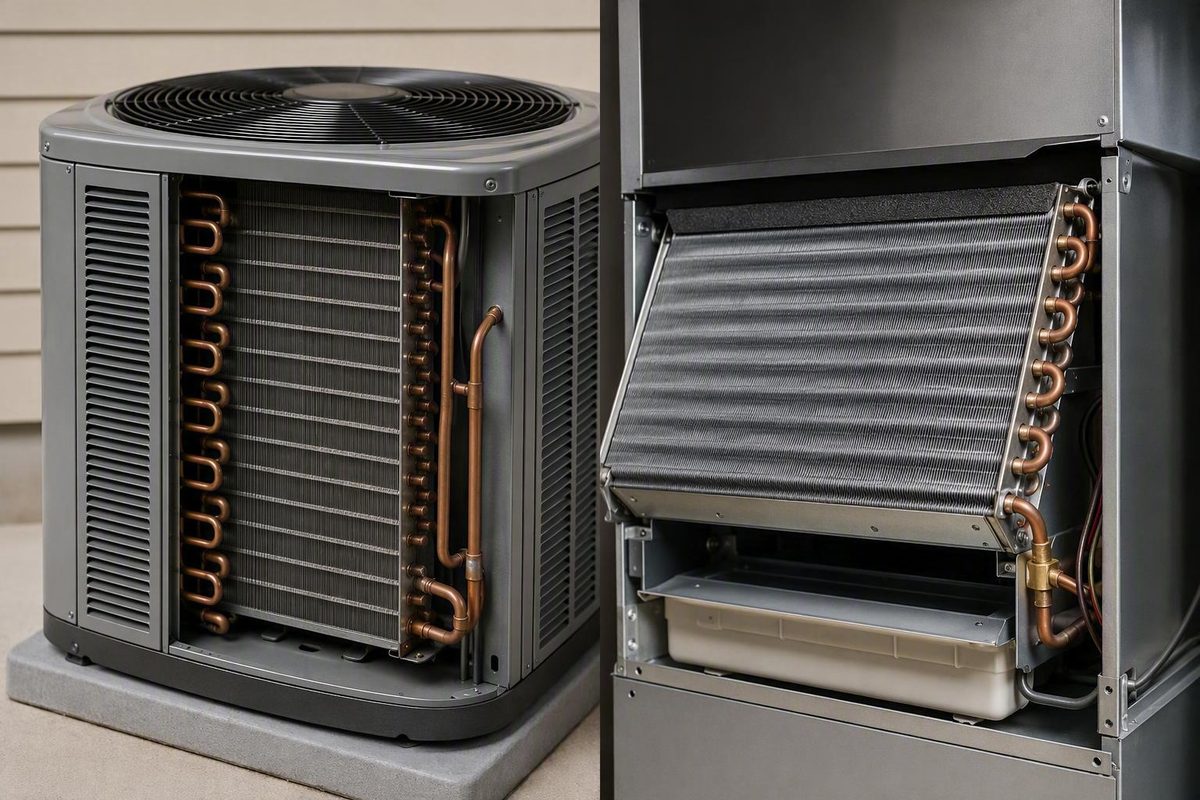
In cooling mode, the difference is straightforward: the evaporator coil absorbs heat from indoor air, while the condenser coil releases that heat outdoors. The evaporator also removes some moisture as condensation. Refrigerant carries the absorbed heat between the coils, changing from liquid toward vapor at the evaporator and from vapor toward liquid at the condenser.
Understanding the condenser coil vs. evaporator coil distinction can help you follow an HVAC diagnosis. It cannot identify a failed part by itself. Ice, water, warm air, long run times, unusual noise, short cycling, and higher energy use can have multiple causes. Treat those signs as clues, not proof that a coil needs cleaning or replacement.
Condenser coil vs. evaporator coil at a glance
In a conventional split air conditioner, the evaporator is usually inside an air handler or near a furnace. The condenser coil is usually part of the outdoor unit. They are complementary heat exchangers in one refrigerant circuit—not competing options from which a homeowner chooses.
| Comparison | Evaporator coil | Condenser coil |
|---|---|---|
| Main function in cooling mode | Absorbs heat from indoor air | Releases carried heat to outdoor air |
| Typical location | Inside the air handler or near the furnace | In the outdoor condensing unit |
| Heat direction | Indoor air to refrigerant | Refrigerant to outdoor air |
| Refrigerant change | Refrigerant evaporates toward vapor while absorbing heat | Refrigerant condenses toward liquid while rejecting heat |
| General operating character | The generally cold coil | The generally warm coil |
| Moisture handling | Collects condensation and contributes to dehumidification | Does not normally manage indoor condensate |
| Main exposure | Indoor dust, restricted airflow, condensate, and drainage trouble | Leaves, dirt, vegetation, weather, impact damage, and salt in some environments |
| Common problems | Dirty surface, low airflow, freezing, drain trouble, corrosion, physical damage, or refrigerant leaks | Blocked or bent fins, debris, corrosion, physical damage, or refrigerant leaks |
| Associated equipment | Blower, filter, drain pan, condensate line, and metering device | Outdoor fan, compressor, and electrical controls |
The names describe what the refrigerant is doing. It evaporates as it absorbs heat in the evaporator and condenses as it rejects heat in the condenser. Carrier’s comparison of evaporator and condenser coils supports these typical locations, phase changes, moisture collection, and shared role in the cooling circuit.
Calling the evaporator the “cold coil” and the condenser the “warm coil” is useful shorthand. It is not a universal surface-temperature test.
Location labels also have limits. “Indoor evaporator” and “outdoor condenser” accurately describe a conventional split system in cooling mode. A heat pump reverses the coils’ functions in heating mode, while packaged and ductless equipment may arrange components differently.
How both coils move heat through one cooling cycle
An air conditioner does not manufacture cold as a substance. It cools the home by absorbing heat indoors, carrying that energy through the refrigerant circuit, and releasing it outside.
Here is the cycle in practical order:
-
Indoor air passes over the evaporator. The blower moves return air across the indoor coil. Heat transfers from the air into the refrigerant, allowing cooler air to return to the rooms. As the refrigerant absorbs heat, it evaporates toward a vapor.
-
Refrigerant carries the absorbed heat away. The vapor leaving the evaporator travels through the refrigerant circuit toward the outdoor equipment. It carries energy taken from the indoor air.
-
The compressor raises refrigerant pressure and temperature. The compressor is a separate mechanical component, even though it is commonly housed beside the condenser coil in the outdoor unit. It prepares the refrigerant to release heat outdoors by raising its pressure and temperature. The condenser coil does not perform the compression.
-
The condenser releases heat outdoors. Hot refrigerant moves through the condenser coil. The outdoor fan moves air across the coil, helping transfer heat into the outdoor environment. As the refrigerant rejects heat, it condenses back toward a liquid state.
-
The metering or expansion device prepares the refrigerant to return indoors. Its exact operation varies by system, so homeowner diagnosis should not rely on generic pressure or temperature targets.
-
The cycle repeats. The system continues moving heat until the thermostat is satisfied or its controls stop the cycle.
Both coils must transfer heat effectively. If restricted indoor airflow keeps the evaporator from absorbing enough heat, the cooling loop is impaired. If debris or poor outdoor airflow keeps the condenser from releasing heat, the same loop is impaired from the other end.
That is why a visibly turning outdoor fan does not prove that the entire outdoor unit is operating correctly. Air may not be passing effectively through blocked sections of the coil, and fan operation alone does not establish the condition of the compressor, electrical controls, or refrigerant circuit. AC Direct’s cooling-cycle overview likewise distinguishes indoor heat absorption from fan-assisted outdoor heat rejection.
Why the evaporator coil also affects indoor humidity
The evaporator performs two related jobs in cooling mode: it lowers air temperature and removes some moisture from the air.
Warm indoor air contains water vapor. When that air passes over a sufficiently cold evaporator surface, some of the vapor condenses into liquid droplets. The water should move from the coil into a drain pan and then leave through the condensate line.
This condensation is normal. It is not evidence that the coil is leaking.
The distinction between water and refrigerant matters:
- Water on the evaporator is normally condensed moisture from indoor air.
- Refrigerant remains inside the sealed tubing and associated components.
- A puddle near the indoor unit does not, by itself, prove a refrigerant leak or justify coil replacement.
In humid climates, moisture removal may matter almost as much as temperature reduction. When evaporator heat transfer, airflow, or system run behavior is impaired, weak cooling and clammy conditions can occur together. Those symptoms show that cooling and moisture removal deserve investigation, but they do not identify the failed component.
Normal condensation should be collected and drained. Water spilling around an air handler, furnace cabinet, ceiling, or nearby floor is not reaching its intended destination. Possible explanations include:
- a clogged, disconnected, damaged, or poorly draining condensate line;
- an overflowing or damaged drain pan;
- water released as evaporator ice thaws;
- an equipment-position or drainage problem;
- another source of water near the unit.
A frozen evaporator can create a delayed water problem. Ice may accumulate while cooling is running and then melt after shutdown, producing water after the original icing is no longer visible. That timing can make the symptom misleading.
Humidity performance also depends on more than the coil itself. Airflow, equipment capacity, cycle length, thermostat operation, blower behavior, duct conditions, and indoor moisture loads can all affect how the house feels. The evaporator is central to dehumidification, but a clammy room does not automatically mean the coil has failed.
Trane’s evaporator-coil guide describes the normal coil-to-pan-to-drain path and the indoor coil’s role in absorbing heat and moisture. If water is escaping that path, note where it appears and whether it follows long cooling cycles, shutdowns, or visible icing.
How heat pumps change the indoor-versus-outdoor rule
“Evaporator equals indoor coil” and “condenser equals outdoor coil” are convenient labels for a conventional split air conditioner in cooling mode. They are not universal definitions.
A heat pump can reverse refrigerant flow to provide heating. In heating mode:
- the outdoor coil absorbs heat and functions as the evaporator;
- the indoor coil releases heat and functions as the condenser.
The coils do not move. They remain in their indoor and outdoor locations; their refrigeration functions reverse. Lennox’s overview of HVAC coils identifies the indoor coil as the condenser during heat-pump heating.
The terminology is easier to follow when location and function are separated:
- Evaporator and condenser are functional names based on refrigerant phase change and heat-transfer role.
- Indoor coil and outdoor coil are location names.
A technician may therefore call a heat pump’s outdoor coil an evaporator while discussing heating operation and a condenser while discussing cooling operation. Both descriptions can be correct.
Equipment configuration matters as well. Ductless and packaged equipment may not resemble the familiar indoor-furnace-and-outdoor-box arrangement. Before applying location-based troubleshooting advice, identify whether the equipment is a split air conditioner, split heat pump, packaged system, or ductless system. The heat-transfer principles remain the same, but component placement, access, controls, and maintenance instructions may differ.
What commonly goes wrong with each coil
Evaporator and condenser coils share several failure mechanisms, but their surroundings produce different patterns. The evaporator is affected mainly by indoor airflow and condensate. The condenser is exposed to outdoor airflow, vegetation, dirt, weather, and physical impact.
Evaporator-leaning problems
- Indoor dust and surface buildup: Material on the coil can interfere with heat transfer between moving air and the coil surface.
- Dirty or overly restrictive filter: Reduced airflow can limit the amount of indoor heat reaching the coil.
- Closed or blocked vents: Restrictions in supply or return airflow can contribute to poor system airflow.
- Duct or return-air problems: Airflow can be limited even when the filter appears acceptable.
- Weak blower performance: A blower or control problem may reduce air movement across the evaporator.
- Freezing: Ice indicates an operating problem; it is not a diagnosis by itself.
- Condensate drainage trouble: A blocked line, pan problem, or thawing ice can lead to water around the indoor unit.
- Corrosion or physical damage: Deterioration can affect the heat-transfer surface or refrigerant tubing.
- Refrigerant leaks: A leak may occur in a coil, connection, line, or another refrigerant-containing component. Its location must be established rather than assumed.
A frozen evaporator may be associated with insufficient airflow, a dirty coil, blower trouble, or a refrigerant-side problem. Dave’s Services’ evaporator problem guide lists dirty filters, blocked vents, duct restrictions, weak blower performance, dirt, and refrigerant problems as possible contributors. That range is why “the coil froze” should not be translated directly into “the coil must be replaced.”
Condenser-leaning problems
- Leaves and loose debris: Material can collect around or against the outdoor coil.
- Vegetation: Plants can obstruct airflow through the unit.
- Dirt on fins: Buildup can reduce contact between outdoor air and the heat-transfer surface.
- Bent fins: Flattened or damaged fins can restrict airflow through part of the coil.
- Weather or impact damage: Hail, falling objects, landscaping equipment, and other impacts can damage the outdoor assembly.
- Corrosion: Moisture, contaminants, and salt exposure in some environments may contribute to deterioration.
- Refrigerant leaks: Outdoor coils, tubing, joints, and other refrigerant-containing components can leak.
A running outdoor fan cannot force effective airflow through a heavily obstructed coil. The fan may remain visibly active while leaves, dirt, or vegetation prevent adequate heat rejection.
Problems shared by both coils
Both coils can be affected by dirt, corrosion, physical damage, restricted airflow, and refrigerant leaks. These conditions may reduce heat transfer, weaken cooling, lengthen operation, increase system workload, and contribute to higher energy use.
Those consequences overlap with many non-coil faults. A dirty filter, blower problem, compressor fault, electrical control issue, thermostat problem, blocked drain, duct restriction, or refrigerant problem elsewhere in the circuit may create similar complaints. Cleaning is appropriate only when dirt is actually part of the problem; it cannot repair a corroded tube, failed blower, electrical fault, or confirmed leak.
It is also unhelpful to declare one coil universally more failure-prone or one construction material categorically superior. Design, installation, environment, drainage, contaminants, maintenance, and operating conditions all influence the result.
Reading symptoms without jumping to a coil diagnosis
Symptoms can tell you what to observe and report. They usually cannot identify the failed component without equipment-specific testing and measurements.
| Evaporator-leaning clues | Condenser-leaning clues | Symptoms that commonly overlap |
|---|---|---|
| Visible ice on the indoor coil or nearby tubing | Outdoor fins visibly covered by leaves, lint, vegetation, or heavy dirt | Warm or insufficiently cool vent air |
| Water appearing as indoor ice thaws | Bent fins or obvious impact damage outside | Reduced cooling capacity |
| Weak airflow from multiple vents | Vegetation tightly surrounding the outdoor unit | Long run times |
| A heavily loaded filter | A visibly obstructed outdoor-coil surface | Short cycling |
| Airflow changes after filter or vent correction | Outdoor-coil corrosion or weather damage | Unusual noise |
| Drain-pan or condensate-line trouble | Limited airflow through visibly blocked coil sections | Higher energy use |
| Clammy conditions accompanying weak cooling | Heat-rejection trouble suspected during hot weather | Failure to reach the thermostat setting |
The left and center columns show where to look first, not what to replace.
Likewise, weak indoor cooling with a running outdoor fan does not clear the condenser. The coil may still be obstructed, and fan operation alone says little about the compressor or the rest of the refrigerant circuit.
Hissing or bubbling may warrant professional investigation, particularly when paired with cooling loss or icing. Sound alone does not establish that refrigerant is leaking, identify a leak location, or prove that either coil needs replacement.
A safe homeowner observation sequence is:
-
Confirm the thermostat setting. Make sure the thermostat is in the intended cooling mode and that the setpoint calls for cooling. Note the indoor-fan setting.
-
Inspect the filter. Check its condition, size, fit, and installation direction. Replace it when appropriate under the filter and equipment instructions.
-
Check visible supply and return openings. Open unintentionally closed vents and remove obvious household obstructions.
-
Note the airflow pattern. Compare airflow with what is normal for the home. Determine whether the weakness affects the whole house or only certain rooms.
-
Look for visible ice or water. Observe accessible areas without opening equipment panels. Record where the ice or water appears and whether it follows a cooling cycle or shutdown.
-
Inspect the area around the outdoor unit. Look for leaves, loose debris, vegetation, flattened fins, corrosion, or visible impact damage.
-
Document cycle behavior. Record whether the system runs continuously, stops unusually quickly, repeatedly restarts, or fails to start. Note the time, outdoor conditions, affected rooms, filter condition, noises, odors, ice, water, and outdoor observations.
If evaporator ice is visible, turn off cooling and arrange a diagnosis instead of repeatedly restarting the system. Freezing can reflect airflow, cleanliness, blower, or refrigerant problems that require the underlying cause to be identified; Dave’s Services also advises shutting the system down when ice is found in its evaporator troubleshooting guidance.
A useful contractor report might read: “Cooling became weak throughout the house after midafternoon. Airflow was lower than usual at all vents. The filter was heavily loaded, and ice was visible on the insulated line near the indoor cabinet. Water appeared after cooling was turned off.”
That description is more useful than saying only, “The evaporator is bad.”
Maintenance: what homeowners can do and what requires a technician
Coil maintenance should follow equipment instructions and actual conditions rather than a universal annual or twice-yearly cleaning rule. Equipment exposed to construction dust, heavy vegetation, long cooling seasons, storms, or coastal salt may need different attention from a lightly used system in a protected setting.
Reasonable homeowner observations and upkeep include:
- checking the filter and replacing it when appropriate;
- keeping supply and return openings unobstructed;
- keeping loose leaves and vegetation away from the outdoor unit;
- looking for water where condensate should not be;
- noting visible ice, bent fins, corrosion, or impact damage;
- observing changes in airflow, cycle behavior, noise, and comfort;
- following the maintenance and clearance instructions for the specific equipment.
Exterior cleaning is not automatically a harmless do-it-yourself task. Follow the manufacturer’s instructions, including any required power-isolation steps, before attempting a permitted exterior procedure. Delicate fins can bend, electrical components may be nearby, and inappropriate water pressure or chemicals can damage equipment. Trane warns that air-conditioning equipment contains hazardous high voltage and recommends licensed professional service for internal evaporator access in its coil safety guidance.
Do not assume one coil cleaner is appropriate for the other coil. Evaporator-coil cleaner should not be used on a condenser unless the product label and equipment guidance explicitly permit that application. Chemical compatibility, coatings, metals, rinsing requirements, and nearby components can differ.
This article does not provide instructions for opening cabinets that expose internal electrical or refrigerant components. Refrigerant recovery or charging, leak detection and repair, brazing, pressure-based diagnosis, internal electrical work, metering-device service, and internal coil removal or replacement should be left to a qualified technician. Internal access can involve high voltage, refrigerant hazards, equipment damage, and warranty concerns, as Trane’s safety guidance explains.
A technician can also determine whether visible dirt is the main fault or part of a broader problem. A dirty evaporator, for example, may coexist with a poorly fitted filter, return-air leakage, weak blower performance, or drainage trouble. Cleaning one visible surface may not correct the underlying cause.
Inspection needs can change over time. Landscaping may gradually reduce outdoor clearance. Renovation dust may load a filter or indoor coil. A storm may damage fins. Salt exposure may increase corrosion concerns. The appropriate response is condition-based inspection and equipment-specific service rather than an invented schedule for every home.
HVAC Lens describes its articles as general homeowner information, not contractor advice. Its terms also state, as a limitation on that general information, that major HVAC changes should be confirmed with a licensed professional.
Repairing one coil, replacing a matched component, or replacing the system
A failed coil does not automatically require replacement of both coils or the complete HVAC system. In some cases, a technician can replace only the failed evaporator or condenser coil. Whether that is a sound repair depends on compatibility and the condition of the equipment that remains.
A proposed replacement coil should be checked for:
- system capacity;
- refrigerant type;
- required airflow;
- metering-device compatibility;
- approved equipment pairing or efficiency match;
- physical dimensions and cabinet fit;
- applicable installation requirements;
- relevant manufacturer warranty terms.
“Matched” does not mean both coils must always be replaced at the same time. It means the installed components must work together as a technically appropriate system. AC Direct’s coil-replacement guidance notes that one failed coil can often be replaced when system capacity, refrigerant, and airflow compatibility are confirmed.
Use a broader decision framework before approving major work.
System age: Age provides context about remaining components, parts availability, and possible future repairs. It is not a verdict, and no decision should be based solely on crossing a particular birthday.
Overall condition: Consider the compressor, blower, outdoor unit, controls, electrical components, drainage, ductwork, and maintenance history. A coil-only repair is easier to justify when the rest of the system is sound.
Diagnostic evidence: Ask how the fault was established. Was a leak located? Is physical damage visible? Was airflow evaluated? Was a restriction ruled out? The recommendation should address a confirmed defect rather than only a symptom.
Warranty status: Determine whether a parts warranty applies and what it covers. Parts coverage may not include labor or refrigerant; obtain the applicable terms in writing. Commercial replacement guidance also notes that warranty status can materially affect the owner’s cost, while coverage details vary by agreement.
Refrigerant type and availability: The existing refrigerant affects compatible parts, service scope, and replacement economics. Refrigerant loss should be investigated rather than treated as routine consumption.
Parts availability: An otherwise reasonable repair may become impractical if suitable components are unavailable, delayed, or incompatible.
Access: A readily accessible coil and one installed in a cramped attic or finished enclosure can involve very different labor scopes.
Total quoted scope: Compare everything included, not just the coil price. Depending on the job, a proposal may address refrigerant handling, drain work, a metering device, cabinet modifications, testing, or related materials.
Published replacement prices vary widely because estimates use different equipment sizes, markets, access assumptions, warranty conditions, refrigerant scopes, and related repair requirements. Older commercial cost guides also may not represent current local pricing. Rahn Industries’ replacement-cost guide, for example, presents size-dependent ranges while cautioning that region, warranty, refrigerant, coil construction, and labor affect the total. A defined local quote is more useful than a single supposed national average.
Before approving a repair or replacement, ask for:
- the exact failed component;
- the evidence supporting the diagnosis;
- the proposed model or part number;
- the replacement coil’s capacity;
- confirmation of refrigerant compatibility;
- any required metering-device changes;
- airflow and equipment-matching considerations;
- included refrigerant and refrigerant-handling work;
- included labor and related materials;
- parts and labor warranty terms;
- any drain, cabinet, electrical, or control work included;
- any permits or performance testing that apply to the proposed job;
- exclusions that could become additional charges;
- alternatives, such as replacing the complete outdoor unit or full system.
Compare written scopes rather than price alone. One quote may include refrigerant, a metering device, drainage modifications, startup testing, and labor coverage, while another may list only the coil and installation labor.
If a contractor proposes complete-system replacement after identifying only one faulty coil, ask why. Compatibility, unavailable parts, multiple existing faults, refrigerant constraints, poor overall condition, or an unfavorable repair scope may provide a defensible reason, but that reason should be explained. Conversely, a low-cost coil-only proposal is not automatically the better value if it leaves unresolved matching problems or known defects.
Frequently asked questions
Which coil is inside and which coil is outside?
In a conventional split air conditioner operating in cooling mode, the evaporator is usually inside the air handler or near the furnace, while the condenser coil is in the outdoor unit.
For a heat pump in heating mode, the location does not change, but the functions reverse: the outdoor coil acts as the evaporator and the indoor coil acts as the condenser.
Can a dirty condenser coil cause poor indoor cooling even if the outdoor fan runs?
Yes. A running fan does not guarantee adequate airflow through the condenser coil or effective heat rejection. Dirt, leaves, vegetation, or flattened fins may obstruct the coil while the fan remains visibly active.
Poor heat rejection can weaken cooling and lengthen operation, but similar indoor symptoms can result from compressor, electrical, airflow, or refrigerant problems. The outdoor coil should be inspected as part of the diagnosis rather than assumed to be the cause.
What should I do if the evaporator coil is frozen?
Stop cooling operation and arrange professional diagnosis. Check the filter and visible supply and return openings, but remember that freezing may also involve a dirty coil, weak blower, duct restriction, metering problem, or refrigerant fault. Water may appear as the ice thaws, so watch for overflow around the indoor equipment.
Can only one HVAC coil be replaced?
Sometimes. One evaporator or condenser coil can be replaced without automatically replacing the other coil or the whole system, provided the replacement is compatible and the remaining equipment is in suitable condition.
Ask the contractor to verify capacity, refrigerant, airflow, metering-device requirements, equipment matching, fit, and warranty implications. Compare the coil-only repair with other options using the total scope and overall system condition—not age or price alone.
Do the evaporator and condenser switch jobs in a heat pump?
Yes, in functional terms. During cooling, the indoor coil absorbs heat as the evaporator and the outdoor coil releases heat as the condenser. During heat-pump heating, refrigerant flow reverses: the outdoor coil absorbs heat and the indoor coil releases it.
The coils do not physically switch locations. Their roles change because “evaporator” and “condenser” describe refrigerant function, while “indoor coil” and “outdoor coil” describe location.
The practical distinction remains simple: in cooling mode, the evaporator takes heat and moisture from indoor air, while the condenser releases the carried heat outdoors. Homeowners can check filters, vent obstructions, visible ice, drainage, and outdoor debris, but overlapping symptoms make coil failure difficult to diagnose by observation alone. Document the pattern, ask a qualified technician to identify the failed function and supporting evidence, verify replacement compatibility, and obtain a written scope before approving major work.