
System Decisions
Repair Usually Wins Until the 2029 Supply Stepdown
Current R-410A supplies remain adequate. Compare your repair quote, system age, failure type, and the approaching 2029 HFC production stepdown.
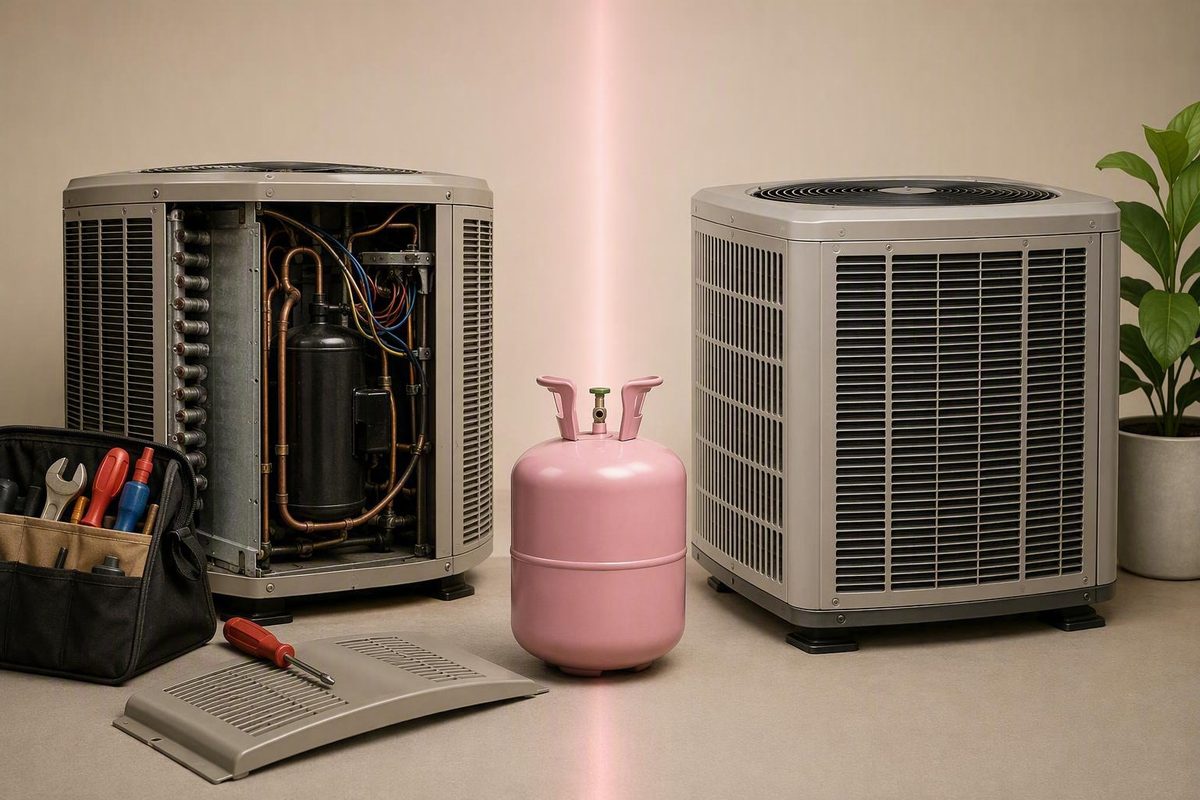
R-410A Alone Is Not a Reason to Replace Your AC
Repair is usually the more economical choice for a serviceable R-410A air conditioner in 2026–2028. Nearly 80% of surveyed HARDI distributors entered the 2026 cooling season with R-410A inventory at or above target, while the next major regulatory supply stepdown does not arrive until 2029, according to ACHR News’ reporting on R-410A inventories. An isolated, reasonably priced repair can therefore make sense even though new equipment has moved to R-32 or R-454B.
The decision changes when an older system needs expensive sealed-system work, has recurring leaks, or has suffered several recent failures. Refrigerant type belongs in that calculation, but R-410A has not become illegal to use for servicing installed equipment.
National price figures are not available in the supplied evidence. Use complete local repair and replacement quotes rather than a claimed national cost per pound.
Enter both quotes and your system age; the tool shows which option costs less now and where repeated repairs would cross the 2029 line.
Compare the two quotes directly, then see when repeated repairs of the same size would overtake replacement. The repeat-repair line is a stress test, not a forecast.
Default values use 30 versus 100 comparison units—not national prices, which the evidence does not supply.
The repair is 30% of replacement cost. In 2026, that leaves three years before the 2029 production stepdown.
| Age | Failure | Refrigerant Work | Initial Lean |
|---|---|---|---|
| 7 years | Failed capacitor; normal motor and compressor tests | No | Repair |
| 9 years | One documented, accessible leak | Yes | Repair may still make sense |
| 13 years | Evaporator-coil replacement | Yes | Compare all paths |
| 15 years | Failed compressor plus recent service calls | Yes | Replacement generally favored |
The 30%–50% repair ratio is an informal screen, not an official standard. Diagnosis, warranty, leak history, condition, comfort, and complete local quotes still control.
Sources: ACHR News, Aug. 12, 2026 (nearly 80% inventory at/above target; 99% A2L ducted sales); EPA final rule, May 26, 2026 (HFC transition requirements). The scheduled 2029 production/consumption level is 30% of baseline.
The Case for Replacing Now Is Not Baseless
The received wisdom has a sound foundation: the new-equipment transition is essentially complete. As of June 2026, A2L systems using refrigerants such as R-32 or R-454B accounted for 99% of ducted-equipment sales reported by HARDI distributors, according to ACHR News. A homeowner buying a complete system today will generally be offered one of those newer designs rather than another R-410A system.
R-410A service supply will also face more uncertainty. Allowable U.S. HFC production and consumption is scheduled to fall to 30% of the pre-phasedown baseline in 2029. That gives legitimate weight to refrigerant quantity, leak history, and future repair exposure when evaluating an aging system.
A 15-year-old unit with a failed compressor and several recent service calls usually leans toward replacement. A 13-year-old system needing an evaporator coil belongs in a close comparison, particularly if it has no warranty coverage or has previously lost refrigerant. In those cases, replacement is not merely a refrigerant sales pitch.
The overreach is treating that future risk as a present shortage or a prohibition on repairing existing equipment. Distributors are not reporting a broad shortage today, and the 2029 stepdown does not prove that R-410A will disappear. Existing virgin inventory and properly reclaimed refrigerant can continue contributing to service supply.
The EPA final rule published May 26, 2026 also extended or adjusted several HFC Technology Transitions requirements rather than accelerating every deadline. It addresses replacement condensing units and stranded residential and light-commercial inventory, but it does not establish that every proposed partial replacement is permitted. Exact equipment, installation date, manufacturer documentation, federal requirements, local codes, and permits still control.
The 2029 Stepdown Matters Most for Refrigerant-Heavy Repairs
Replacing a capacitor, contactor, thermostat, control, blower motor, or condenser-fan motor generally does not require opening the refrigerant circuit. On an otherwise dependable system, the future R-410A market contributes little to that decision.
A leaking coil, line leak, or compressor replacement is different. The work may require leak diagnosis, refrigerant recovery, component replacement, evacuation, a measured recharge, and performance testing. A large recharge exposes the homeowner more directly to local refrigerant prices and future supply uncertainty.
That distinction explains why the repair decision does not flip on one universal date. A small electrical repair can remain sensible on an older unit after the production stepdown. A large sealed-system repair may become unattractive earlier when age, refrigerant quantity, prior failures, and a high quote occur together.
The 2029 rule reduces allowable production and consumption to 30% of baseline; it does not specify a future retail price. Any contractor predicting an exact R-410A price from the rule alone is going beyond the available evidence.
Require a Diagnosis Before Comparing Prices
Weak cooling, icing, long runtime, high electric use, and unusual noise are symptoms. They can result from refrigerant loss, but also from restricted airflow, dirty coils, failing motors, controls, duct leakage, drainage problems, or incorrect sizing.
Before approving either path, obtain the failed component’s name and the measurements or observations supporting the diagnosis. For a suspected refrigerant problem, ask how the leak was located, how much R-410A the nameplate and measured conditions require, and whether the quote fixes the leak rather than merely adding refrigerant.
A compressor diagnosis should include evidence that starting components and simpler electrical causes were checked. An apparent major failure can have a less costly cause.
For sealed-system work, the itemized quote should separate:
- Leak detection and the documented leak location
- Recovery and component work
- Evacuation and the measured R-410A charge
- Labor, startup, and performance testing
- Parts, labor, and callback warranties
Adding refrigerant does not repair a leak. Repeated top-offs without a documented leak location or repair plan are a reason to pause and obtain another diagnosis.
Homeowners should not open the refrigerant circuit or use DIY recharge cans, sealants, or top-off products. Recovery, evacuation, leak repair, and charging require a qualified HVAC technician. Turn the thermostat off if the system is severely iced, and disconnect power if there is a burning smell or abnormal electrical buzzing.
Repair Wins When the Failure Is Isolated
A seven-year-old R-410A system with a confirmed failed capacitor, normal motor and compressor tests, dependable service history, and good humidity control generally favors repair. The refrigerant transition is largely irrelevant because the sealed circuit need not be opened.
A nine-year-old system with one accessible, documented leak can also favor repair. The case is strongest when the leak can be repaired correctly, prior refrigerant loss has not recurred, the compressor and coils otherwise test well, and warranty coverage reduces the homeowner’s cost.
Warranty details can materially change the result. A major component may be covered while labor, refrigerant, shipping, diagnostics, or processing fees remain the homeowner’s responsibility. Compare the complete out-of-pocket repair cost with the complete installed replacement cost.
A bridge repair can be rational when it restores useful service while the homeowner budgets, compares equipment, or avoids an emergency peak-season installation. The contractor cannot promise an exact remaining lifespan, but should explain what the repair will restore, which defects remain, and why the proposed service window is plausible.
Replacement Wins When Several Risks Stack Up
Replacement deserves serious consideration when advanced age coincides with a compressor or coil failure, a recurring or inaccessible leak, repeated refrigerant additions, multiple service calls, declining comfort, unavailable parts, or a high repair quote.
A 13-year-old system needing an evaporator coil sits in the comparison zone. Strong warranty coverage and excellent condition elsewhere may support repair. No coverage, previous refrigerant loss, declining performance, and other worn components shift the balance toward replacement.
A 15-year-old system with a failed compressor and several recent service calls generally favors replacement. That result comes from retaining numerous aging components after an expensive repair, not from R-410A alone.
Reliability deserves extra weight where an outage would endanger vulnerable occupants or cause serious disruption during extreme weather. That is a practical risk calculation, not evidence that the refrigerant has become unavailable.
Poor comfort does not automatically condemn the equipment. Airflow restrictions, blower settings, dirty coils, duct leakage, improper sizing, insulation, controls, drainage, and incorrect charge should be evaluated first. New equipment installed on defective ducts or with poor sizing can reproduce the same problem.
Use Cost Ratios as Screens, Not Verdicts
Contractors sometimes suggest replacement when a repair reaches 30%–50% of replacement cost. That range appears in commercial HVAC guidance, but it is not an official or validated residential standard.
A repair below 30% can still be unattractive when the system has recurring leaks or repeated failures. A repair above 50% can still be rational when warranty coverage absorbs most of the expense and testing shows the remaining equipment is healthy.
The age-times-repair-cost formula is similarly limited. It cannot account for warranty coverage, installation quality, climate, repair history, financing, comfort, or how long the homeowner expects to remain in the property.
For a five-year comparison, count each expense once. A repair path can include the current work, refrigerant, maintenance, plausible additional failures, energy use, and a later replacement if one is expected during that period. A replace-now path should include equipment, labor, permits, electrical or duct changes, controls, disposal, financing costs, and verified incentives.
Do not assume a new refrigerant will produce enough energy savings to pay for replacement. Savings depend on the proposed models, local utility rates, climate, runtime, current performance, sizing, duct condition, and installation quality. The refrigerant name alone does not establish a payback.
R-32 and R-454B Are Not R-410A Refills
R-32 and R-454B are not drop-in replacements for R-410A and should not be mixed into an R-410A charge. Newer refrigerants require equipment designed and approved for their operating and safety characteristics.
Keep three proposals separate: repairing the existing R-410A system, replacing one major component such as the outdoor condenser, and installing a complete new matched system. They have different compatibility, regulatory, warranty, and cost implications.
A condenser-only proposal requires documented compatibility with the indoor coil, metering device, airflow, controls, and pressure requirements. Ask for both model numbers and written manufacturer or matched-system documentation. A verbal statement that the combination will work is insufficient.
The 2026 federal rule confirms that replacement condensing units are regulated, but it does not answer every project-specific question. The contractor should verify the proposed equipment against current EPA requirements, manufacturer instructions, state and local codes, and permit rules.
Ask for Comparable Repair and Replacement Proposals
For the repair proposal, require the exact failure, supporting test results, warranty status, complete scope, refrigerant quantity, and risks that remain afterward. Expensive compressor, coil, and leak diagnoses warrant a second opinion when practical.
For replacement, require indoor and outdoor model numbers, efficiency ratings, refrigerant type, approved-match confirmation, sizing basis, permits, electrical and duct work, controls, startup procedures, warranties, financing costs, incentives, and exclusions.
The initial lean should follow the evidence:
| Equipment And Failure Pattern | Initial Lean |
|---|---|
| Younger, dependable system with an isolated fault | Repair |
| Middle-aged system with major sealed-system work | Compare all paths |
| Older system with recurring leaks or repeated calls | Consider replacement |
| Any age with an unclear diagnosis | Pause for evidence |
| Partial replacement without compatibility documents | Do not approve yet |
A contractor saying “R-410A is illegal now” should be asked to identify the rule that applies to the exact repair. A contractor saying any old R-410A equipment can always be installed should face the same requirement for project-specific support.
Answers to Common R-410A Repair Questions
Can an R-410A Air Conditioner Still Be Repaired?
Generally, yes. Rules governing newly manufactured equipment are distinct from continued operation and servicing of installed R-410A systems. Whether repair makes financial sense depends on the failure, system condition, warranty, refrigerant quantity, local availability, and complete quotes.
Will R-410A Run Out in 2029?
The regulation does not establish that. The scheduled reduction to 30% of baseline may increase supply and price uncertainty, but existing inventory and reclaimed refrigerant can support servicing. No sourced future retail price is available.
Is Another Recharge Worthwhile When the System Leaks?
Only after the leak is located and the scope is clear. One accessible, repairable leak on an otherwise healthy system may justify repair. Repeated top-offs, multiple leaks, a failed inaccessible coil, or a history of breakdowns strengthens the replacement case.
When Should the Refrigerant Affect the Final Decision?
Give it little weight for a non-refrigerant electrical repair. Give it progressively more weight when the circuit must be opened, the recharge is large, prior leaks have occurred, the equipment is aging, and the work approaches the cost of a complete replacement. Before 2029, that is a reason to calculate carefully—not a reason to assume replacement automatically wins.